
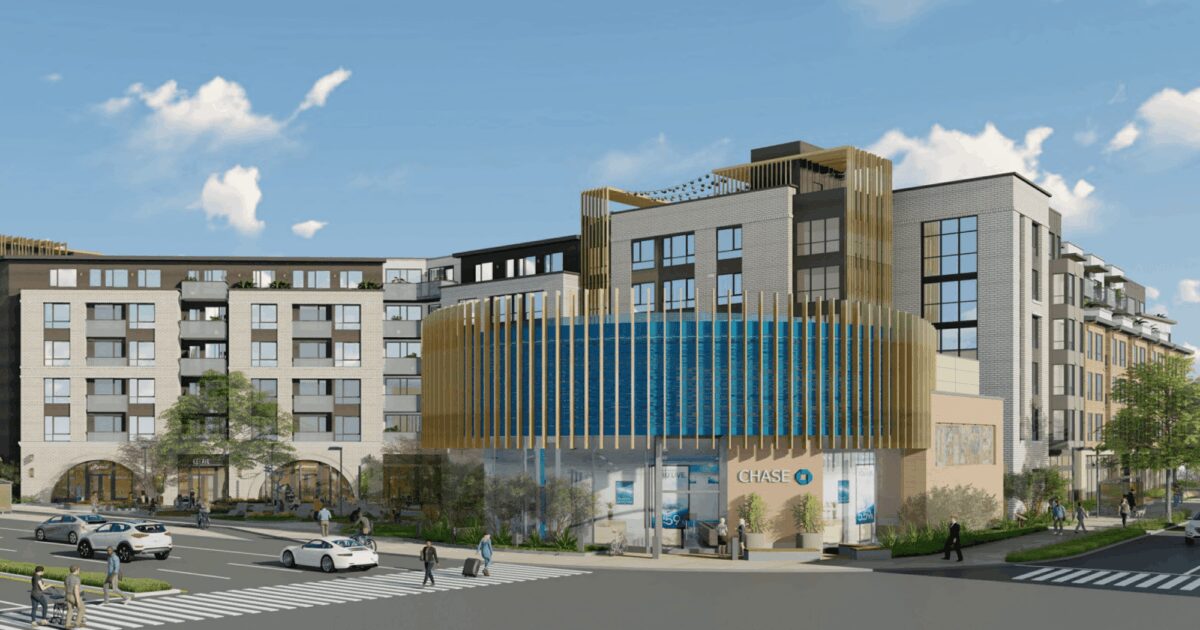
The Mountain View City Council voted Tuesday to approve a new mixed-use housing project that will add hundreds of apartments at one of Mountain View’s most prominent intersections, preserving elements of the existing historic bank building on the site.
While councilmembers sang the praises of the developer’s efforts to win over the community, build housing and go above and beyond in terms of public amenities, the approval at the Nov. 18 meeting was anything but cheerful. The developer, Greystar, sought last-minute compromises and made requests of the city that led to contentious debate, culminating in threats of legal action and visible frustration at the public hearing.
The project passed on a 6-1 vote, with Councilmember Alison Hicks voting in opposition.
Greystar is seeking to demolish the Chase Bank building and adjacent parking lot at the southeast corner of El Camino Real and Castro Street and replace it with a six-story, 299-unit apartment building, along with just under 11,000 square feet of ground floor retail space. The corner will also have a newly constructed bank along with an adjacent public plaza facing El Camino.
The developer is leveraging state law to increase the project’s density beyond what is normally allowed, providing affordable housing in exchange for an additional 90 units on the roughly 3-acre site. State law is also allowing the project to skirt maximum height limits adjacent to and across from existing homes, as well as setback requirements from El Camino.
Despite the high density, the more prickly issue has been the loss of the existing Chase Bank building, which has been identified as a historic resource. The building was designed in the 1970s by the studio of Millard Sheets, a famous artist and architectural designer. The structure, with its large mosaic mural and distinctive arches, has long been an iconic fixture at the busy intersection, and its proposed demolition spurred opposition and calls for preserving the building.
Greystar is proposing to keep the mosaic and integrate it into the new bank design, along with the stained-glass window and other historically significant features of the existing building.
For some public speakers, the project was exactly the kind of thing that should be getting built in Silicon Valley. Alex Shoor, speaking on behalf of the organization Catalyze SV, called it an exemplary project and commended Greystar for designing the mixed-use development around community engagement and building support for the proposal.
“We hope to see many, many more projects like this in Mountain View and across the Bay Area,” Shoor said.
Last-minute demands cause tension, litigation threat
Despite the positivity and general support for the project, the tenor quickly shifted Tuesday evening when Greystar came forward with last-minute demands of the city, specifically dropping the $5 million community benefits contribution that the city was requiring and requesting a lengthy extension on the permits to begin construction from two years to eight years.
Dan Deibel, speaking on behalf of Greystar, argued that the voluntary project features, ranging from the art preservation to bike and pedestrian transit improvements, ought to be considered over $6 million in value and should outright erase the community benefits requirement. He also argued that, because it’s a phased project with a long timeline, Greystar needs a longer, eight-year timeline to start construction in order to navigate financing uncertainties.
The idea did not sit well with most of the councilmembers, many of whom swiftly opposed making changes this late in the process. Councilmember John McAlister said he worried about projects being put off, or eventually never getting built at all. The project has been under consideration for years, he said, yet all of the sudden the developer is arguing there’s a need for more time to figure it out.
“I cannot support anything where we do a concession on the timeline,” he said.
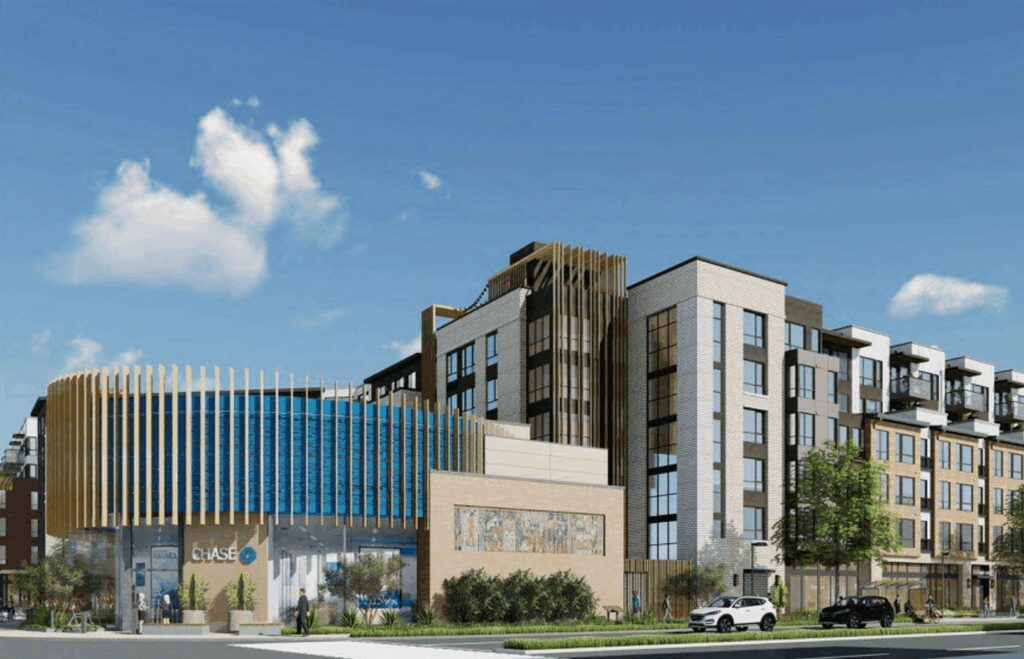 The project would preserve the existing mural and integrate it into the new bank design. Rendering courtesy of Mountain View.
Councilmember Lucas Ramirez took a more balanced approach, arguing that the extension could provide more certainty if there’s a longer window to pull building permits and begin construction. He argued that there is a lot to like about the project, including the commercial space, public benefits and improvements to the property, and that the limited time to begin construction could pose an issue. Even with a two-year extension, which is typically granted for big projects, plenty of projects are approved, only to die off after the permits expire.
“We have seen a number of really good projects expire, take the full four-year period … and never break ground because it’s been a very difficult economic cycle,” Ramirez said.
Pamela Baird, a Mountain View resident, vouched that the project looked much better than what was originally proposed, and that it’s commendable that the artwork is being repurposed, but also worried that the project could sink over poor economic conditions. She pointed out that major projects, particularly in North Bayshore and East Whisman, have not come to fruition in recent years.
“It would really be a shame to see this one fizzle out because it can’t pencil out anymore,” she said.
Adding to the complexity of the late-night tweaks to the project, Greystar was specifically requesting the eight-year permit expiration as a “concession” under the State Density Bonus Law, which provides waivers and concessions to residential developments that provide affordable housing. The law requires cities to relax local development regulations if it can help make a project financially feasible. But city staff said that trying to extend that logic to an extended permit window was a stretch, and goes against the very purpose of the law and its goal of spurring the timely delivery of affordable housing.
“I do not find the argument compelling that this qualifies as a concession,” Councilmember Chris Clark said.
The back-and-forth turned confrontational when it was revealed, partway through council deliberations, that members of Greystar’s development team were demanding an opportunity to speak again. After a brief recess, Mayor Ellen Kamei disclosed that the applicant had threatened legal action unless they were granted another chance to address the council.
“Never in all my time on the Planning Commission or on council have I ever experienced anything like this,” Kamei said.
Despite the prospect that the city may have to defend denying a concession under state housing law, councilmembers forged ahead with their decision not to grant an eight-year permit window. After some negotiating, the council did vote to reduce the required community benefits by roughly $1.7 million to account for some of the project’s public amenities that go above and beyond what’s necessary.
Hicks, the lone dissenting vote, lamented that the project’s design still removes the historic building and only integrates the artwork. She said that more could have been done to preserve the bank building, and that many felt that demolition was a foregone conclusion — even if that wasn’t necessarily the case.
“This is one of the most renowned historic architects in the state, and councilmembers who voted to have this building built said this will be something that will mark the entrance to Mountain View forever,” Hicks said. “So the fact that that’s lost so quickly is concerning to me.”
This story originally appeared in the Mountain View Voice. Kevin Forestieri is the editor of Mountain View Voice, joining the company in 2014.