
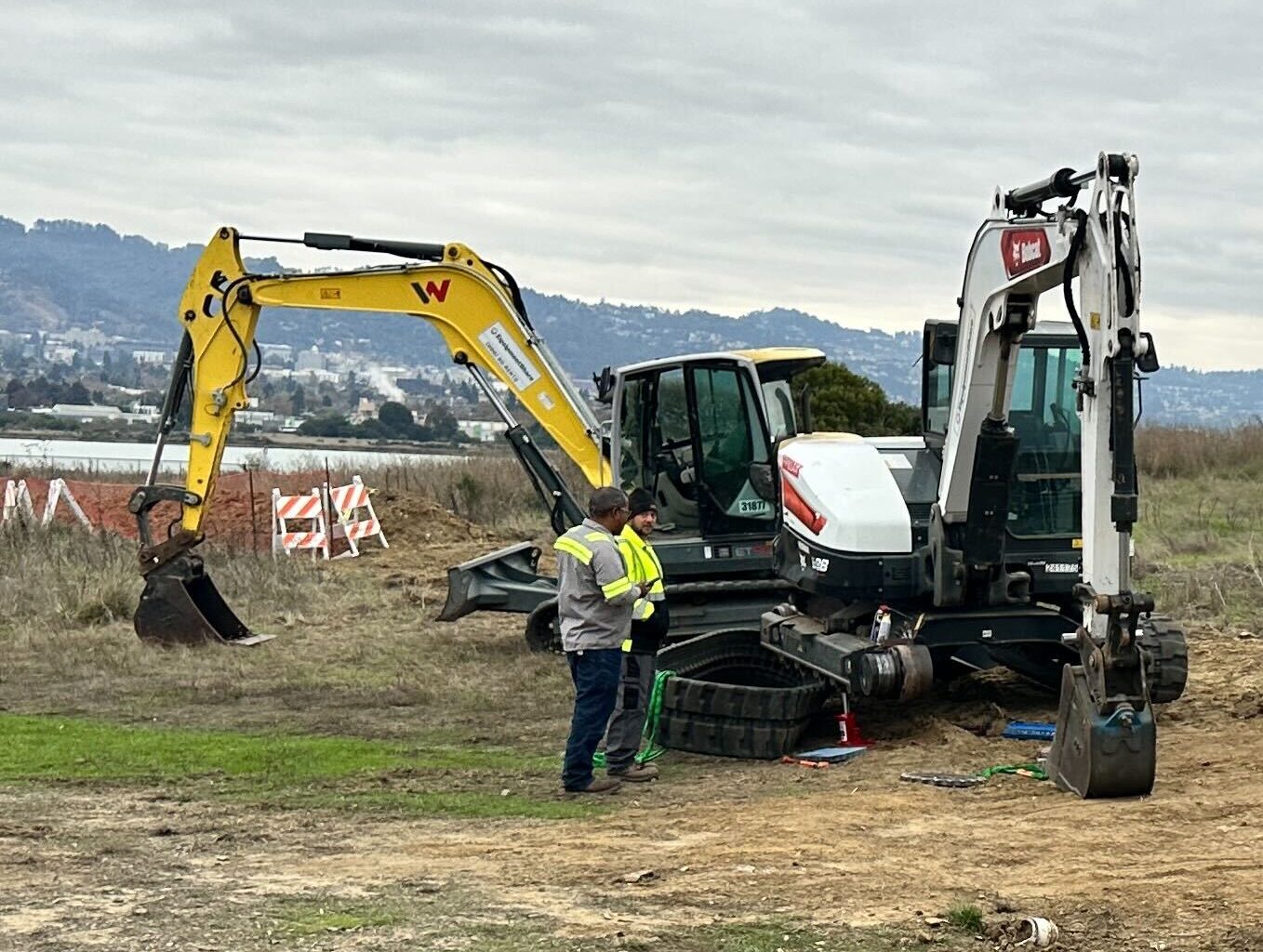
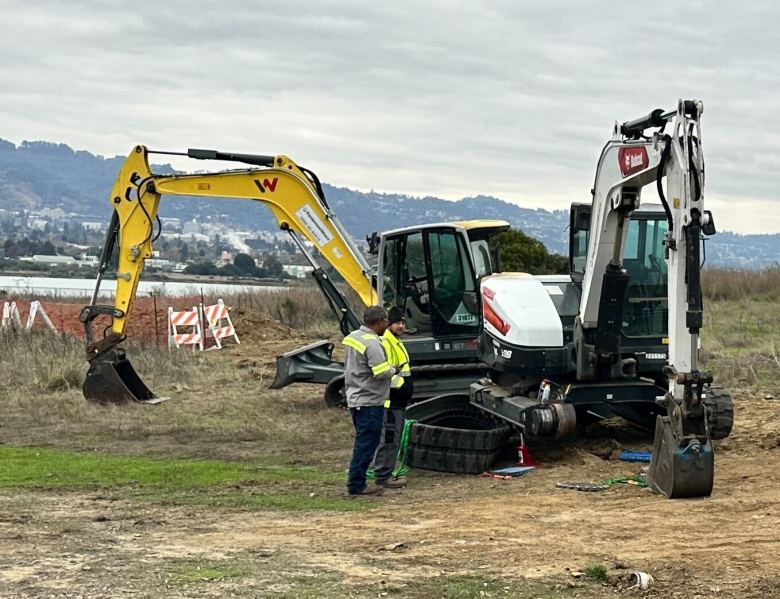
 Engineers contracted by the city work on pipes of Cesar Chavez Park’s largely underground gas collection system earlier this month. Credit: Tracey Taylor
The results of recent follow-up testing for hazardous radiation at Cesar Chavez Park, linked to its long ago history as a landfill, are reassuring for recreational use, from jogging to kite-flying to family picnics. They essentially affirm earlier city findings of above ground park safety.
But, the subsequent testing brings new concerns for underground work at the waterfront park’s gas extraction system, a buried network of wells and pipes for trapping and removing methane, a common byproduct of decomposing landfills.
The new round of testing, conducted in summer to drill down on earlier tests showing some elevated radiation underground, included first-ever park checks for radon, a radioactive gas which can become a health hazard at higher levels. Radon occurs naturally, but is also linked to chemical waste suspected of being dumped at the old landfill decades ago.
Above ground air tests for radon indicated no safety worry, reflecting average outdoor ambient air standards per the Environmental Protection Agency (EPA), according to city documents. Air measurements were taken at 11 spots across the park from an average upright adult’s breathing zone.
But underground radon testing of vapor at the gas collection system’s extraction wells, essentially holding tanks, found potentially dangerous levels, especially at one of the 12 wells tested.
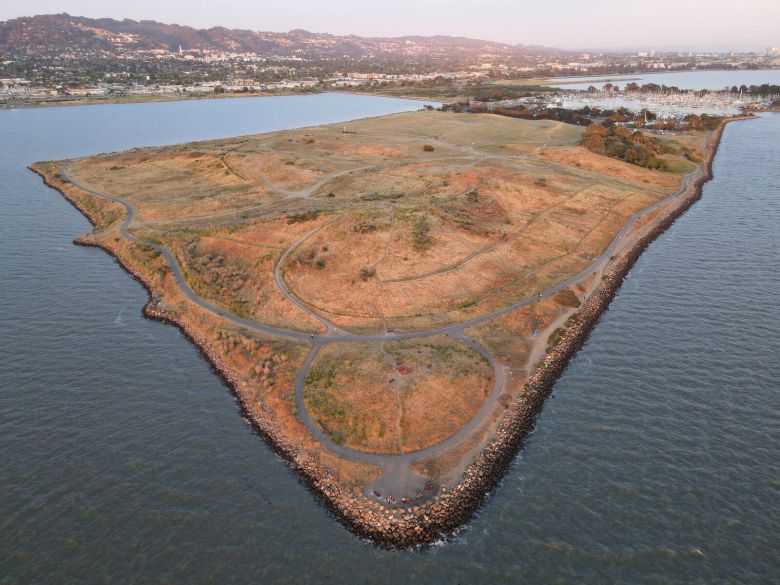 Cesar Chavez Park in June 2020. Credit: Phil Rowntree
Radon detected in the vapor from 12 extraction wells ranged from 6.0 to 876 pCi/L, according to city data. The EPA sets 4 pCi/L as an indoor air threshold for taking action to clear radon. The 876 pCi/L levels is considered “extremely high” by the EPA.
Underground radon levels fluctuate based on changes in temperature, water flows, and soil conditions, and these results could differ at different times. Berkeley’s policy is to follow the precautionary principle with potential health threats, which means enacting strict safety or preventative measures even before risks are scientifically proven.
In response to the radon findings, the city has enacted a new set of radiation safety procedures for workers on the gas system. The new testing results, and related updated city policies were presented to the City Council in a memo from city manager Paul Buddenhagen earlier this month.
“While there is potential for LFG [landfill gas] extraction system worker exposure to elevated radon during certain work activities, Cesar Chavez Park remains safe for members of the public,” Buddenhagen said in the detailed memo.
The city emphasizes that the gas collection infrastructure is locked, and can’t be accessed by the public.
“The GCCS [subsurface gas collection and control system] is a closed system that is maintained under vacuum, minimizing the risk of releases of radon to the surface, as made evident by the low levels detected in the ambient air sampling,” Buddenhagen said in the memo.
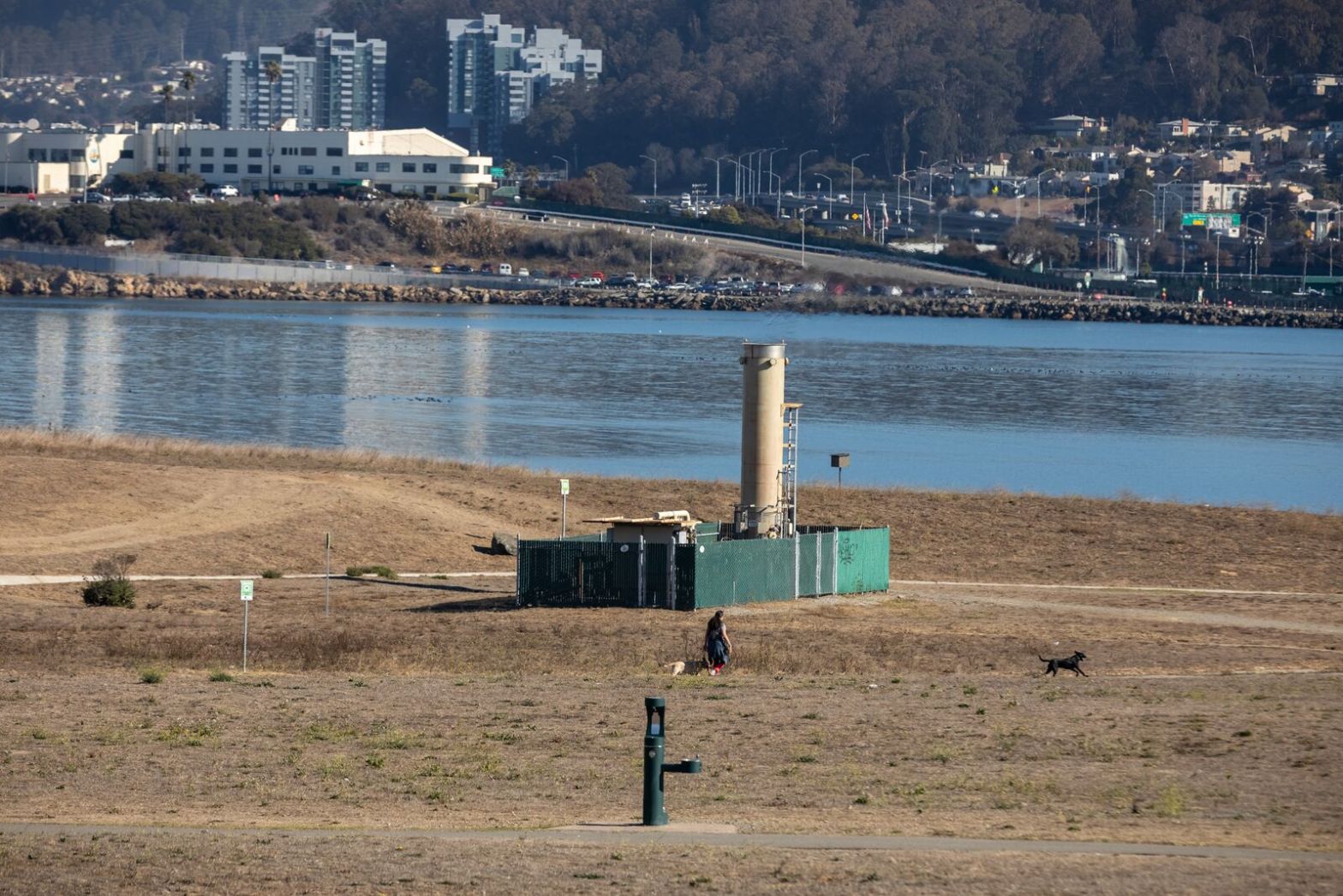 Cesar Chavez Park sits directly on top of a former city landfill. Since the 1980s, a flare station at the park’s eastern edge has turned methane-filled landfill gas into less harmful carbon dioxide. File photo: Kelly Sullivan
“When work occurs on the GCCS that has potential for radon exposure, workers will follow all applicable health and safety protocols and have radiation monitoring instruments for both area and individual monitoring.”
Radon exposure is a leading cause of lung cancer, with risk tied to exposure time, and radiation levels. Berkeleyside has asked the city for information on how long workers typically spend or spent at or near the underground gas extraction wells, and will provide updates if we learn more.
Follow-up testing for radiation detected last year in the former landfill’s groundwater and leachate, subsurface leakage that’s often polluted, found significantly lower levels this time around. The new testing used a different method to second-check or verify initial results.
In fact, it was the finding last year of concerning levels of two radionuclides, radium-226 and radium-228, in the site’s underground liquids that prompted this year’s testing for radon in well vapor and air.
These radionuclides are naturally occurring radioactive elements that can become hazardous after human activities. Radon is a decayed state of radium-226, and a form of radionuclide. Therefore, the discovery of elevated radium-226, linked to chemical waste that could have been dumped at the site decades ago, was a red flag for radon.
“Based on these results, future screening for radionuclides in groundwater and leachate appears to be unnecessary,” the city manager’s report said.
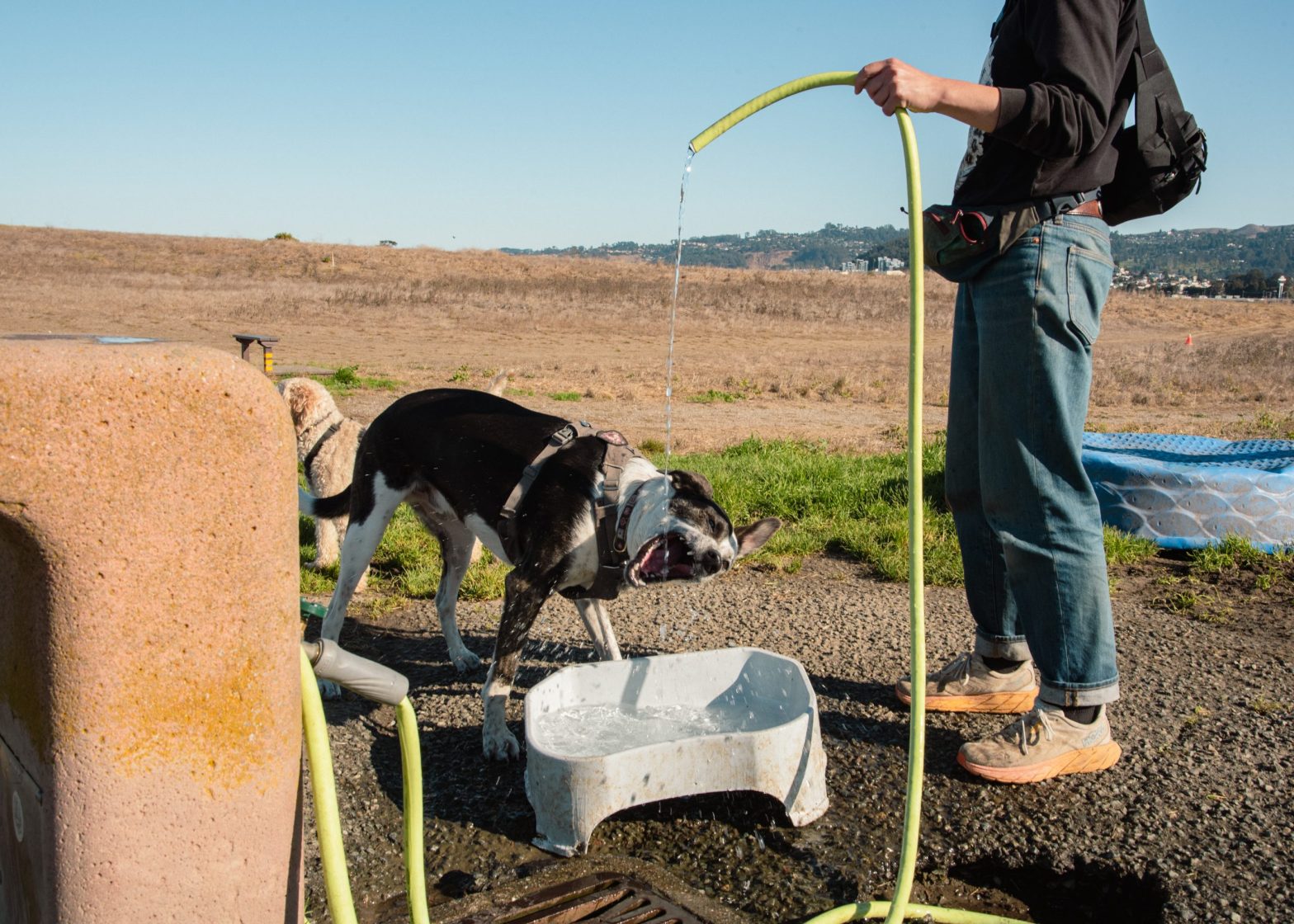 Lou, a 1-year-old dog, laps up water from a hose at Cesar Chavez Park in 2024. File photo: Ximena Natera, Berkeleyside/CatchLight Local
In response to the recent results, the city has updated park use rules enacted early last summer before the new testing, included in the city manager’s November report. The restrictions applied only to activities that could disturb park soil, such as gardening and digging dogs, as a precaution until more was learned about underground radiation.
The revised rules refine soil contact to prohibit activities below 1 foot deep. Previous rules halted anything that stirred up even surface soil.
“The updated RHASP [radiology health and safety plan] has determined that safety precautions apply to any work that disturbs the ground surface at depths of one foot or deeper,” the city report said.
This means dogs still aren’t allowed to dig at the park, according to the new rules. For fear off-leash critters out of sight of their owners could paw deep.
But gardeners tending to the park’s native plants, put on notice last summer to hang up their trowels during the testing, can now resume weeding and sowing seeds, as long as they don’t disturb earth deeper than 1 foot.
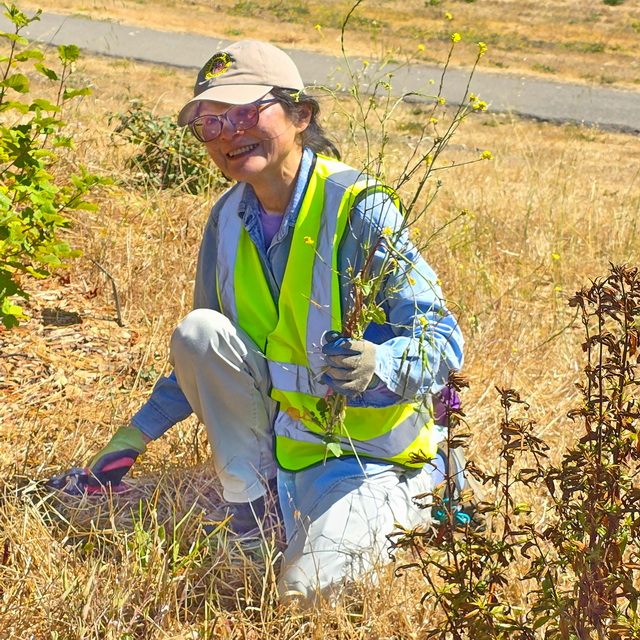 Carlene Chang uses scissors to weed the Native Plant Area on July 6. Credit: Martin Nicolaus
The same rules apply to city work. Maintenance down to 1 foot underground is OK. Deeper than this triggers the new radiation safety protocols.
The aim is to prevent anything that could break a clay seal covering the old landfill, which was installed as one element of the park conversion process. The clay cap, which averages 1-foot thick, ranges from 3 to 30 feet below the surface, depending on park topography.
“For volunteer planters at the park, we expect they will follow the standard of not digging more than a foot. Off-leash dogs are animals, but they have owners who we expect will control their dogs from digging and accidentally breaching the landfill cap,” said Seung Lee, city spokesperson.
The city will also continue monitoring the activities of rodents, notorious for tunneling in park soil, and burrowing owls, who winter at Cesar Chavez, living and breeding underground, often in rodent tunnels.
At this point, no one really knows how long restrictions on deeper soil activities will be in effect.
As with all former landfills in the state, Cesar Chavez Park is regulated by several government agencies which enforce environmental laws. Located along the San Francisco Bay, a primary regulatory agency is the state Water Resources Control Board. One concern about subsurface landfill toxins is runoff into the bay.
The summer’s radon testing was ordered by the water board, in response to the elevated radionuclides found last year.
The city has submitted its latest findings to the water board, and is awaiting next steps.
The water board must approve the city’s plans for addressing toxics at the site, including if additional testing is needed.
Eileen White, executive officer of the San Francisco Bay regional office of the water board, said they’re still reviewing Berkeley’s recent testing results and “expect to respond in a month.”
Permanent bathroom, new perimeter trail off the table
Regardless of what comes next, previously budgeted and approved plans to build a new perimeter trail around the park, and permanent bathrooms, are victims of construction precautions.
Funding for these projects was re-directed by the City Council to other waterfront projects when deep-soil disturbance was banned.
“12 inches [deep] is enough to do most small maintenance projects, but not deep enough for larger CIP [capital improvement] projects,” said Scott Ferris, Berkeley’s director of parks and recreation.
“Perimeter pathway maintenance will consist of mill and overlay of existing asphalt but cannot disturb the underlying soil one foot more below the ground surface,” he added.
A once-planned brick-and-mortar, plumbed-and-wired bathroom may be out at Cesar Chavez Park, but it’s now home to one of the city’s new semi-portable Throne Labs bathrooms, self-maintaining units with flush toilets and sinks with running water.
The city is testing Thrones at five locations, including the park.
The legacy of a landfill endures
Recent concern over unsafe toxins at Cesar Chavez Park point directly back to a little-known chapter of its landfill past.
The landfill operated from 1961 to 1983, and then was converted to a park, which opened in 1991.
Last year, the water board notified Berkeley that the park could have been dumping grounds for industrial waste with radioactive and other hazardous materials.
 The city conducted overhead drone monitoring in 2024, finding “typical background levels of radiation expected in the ambient environment” at the park’s surface and shallow subsurface. Credit: City of Berkeley
This was linked to newly discovered information by the water board, and the California Department of Toxic Substances and Control, that Berkeley’s landfill was among several in the East Bay used for waste by the former Stauffer Chemical Company in Richmond, including potentially toxins and radioactive materials. Notably, Stauffer dumped alum or red mud, a byproduct of processing bauxite ore into aluminum.
Other former landfills in Albany, Richmond and Benicia got the same alert.
This came as a surprise to city and regulatory officials, as Berkeley’s dump was licensed for non-hazardous municipal waste.
Stauffer, starting around 1897, processed sulfuric acid and made pesticides and fungicides at its bayside site for decades, eventually becoming Zeneca, Inc., then Astra-Zeneca, after several sales and mergers. It closed in 1997 leaving a heavily contaminated site, which the company and city are still dealing with.
Based on this, the water board required Berkeley, and the other former landfills, to test for a number of toxins linked to Stauffer’s waste.
Thus launched a couple of years and counting of city focus on lingering possibilities from Cesar Chavez Park’s past.
In addition to testing for underground radionuclides, measured at lower levels last summer than initial results, the city last year conducted overhead drone monitoring, finding “typical background levels of radiation expected in the ambient environment” at the park’s surface and shallow subsurface.
Required testing for DDT, the once common pesticide banned in 1972 for significant health risk, came up negative.
The water board also asked the city to test Cesar Chavez Park for Per- and Polyfluoroalkyl Substances (PFAS), also known as “forever chemicals,” because they don’t completely break down and show up in human tissue.
Berkeleyside has asked the city for an update on this testing.
As well, the city continues working on fixes and upgrades to the gas collection system related to flaring, or periodic methane gas burn offs.
The Bay Area Air Management Quality District cited the city last year for flaring violations. Methane, a greenhouse gas, is a known contributor to global warming.
“The Air District is observing that the repairs being made are resolving methane gas violations,” Maria Iglesias, an air district spokesperson told Berkeleyside in July.
“*” indicates required fields