
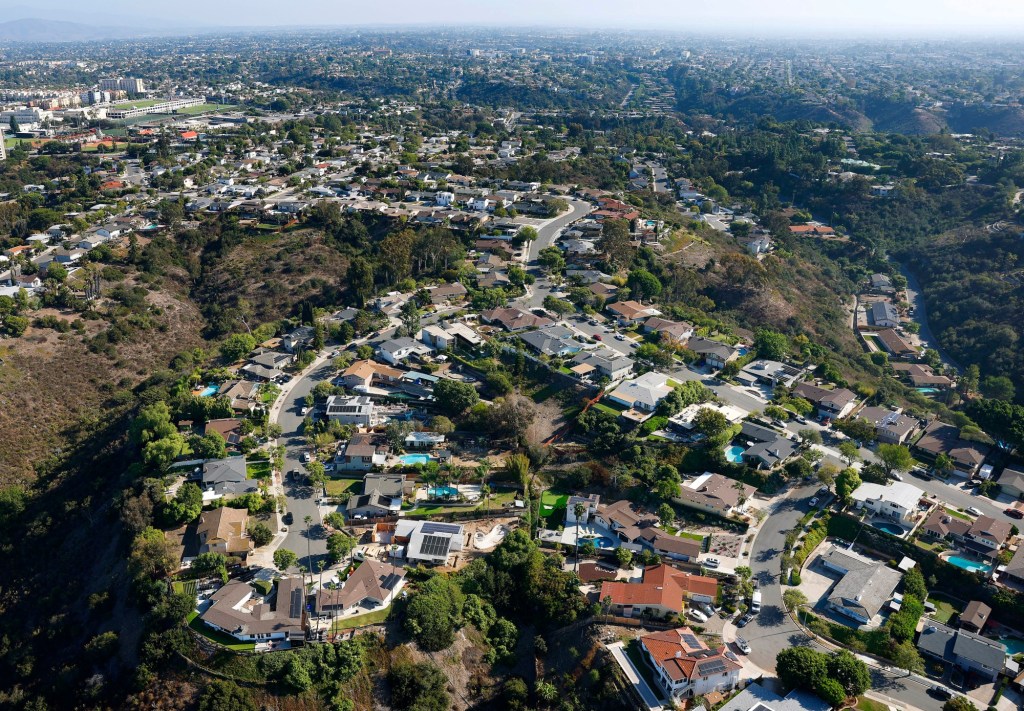
A development blueprint that plans for tripling the population of the College Area over the next 30 years is one step closer to being adopted, after a San Diego City Council committee voted to approve the update.
The community plan, which hasn’t seen an update since 1989, will guide land use and development for the neighborhood for the next two to three decades. It will now head to the full City Council for review.
It projects ambitious population growth in the College Area and expects more opportunities for cycling and public transit, green spaces along busy streets and a campus town center near San Diego State University.
“I’m excited to see how, outside this plan update, we can work to make those recommendations a reality for the community,” Councilmember Sean Elo-Rivera, whose District 9 includes the area, said at Friday’s meeting of the Land Use and Housing Committee.
The plan update passed 3-1, with Councilmember Raul Campillo, who represents nearby District 7, voting no.
“As I reviewed the plan for discussion today, I had many questions relating to the magnitude of the density as part of this plan, the traffic and infrastructure impacts that we are seeing from increased density,” Campillo said.
Response to the proposed update has varied, with some community members praising it for housing plans they hope will bring more affordable housing to families and SDSU students who live in the area.
But over the course of the update’s development, others have raised concerns about its expected growth and what they see as a lack of services to support it, pushing for more fire safety, parks and parking for the College-Rolando Library.
The College Area is served by three fire stations in the surrounding neighborhoods, but residents want to see more of a focus on fire safety in the immediate area. There is now one neighborhood park, the 1.6-acre Montezuma Park. And neighbors have pursued a years-long effort to improve parking access to the library.
“We need to get the ability to get those facilities that we desperately need before we allow density to go so extreme that we’ve created an unsafe, unhealthy living environment,” said Julie Hamilton, chair of the College Area Community Council.
San Diego’s future population is expected to grow by nearly 5% by 2050, from the current 1.37 million to 1.44 million, according to estimates from the San Diego Association of Governments.
City planners see the College Area as a neighborhood that is uniquely well positioned to help accommodate the growing population. Under their plan update, the area could see its population capacity reach about 76,800 people, living in around 34,000 homes.
That would be a significant jump from the current numbers — about three times as many people, and four times as many homes. As of 2022, the College Area had more than 26,000 people and 8,000 homes, according to SANDAG.
The city’s Planning Department has stressed that those are just projections, and that the plan does not mandate new construction in the College Area. “Development only occurs as demand and economic conditions allow,” said Nathen Causman, the city planner.
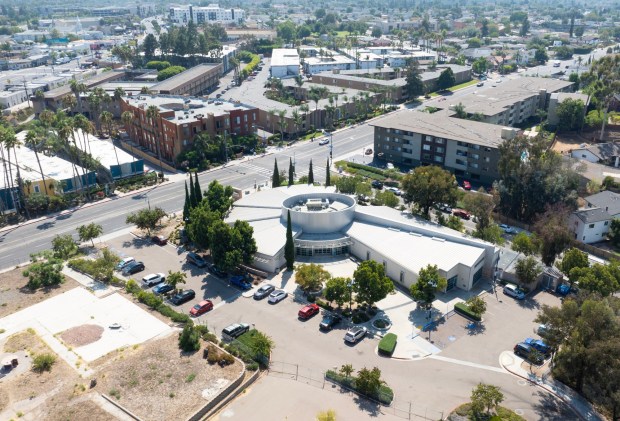 The College-Rolando Library on Montezuma Road in San Diego. (Nelvin C. Cepeda / The San Diego Union-Tribune)
More than 70 people signed up to speak about the plan update at public comment at Friday’s meeting.
Campillo, the lone dissenting vote on the committee, questioned how the plan would support affordable housing development near high-resourced areas to align with a policy adopted earlier this year that directs at least 70% of affordable housing to moderate- and higher-resourced neighborhoods by 2028.
He also shared residents’ concerns about public resources, such as parking at the College-Rolando Library, and questioned the city’s plan for acquiring property to develop new park spaces.
The plan cites two potential parks that would require collaboration with either private property owners or other public entities to come to fruition. It also includes plans to pursue lease agreements and joint-use agreements to create more opportunities for parks and recreational facilities.
“It’s a problem of city governance to set up plans that include amenities that we can’t possibly control,” Campillo said. “It feels opaque and non-transparent that we would suggest that parks are going to go where private landowners might have it.”
But several community members said their focus is on increased housing that they hope will bring down the cost of rent in the College Area, especially for university students.
“We always say that we need more parks and more stations and more parking,” said Krishna Hammond, the secretary of YIMBY Democrats of San Diego. “But the reality is … we have a crisis right now, and this is not the time to say we need some density, or comparable density, or smart density. You need to do what people voted for and build more housing.”
The latest draft of the community plan, much like previous iterations, includes some higher-density mixed-use development near current and planned transit corridors, such as bus routes along Montezuma Avenue and trolley stations at 70th street and the SDSU Transit Center. Medium- and lower-density housing would be concentrated on more residential streets farther from the SDSU campus.
Some areas originally designated for higher density were reduced to lower density in the second draft of the plan, released this summer — including East View Falls Drive and properties near the Campus Village Center south of Montezuma Road. The city said this was due to potential fire risk.
The latest plan, updated from the draft this summer, includes a consideration for a new fire station in the College Area. The location is not yet determined, though potential sites include either near the SDSU campus, on property owned by the university or in the eastern portion of the community.
The plan also envisions transportation upgrades, including coordination between SANDAG and MTS to improve frequency and coverage to support the needs of a growing community.
It also includes pedestrian mobility and safety improvements, including raised sidewalks, rapid flashing-light beacons for crosswalks and raised refuges in street medians for pedestrians crossing more than one lane of traffic.
And the city said this summer that it would require new development to ensure continuous sidewalks on 63rd Street, since it’s been identified as a pedestrian connector street.
“I feel like a second-class citizen behind drivers whenever I bike, walk or take transit,” said College Area resident Stephen Greenwood. “All of the transportation changes in the plan are a vast improvement.”