
The bloodstains are visible from space.
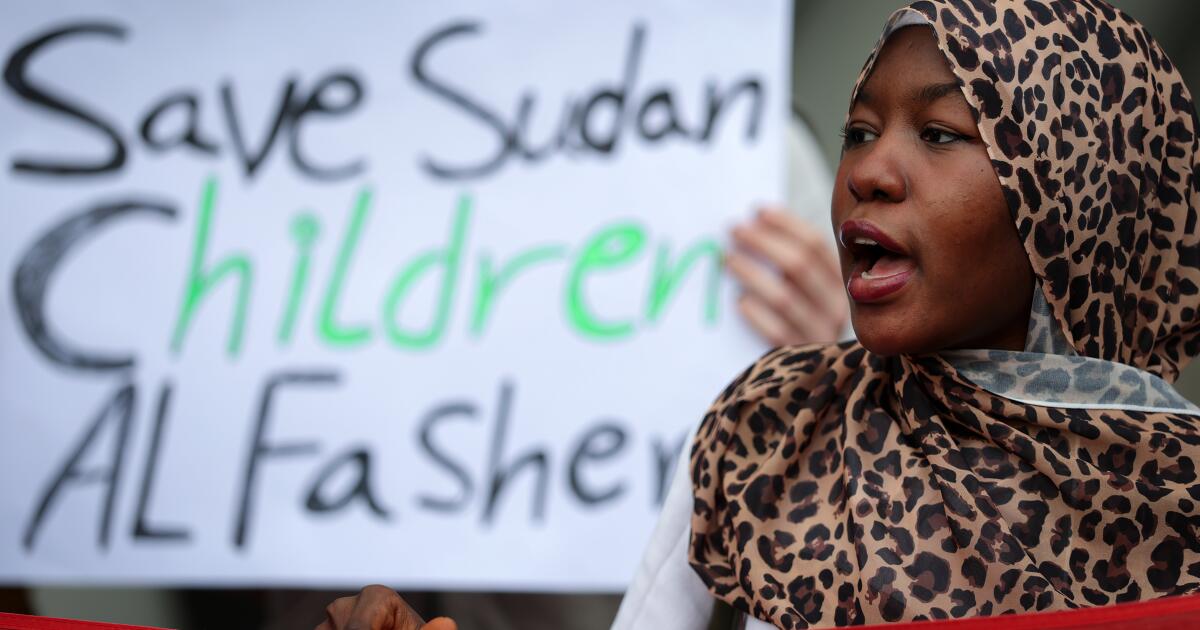
In the last weeks, the Rapid Support Forces — one party in Sudan’s years-long civil war — captured the desert city of el-Fasher after a 17-month siege. Since then, fighters have embarked on a campaign of horrors: lining up and executing civilians, systematically killing patients in the city’s last functioning hospital, raping women and girls and shooting those who tried to flee at the city walls. According to the Yale Humanitarian Research Lab, the bloodstains soaked into el-Fasher’s sand are so large as to be visible via satellite. Thousands are estimated dead.
So far, this tragedy has largely gone unnoticed in the United States — and it’s easy, if unsettling, to understand why. The violence is but one more strike in an overwhelming drumbeat of conflict and crisis unfolding around the globe.
Last year, the world saw more active conflicts than in any other year since the end of World War II. Global reports of political violence surged by 25%. More humanitarian aid workers were killed in 2024 than in any other year on record.
This all points to a dawning era of what we might call “inhumanitarianism.” The idea that we share mutual obligations with our fellow humans — that our fates are somehow tied together — has gone out of fashion, perhaps lost in the isolation of the COVID-19 pandemic or in an argument with some faceless stranger online. Instead, many devalue human life and reject the community ideal in favor of an “us against them” notion of strength.
Inhumanitarianism doesn’t only show up in overt war crimes. A year ago, the U.S. was leading the global humanitarian response to the crisis in Sudan through the U.S. Agency for International Development — but that ended in February with most of the rest of USAID’s lifesaving work around the world. Governments that would have once confronted war criminals and their enablers are increasingly quiet where they were once vocal.
If inhumanitarianism is on the march, the best countermeasure must be a march of humanitarians. Those of us on the sidelines need to lift up those on the front lines.
We can revive humanitarianism by supporting people who are already making the choice to care. As you read this, hundreds of thousands of grassroots humanitarians are taking care of others in crisis zones across the world.
Take Dr. Jamal Eltaeb from Sudan. Amid the country’s ongoing conflict and the collapse of its health system, Eltaeb has kept Al Nao Hospital in Omdurman open — one of the last lifelines for thousands in Khartoum.
Grassroots humanitarians including Eltaeb know better than anyone else what their communities need — and if we can give them the tools and resources to continue and expand their work, we will take a significant step toward reviving the spirit of humanitarianism.
We also must commit to being humanitarians in our own lives, stepping up to help others in need even, or especially, at our own risk. We must awaken and nurture the humanitarian that lives in each of us.
During the Armenian genocide, in 1915, my grandfather was on a train that was carrying him to begin a death march in the desert. He survived only through the unexpected grace of two German soldiers who pulled him and his brother off the train — saving their lives, enabling mine and a century later inspiring the Aurora Humanitarian Initiative, which I co-founded and which recognizes similar acts of courage and humanity. This month, Aurora awarded its namesake prize to Eltaeb along with $1 million to help him expand and continue his work.
That sort of awareness and action are the antidote to inhumanitarianism. It’s a brief but impossibly consequential moment of shared humanity on a hot train in the desert — or a doctor who, in the face of unimaginable despair, chooses humanity.
Change starts with supporting those individual heroes who are already working to make their own communities better. It starts with each of us choosing to care for people who are vulnerable in our own lives. I believe those choices can inspire a ripple effect that will reverberate through generations — just as the choice two soldiers made a century ago inspires my humanitarianism today.
The traditional humanitarian champions have ceded the field. The cavalry isn’t coming. And so if inhumanitarianism is to be defeated — if we are to somehow avoid the next el-Fasher — it will start from the bottom up, with me, you and thousands of grassroots humanitarians around the world declaring our care for our fellow humans through our actions.
Noubar Afeyan is a co-founder and the chairman of the board of Aurora Humanitarian Initiative.
Insights
L.A. Times Insights delivers AI-generated analysis on Voices content to offer all points of view. Insights does not appear on any news articles.
Viewpoint This article generally aligns with a Center Left point of view. Learn more about this AI-generated analysis Perspectives
The following AI-generated content is powered by Perplexity. The Los Angeles Times editorial staff does not create or edit the content.
Ideas expressed in the piece
The author argues that the world is experiencing an era of “inhumanitarianism” characterized by a retreat from the principle that humans share mutual obligations with one another, with traditional humanitarian institutions and governments abandoning their responsibility to address global crises.
The author contends that institutional humanitarian champions have “ceded the field,” citing the U.S. termination of most USAID humanitarian work in February 2025 as emblematic of this withdrawal of government-led humanitarian engagement.
The author emphasizes that the atrocities in Sudan—including mass executions, killings in hospitals, sexual violence, and violence against fleeing civilians documented by satellite imagery—exemplify the catastrophic consequences of this humanitarian collapse.
The author asserts that grassroots humanitarians operating at the community and individual level, rather than international institutions, represent the viable path forward for addressing humanitarian crises and building a culture of care.
The author advocates for supporting individual humanitarian workers like Dr. Jamal Eltaeb who maintain life-saving operations despite overwhelming challenges and collapse of formal systems, positioning these figures as the primary agents of meaningful humanitarian response.
The author calls for personal commitment to humanitarianism, contending that change begins with individual choices to care for vulnerable people in one’s own community and that such personal acts can inspire broader transformations.
Different views on the topic
International humanitarian bodies maintain that coordinated global action and institutional support remain essential to addressing crises, with UN officials calling on governments to “urgently scale up funding and diplomatic action” rather than rely on decentralized grassroots efforts.[1][2]
Major humanitarian organizations emphasize that ending conflicts requires sustained international diplomatic engagement and pressure on warring parties, not merely supporting local caregivers, arguing that institutional frameworks are necessary to address root causes of humanitarian emergencies.[6]
The World Food Programme and partner UN agencies emphasize that large-scale institutional humanitarian responses coordinated through international structures are necessary to deliver aid at the scale required, particularly for famine prevention and disease outbreak response.[4]
Humanitarian organizations operating in Sudan note that the withdrawal of government aid has forced reductions in essential services, suggesting that government humanitarian funding remains critical rather than viewing institutional support as inherently failed.[5]
International actors argue that addressing the humanitarian crisis requires international coordination to manage regional instability and prevent further displacement, contending that individual actors cannot adequately address structural causes including conflict resolution, infrastructure rebuilding, and economic recovery.[2][3]