
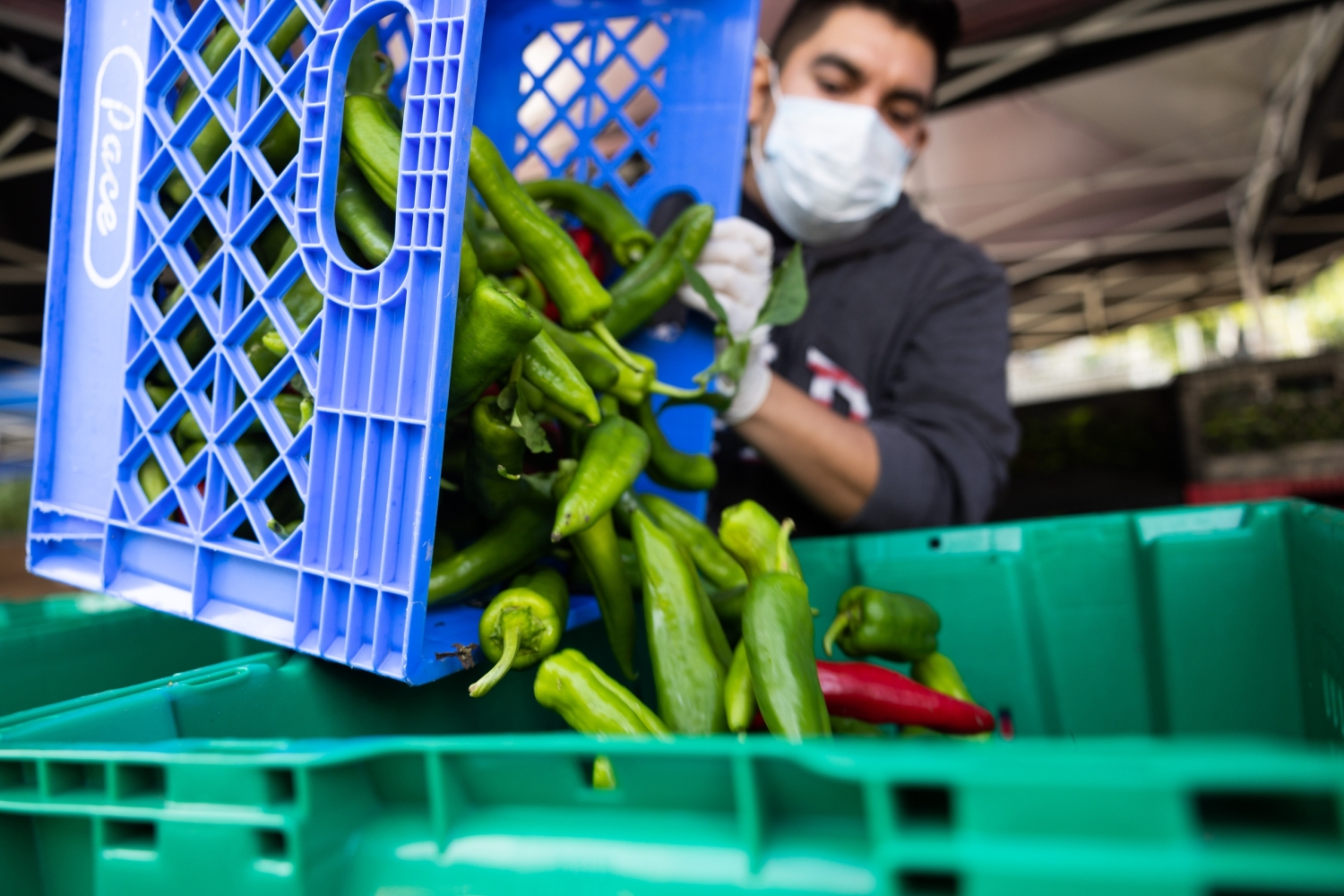
As families prepare to carve up a turkey this Thanksgiving, Orange County food banks, Social Services Agency and CalOptima leaders are bracing for significant cuts and eligibility changes to CalFresh food stamps and Medi-Cal health insurance.
They are now ringing alarm bells on the expected impact’s of President Donald Trump’s Big Beautiful Bill or H.R.1. signed into law earlier this year that includes a trillion dollars worth of cuts to health care programs and $4.5 billion worth of cuts annually to CalFresh, according to food bank leaders.
Those cuts and changes will in turn mean fewer Orange County students will automatically qualify for school meal programs and will result in less federal reimbursements to fund those programs.
“More and more people will go to the food banks, go to the pantries in order for them to get the assistance that they need to meet their basic needs,” said An Tran, director of Orange County’s Social Services Agency, at a virtual convening earlier this month.
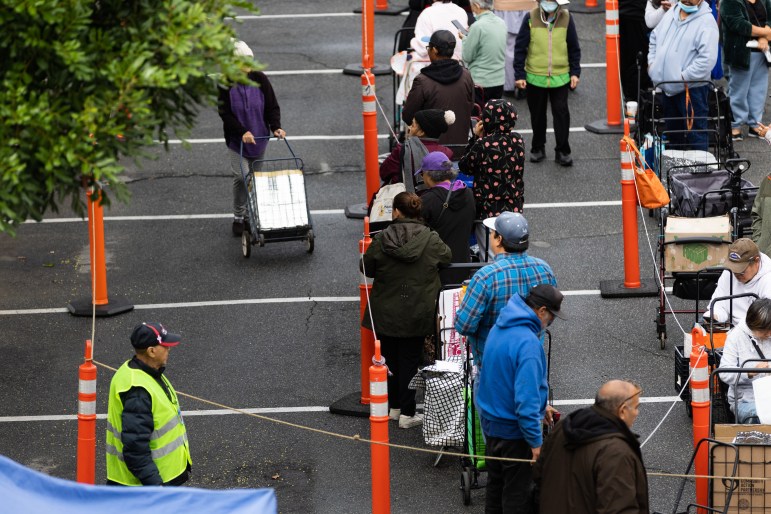 Lines form for the Latino Health Access food bank on Friday, Nov. 21, 2025. Credit: JULIE LEOPO, Voice of OC
“We see a reliance on the system of care that is frankly underfunded and not built out to the level that could support the volume and the magnitude of this change in such a short period of time.”
As of August, over 309,000 people in Orange County – roughly 10% of the population – are enrolled in the CalFresh food assistance program, according to the California Department of Social Services.
Roughly 900,000 people are enrolled in CalOptima, the county-run Medi-Cal program for OC’s neediest residents. That’s 29% of the county’s roughly 3.1 million residents.
Orange County has already got a taste of what a total disappearance of the CalFresh program could mean for hundreds of thousands of families amid the longest federal government shutdown in U.S. history a couple of weeks ago.
[Read: Orange County Grapples With Loss of Food and Housing Benefits as Shutdown Drags On]
During the shutdown, CalOptima board members allocated $5 million to provide $25 flex cards to their members also enrolled in CalFresh.
They also provided $1.5 million to Second Harvest Food Bank and $1.5 million to Community Action Partnership of Orange County – which runs the OC Food Bank.
Mark Lowry, OC Food Bank Director, said the money from CalOptima will help them feed people this Thanksgiving.
“What was at risk during this holiday season was $62 million a month, which put additional strain on the emergency food system,” he said at the virtual panel about the amount of CalFresh benefits received in OC.
“Under the best of circumstances, we struggle to meet people’s daily needs, so we’re still taxed to have a sufficient supply of food.”
Second Harvest Food Bank of OC CEO Claudia Bonilla Keller said even with the end of the shutdown, its impacts will still be felt going into the new year.
“This CalFresh cliff that we went over, even for a shortened period of time, is not only going to impact us in the immediate, it will impact the food banks and thus the network going forward into 2026 as we try to recover from food that’s been pushed into the system earlier than anticipated,” she said at the panel.
Keller also called on people to reach out to their federal representatives to call on them to protect the assistance programs and said the OC Hunger Alliance has launched an emergency food fund.
To donate to the fund, click here.
Kristin Hilleman, director of Food and Nutrition Services at Capistrano Unified School District, said even with the new federal law, state law requires schools to provide a free meal to any student who asks for it.
“Until that goes away, we will continue to provide those free meals for the students. If we see a decline in our federal reimbursements, it is going to detrimentally impact a lot of the budgets of school meal program operators,” she said at the virtual convening.
“When cuts start to come to our programs and they are maybe potentially not budgeted accordingly, we have the potential to run into needing to pull money out of the general fund, which then would take education dollars, and we do not want to do that.”
For food assistance options, visit 211eds OC.
Orange County’s Food Cliff
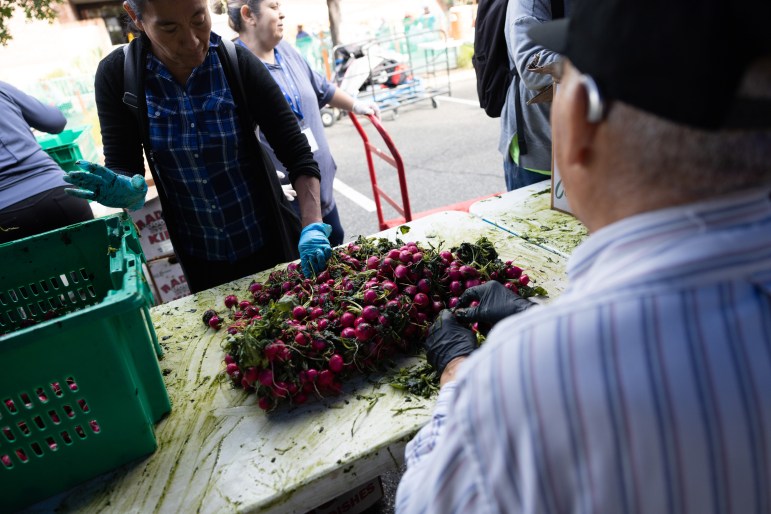 Volunteers for a food bank at Latino Health access clean and separate radishes on Friday, Nov. 21, 2025. Credit: JULIE LEOPO, Voice of OC
The need for food in Orange County has remained high since the government-mandated economic shutdowns during the COVID-19 pandemic.
It has been kept elevated by expensive inflation costs and an abrupt loss of public COVID-19 food assistance benefits – what food banks leaders call a food cliff.
For years now, Orange County Social Services Agency leaders and food bank leaders have been pushing for people to enroll in CalFresh to help them address hunger in the county.
Meanwhile, the recent federal government shutdown and expected cuts to food stamps hasn’t been the only challenge in quelling food insecurity across Orange County.
Widespread deportation sweeps have sparked grass roots efforts to feed families too scared to go to the store or work while food banks, pantries and nonprofit leaders are adapting their models to help immigrant families put food on the table amid the raids.
[Read: Feeding Orange County Families Amid a Federal Immigration Crackdown]
Changes to Food Stamps & Medi-Cal
Food bank and Social Services leaders now worry that changes to the food assistance and health insurance programs under the H.R.1 bill will only exacerbate the problem.
Tran said the new law would expand the age range for work requirements to be eligible for CalFresh and that asylees and refugees won’t be eligible for Medi-Cal.
He added that in 2027 recipients will have to meet work requirements to be able to be eligible for Medi-Cal and recipients 19-64 will have to renew their Medi-Cal application every six months.
Tran said by 2028, Medi-Cal recipients will have co-payments.
 Windows of a medical office in Santa Ana advertises Medi-Cal services on May 6, 2025. Credit: JULIE LEOPO, Voice of OC
To view a timeline of the changes and the OC Hunger Alliance presentation, click here.
Tran also said it will shift $44 million of the cost to run the CalFresh program to Orange County coffers.
“This is not expanding the program. This is not making it easier. This is not helping more people,” he said.
“It is just finding $44 million in order just to keep the status quo and we know that there is no additional income, revenue or funding expected in order for us to do this additional administrative work”
Michael Hunn, CEO of CalOptima, said they plan to invest almost $20 million in an outreach campaign about the changes to inform their members.
“We are not going to back off on community events. We are not going to back off on having enrollers. We are not going to back off in offering enhanced case management. We are not going to back off on working with our hospital navigators. We are not going to back off on taking care of our food banks,” he said at the virtual panel.
He also said they have lost 20,000 recipients since the beginning of the year and they expect to lose more with the expected changes.
“It’s going to create more obstacles and hurdles,” Hunn said. “It’s going to make it just that much harder to sign up, and I anticipate that will absolutely impact the number of enrollees.”
Hosam Elattar is a Voice of OC reporter. Contact him at helattar@voiceofoc.org or on Twitter @ElattarHosam.
Related