
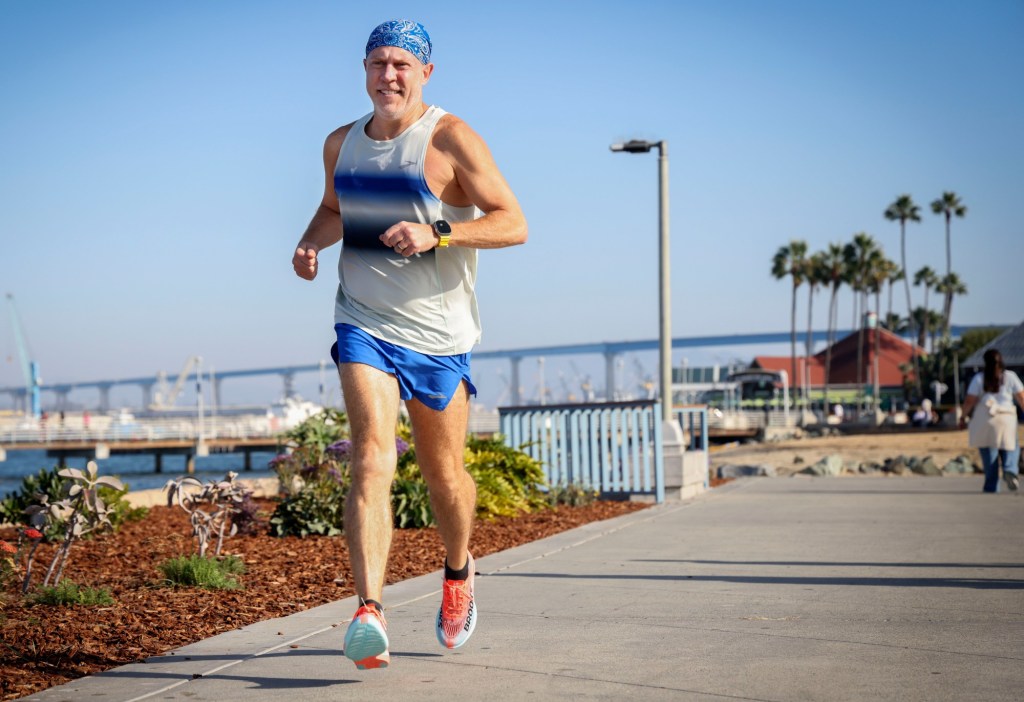
For The Union-Tribune
On most weekends of the year, Joe Mullins laces up his running shoes and races a 5K in San Diego. Mullins ran 31 races last year and is on course to beat that number this year. The 53-year-old orthodontist from Coronado is on a mission to get faster.
Conventional wisdom says that runners slow down as they age. Mullins and a small, tight-knit group of older runners in San Diego County are trying to outrun their bodies’ natural physiological decline. They range in age from their late 40s to their 70s, and they refuse to accept the notion that older means slower. They aren’t the fastest older runners in San Diego, but they shoot for ambitious goals, train strategically and race every chance they get. They have developed a camaraderie — sharing training tips and cheering each other on — race after race.
Mullins started racing in his late 40s, when he decided to prioritize his health and personal goals. He had spent many years “doing the dad thing,” leading his sons’ Boy Scout troop and helping with their cross country team at Coronado High School.
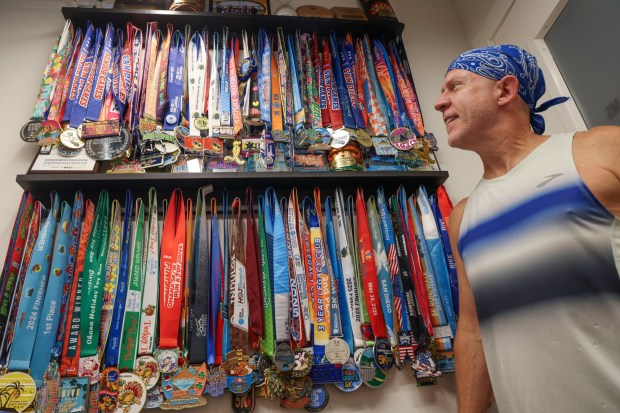 Mullins has a hefty display of 5K race medals at his office in Coronado. (Sandy Huffaker / For The San Diego Union-Tribune)
“I watched my boys and my wife run all these races and do really well,” Mullins said, on a sunny morning after placing second in his age division at the Aloha 5K in Mission Beach. “I thought to myself, I used to be a runner. I want to do this. It was my turn.”
In the course of four years of racing, Mullins shed 40 pounds and began winning his age division. He noticed the same half-dozen or so older runners at the races and befriended them.
Miles Lindsay met Mullins a couple of years ago at a race. The 54-year-old Spring Valley resident started racing in his 30s, and he runs about a dozen events a year, including 5Ks, 10Ks and half marathons. For Lindsay, racing is a chance to test his limits.
 Mullins leaves his office for a run in Coronado. (Sandy Huffaker / For The San Diego Union-Tribune)
“I want to see how fit I can get,” Lindsay said. “It feels good to see how far my times can drop down.”
Stan Ideker, 71, is one of the oldest friends in the group. He has been running two races a month, without fail, for 21 years. The Fallbrook sign contractor usually races a 5K in about 22 minutes, and has won his age division in 41 out of his last 43 races.
“I love competition,” Ideker said. Even when he is not racing with his friends, Ideker looks up their results online and offers congratulations or a “What the hell happened!?” text.
“I call him Coach Stan,” Mullins said, chuckling.
Growing number of older runners
A new wave of older runners are racing. Between 2013 and 2018, the number of runners 55 and older participating in races grew by over 70 percent, from 867,000 to 1.5 million, according to industry group Running USA.
That has resulted in a rise in the average age of racers. Among 5K participants around the world, the average age has increased from 35 to 39 between 1986 and 2018, according to Run Repeat’s State of Running Report 2019. Researchers attribute this to the fact that runners these days have longer racing careers, and more older runners are starting to race.
 Mullins stretches before his run along the bay in Coronado. He started racing in his late 40s when he decided to make his health a priority. (Sandy Huffaker / For The San Diego Union-Tribune)
“Older adults are seeing the importance of exercise and activity,” said Paul Greer, 61, the coach for the San Diego Track Club. “Not only are we living longer, but we want a greater quality of life. And so generally speaking, older people are doing more — running, joining athletic clubs and going to the gym.”
Greer says he has seen significantly more runners 50 and older who train with his track club in the 40 years he has been the coach.
As the ranks of older runners grow, so do the proportion of all runners who consider themselves competitive. In 2015, about 15 percent of runners surveyed by Running USA identified themselves as “serious / competitive runners.” In 2025, that figure grew to 22 percent. There is wide variation between men and women. Thirty percent of men surveyed considered themselves “serious and competitive runners,” compared with 16 percent of women respondents. The majority of those surveyed identified as “frequent / fitness runners.”
Mullins stretches before setting out on a run. (Sandy Huffaker / For The San Diego Union-Tribune)
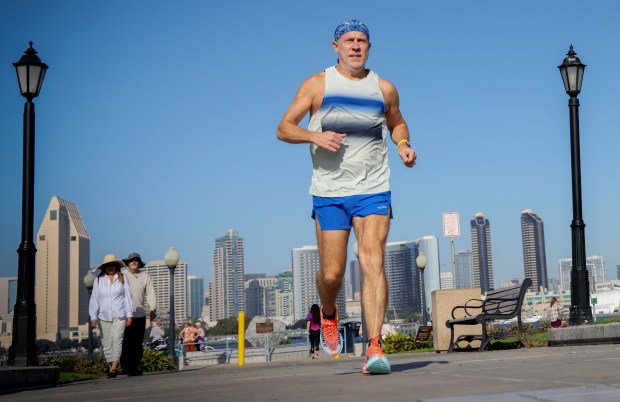
Races can take place year-round in San Diego, where low rainfall, air quality and safety help put it on lists of top cities for running. (Sandy Huffaker / For The San Diego Union-Tribune)
Show Caption
1 of 2
Mullins stretches before setting out on a run. (Sandy Huffaker / For The San Diego Union-Tribune)
Lindsay is one of the serious and competitive runners. Every week, he makes sure to join at least a couple of running clubs for their workouts, to boost the intensity of his run.
“On my own, I might cheat myself, and go slower than I’m capable of,” said Lindsay, who is currently unemployed but has a background in IT cybersecurity. “When I join a running club, it keeps me honest about the pace.”
Lindsay’s goal is to break 18 minutes for a 5K and 1:20 for a half marathon. The last time he ran that fast was seven or eight years ago, when he was in his 40s.
“I’m seeing other guys do it now, and they are in their 50s,” Lindsay said. “That’s why I think it’s possible.”
Can older runners get faster?
“For runners who started training later in life, for example in their 40s, the answer is a resounding yes,” said Aldo Seffrin, Ph.D., a researcher at Federal University of Sao Paolo in Brazil. He has spent more than 10 years studying the intersection of aging, physiology and endurance performance.
“They have enormous potential to improve their times by refining their training, enhancing their running economy, and building their experience,” Seffrin said. The key, he said, is to focus on aerobic endurance and running economy by incorporating speed intervals, strength training and better form.
Greer, the San Diego Track Club coach, says it’s entirely possible for older runners to set personal records in their 50s and 60s — if they are newer to the sport.
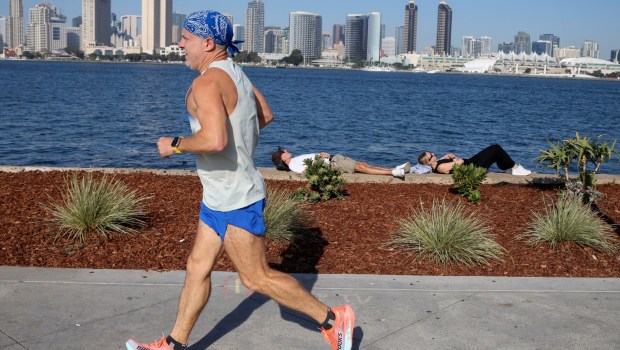 Mullins surpasses almost everyone in his age group, says his private coach, Jim Felty, former head coach for the All-Navy cross country, marathon and triathlon teams. “The younger guys are chasing him,” Felty said. “And it’s because of his great work ethic.” (Sandy Huffaker / For The San Diego Union-Tribune)
There is a window of time, perhaps 5 or 10 years, when people who started running later in life can sharpen their training and improve their times, Greer said.
“How much faster can they get? I can’t put a limit on it,” said Greer, the author of “Going the Distance: Strategies From the First Stride to the Finish Line.” “It may be 30 seconds, or a minute or 2 minutes for a 5K. But it is possible to get faster, even in your 50s and 60s. Of course you can.”
Jim Felty, a private coach and former head coach for the All-Navy cross country, marathon and triathlon teams, says how much older runners improve depends on many factors: how demanding their jobs are, how supportive their family is, whether they are overweight, how long they have been racing, and of course, their dedication to their training.
‘Beating the snot out of’ younger runners
Felty began coaching Mullins two and a half years ago. He plans weekly workouts that focus on speed and endurance to help Mullins meet his goal of breaking 20 minutes for the 5K — a 6:25 mile pace.
“Joe’s beating the snot out of almost everyone out of his age group,” Felty said. “The younger guys are chasing him. And it’s because of his great work ethic.”
In fact, Felty says tackling dozens of races a year can actually limit a training regimen. In his ideal program, runners would build mileage and intensity over a three-week block before taking on a race. For runners over 40, it’s best to limit intense workouts to twice a week. If one of those workouts is a race, it limits the breadth and scope of the harder workout, Felty said.
Mullins says he plans to start spacing out his races more, to help him focus on his training and goal.
“Joe is a racing machine,” said Felty, who noted his job is to adjust to his clients. “He just loves to compete. And you can’t coach desire.”
Of the runners who race 5Ks, only about 1 percent run more than 10 a year, according to data analyzed by RunRepeat, a company that conducts research on athletic activities and shoes.
On occasion, some in the running group have doubled up with two 5K races in one morning. The record for one weekend was three 5Ks.
They have no shortage of races to sign up for in San Diego. The city routinely makes the list for being among the best cities to run in, largely because of its low rainfall, good air quality and safe streets. Runners in San Diego can take advantage of year-round races.
One challenge that older runners face is they become more susceptible to injuries.
Jimmy Hsiao, a runner in the group, has had to cut back from racing this year because of muscle overuse. In years past, the 49-year-old emergency physician from Coronado would race about once a month. He has been more conservative lately, but he’s still enthusiastic about his future.
“I’m going to keep running until I can’t,” said Hsiao, soaked with sweat after winning first place in his division at the Crown Point 8K in October. “I don’t foresee myself stopping at any time.”
Just about every week, friends in the group exchange texts about which race to run next, or to trash talk one another, or issue a running challenge.
“We were competitors at first,” Mullins said. “And then we all became really good friends. Now we help push each other.”
Sometimes friends in the group will go out for breakfast after a race. Some go to church together. Every year on the Fourth of July, members of the group race in the Crown City Classic 5K in Coronado. Afterward, Mullins hosts a brunch and party along the Independence Day parade route in Coronado. They eat, josh, and, of course, talk about running.
Tips for older runners
Some advice from Coach Greer and Aldo Seffrin, Ph.D.:
• Don’t do too much too soon. Increase the number of recovery days between hard workouts. Consider limiting your hardest workouts to twice, or even once a week.
• Stay consistent. You don’t have to run 7 days a week, but if you want to get faster, run a minimum of three days, and ideally 5 days a week.
• Incorporate strides — 100-yard dashes at race pace at least once a week. The short bursts of speed can be tacked on to the end of a short easy run. Running about eight of the 100-yard dashes once a week can help build and maintain fast-twitch muscles, without stressing the body as much as a speed interval workout.
• Strength train. Include regular resistance training to counteract age-related muscle loss, which in turn improves running economy and helps prevent injuries.
• Train strategically. Focus on quality over sheer quantity. This includes targeted workouts to improve aerobic endurance and running economy, not just logging miles.
• Prioritize time to recover. Making time for sleep, good nutrition and rest becomes even more critical as the body’s ability to repair itself slows with age.