
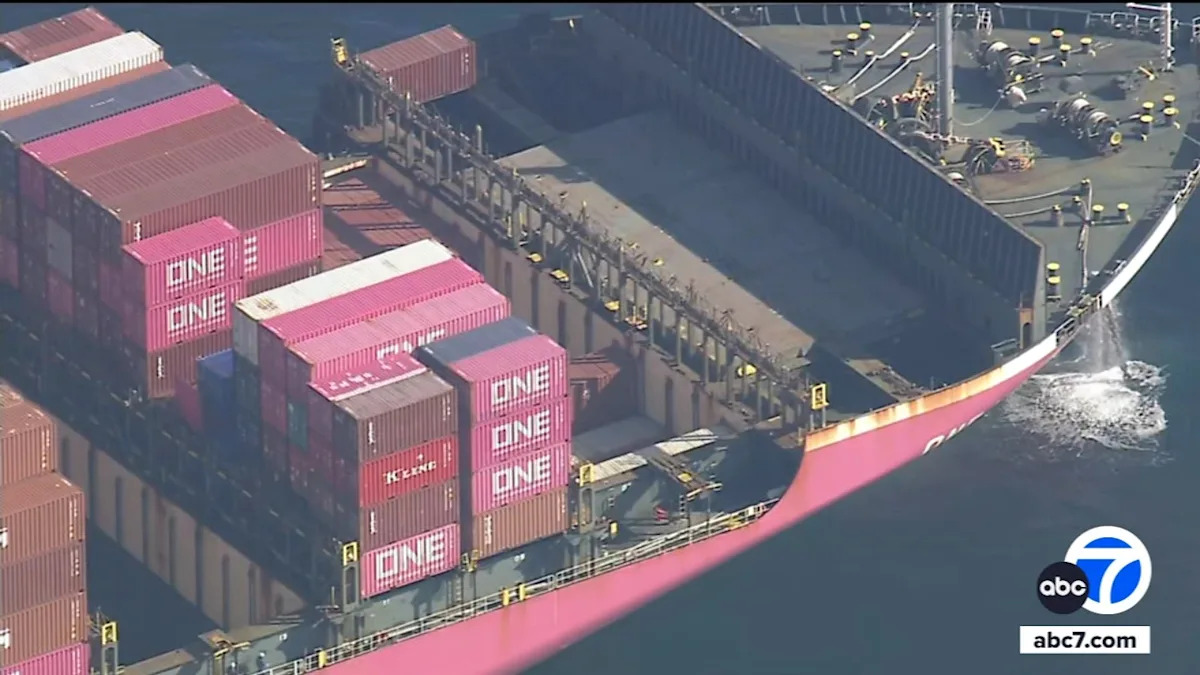
The ports Long Beach and Los Angeles, two of the busiest in the nation, have been working to avoid shipping delays in the aftermath of a major cargo spill in September and a massive fire that erupted last week aboard a container ship.
The past few weeks have been turbulent at the two facilities. The fire broke out on the container ship One Henry Hudson caught on Friday night and burned for days on several levels below deck. The ship was moved out to sea and away from the port early Saturday.
In September, containers toppled off a vessel at the Port of Long Beach, briefly blocking part of the channel. These disruptions come at a time when cargo traffic is already slowing.
After a massive fire erupted on a container ship docked at the Port of Los Angeles, the vessel was moved out to sea and a shelter-in-place order was lifted in San Pedro, officials said.
“From here until the end of the year, we’ll expect a seasonal slowdown in the 10-to-15% range compared to 2024, and there’s a reason for that dip,” said Gene Seroka, executive director at the Port of Los Angeles. “Last year’s numbers were unusually high as many shippers pulled cargo forward right after the election in anticipation of tariffs and changes in trade policy.”
The accidents at the ports were serious incidents, but supply-chain experts say the fact that shippers moved cargo in early actually helped.
“Those two incidents single-handedly would have caused some disruption,” said Nick Vyas, a professor at USC’s Marshall School of Business. “But because the volume was pulled ahead, and then right now, as of October, we have seen the decline in volume, we were able to absorb the shock.”
All of this comes as retailers prepare for the big holiday shopping season. Seroka said uncertainty around tariffs continues to weigh heavily on global shipping decisions.
A salvage and cleanup operation continued at the Port of Long Beach, where multiple shipping containers remained in the water after dozens fell off a cargo ship.
“Tariffs remain elevated across a wide range of goods, and longer-term trade agreements are still unresolved in some cases,” Seroka said.
Said Vyas: “It’s the uncertainty that creates an incredible amount of anxiety in this entire value chain, and therefore you see this kind of a fluctuation, both on the supply side as well as the demand side.”
This year, Seroka expects cargo volumes to drop through November and December – unlike last year, when companies rushed to import early to avoid possible tariff hikes. For now, Seroka said, retailers appear to have enough inventory.