
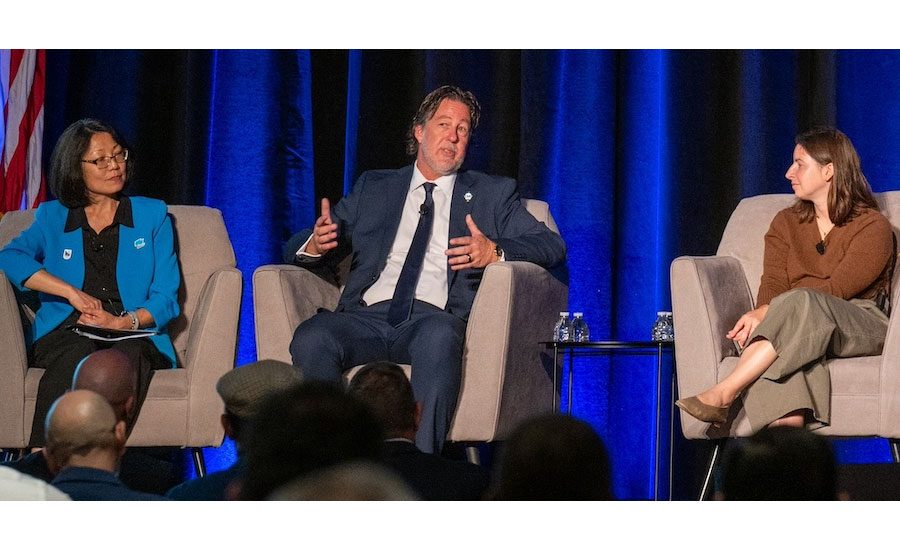
Los Angeles County has more work on its plate than ever as it expands and updates regional infrastructure to meet growing needs amidst federal-level changes that already are affecting how projects are funded, staffed and delivered.
City and county officials told the 400 attendees of ENR’s LA Infrastructure Forum that the region’s strong economy and cohesive infrastructure management team will allow them to tackle upcoming major sporting events, the energy transition and ongoing climate resilience efforts despite federal funding cuts. Held Nov. 3 in Los Angeles, the forum was put on in partnership with public agency group Infrastructure LA.
Officials offered updates on their progress executing major transportation upgrades to accommodate the millions of extra visitors to the greater Los Angeles area for upcoming events—from next year’s World Cup global soccer tournament to the 2028 Olympic and Paralympic Games.
LA Metro Deputy CEO Sharon Gookin said the 2028 competitions “are shaping up to be the biggest ever, roughly the equivalent of hosting seven Super Bowls per day for more than two weeks straight” for the Olympic and Paralympic Games set for July 14-30 and Aug. 15-27, respectively, in addition to handling the region’s daily throng of rail users.
“Between the start of 2025 and end of 2028, Los Angeles will have 10 major events across the city and region,” said Emma Kaplan, chief of operations and planning in LA’s major events office, a hub launched last year by Mayor Karen Bass to centralize project planning, permitting and oversight. “There are a significant number of capital projects. We’re using every opportunity to build and to learn.”
LA28, the Games’ private nonprofit organizer, emphasizes there won’t be a lot of new venue construction, and the events will rely instead on existing facilities built for past Olympic Games hosted in 1984 and 1932. The infrastructure investment is instead focused on improving regional mobility.
The Games will generate “the largest peacetime gathering of human beings in history,” said Bill Panos, LA28 senior vice president. He noted 15 million ticketed spectators and 100,000 employees moving among nearly 50 venues in the Los Angeles region.
Gookin said LA Metro is “by far the fastest expanding U.S. transit system,” noting progress on the region’s “Twenty-Eight by ’28” initiative, begun in 2017 by former Mayor Eric Garcetti, which aims to have 28 major transportation infrastructure projects completed before the 2028 Games.
LA METRO Transit System: Changing Alot Over Time
Click above to activate dynamic map of current and planned LA Metro rail expansion through 2028.
Video courtesy of LA Metro
So Many Projects, So Little Time
Among agency milestones are the addition of three new underground light rail stations downtown, several key subway line extensions open or set to open soon, completion this year of the first LA Metro line to Los Angeles International Airport and a new people mover to airline terminals. “Our plans include running up to 2,700 buses staffed by 10,000 personnel, subject to available funding, and making hundreds of small and medium-sized system improvements,” Gookin said. “So you can move beyond traffic in some of LA’s densest residential and employment centers.”
With the agency’s current effort estimated as a $35-billion program that includes about 60 projects, “there’s a lot of work to get built, and not enough people to do it,” said Tim Lindholm, LA Metro chief program management officer. To speed work and attract contractors, the agency is accelerating use of alternative project delivery. “We’ve done that to bring all the players into the market. We can’t afford to have anyone sitting at the side,” he said.
Lindholm admitted that it is unclear whether federal financial support provided to U.S. hosts of past Olympic Games will be dispensed by the Trump administration. “We know exactly how to do it, but without federal investment, it will be more challenging,” he said. “All of us, working together, can keep pushing and be able to get that investment.”
Technology also will play a key role in highway and local road traffic management among event venues, said Gloria Roberts, California Dept. of Transportation District 7 director, which covers Los Angeles and Ventura counties. “We’re going to use a lot of cameras, CCTVs, dynamic lane messaging and some smart traffic management system technologies,” she added.
“We’re putting on a show for the entire world, so making sure the events go off is not just important for the people here,” said Bane Gaiser, a corporate unit chief executive for AECOM, chosen as the Games’ venue infrastructure delivery partner.
According to Kaplan, “our hope is these things outlive the Games and we’ll be able to reap the benefits for all Angelenos.” She said LA’s youth sports program is still being funded by the 1984 Games.
Upgrades will also benefit existing and future users of Los Angeles International Airport, according to Chief Airport Development Officer Michael Christensen. The airport’s current $30-billion capital program is addressing basic needs such as roadway improvements, people mover service and a new consolidated car rental facility. “It has been an ordeal to get to the airport, so one transformative thing we’re doing is fixing our front door,” he said.
Current projects are the “enabling work” for a broader airport transformation into “the iconic entertainment and creative hub of the world where stars rise and angels fly,” said Courtney Moore, LAX deputy executive director of strategy innovation and experience. Each of its seven terminals will be revamped with a specific LA theme, such as Hollywood, the beach and LA street culture, she said. “Terminal five is our aspirational terminal, one that seeks to receive the Skytrax five-star rating,” Moore added, noting that the city’s iconic Griffith Park Observatory will be evoked with planetary light effects.
Christensen emphasized the LAX multiple-award, task-order contracting program—with categories for environmental planning, design, program management and construction—also includes contracts tailored for smaller bidders “to spread this over the entire spectrum,” directing attendees to the Los Angeles World Airports website dashboard for procurement and partnership information.
New Generation
Boosting power generation capacity, efficiency and distribution to deliver supply for major events, the ongoing energy transformation and the daily needs of one of the fastest-growing regions in the U.S. is a sizable workload for the Los Angeles Dept. of Water and Power, said David Hanson, its senior assistant general manager.
“With 40 years of load growth in the next five years because of AI … we have to build out a transmission system even farther than what we have to accommodate all of this load,” he said.
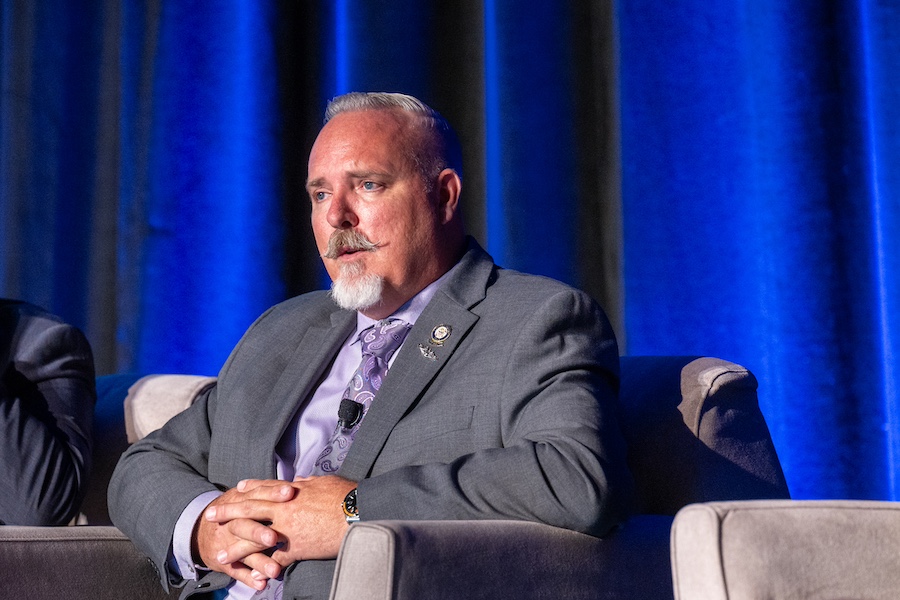
David Hanson, LA Dept. of Water and Power senior assistant general manager. shared major upgrade and buildout plans for regional energy infrastructure at ENR conference.
Photo courtesy of InfrastructureLA
The agency is modernizing two 1950s-era natural gas-fired units at the 830-MW Scattergood power plant in Playa Del Rey to be “green hydrogen-ready.” This project, currently estimated at $800 million, will replace the units, which must be shut down by the end of 2029, with new combined-cycle turbines that can burn gas and a minimum of 30% hydrogen, with intent to boost that to 100%. The upgrade would enhance grid reliability, reduce emissions and help Los Angeles meet a 2035 goal of 100% clean energy. “The Scattergood modernization project is the No. 1 priority on the power system’s ‘Top 10’ priority list,” said Hanson. “This project is essential.”
There are concerns about the future green hydrogen supply after the Trump administration cancelled $1.2 billion in earlier-awarded federal funding this month to the region’s ARCHES public-private hydrogen hub, which was set to provide $100 million to Scattergood. The department said it is pressing on and is fully budgeted, despite skepticism that the current price tag will hold.
Hanson said the agency is weighing use of small modular nuclear reactors to generate emissions-free power for hydrogen fuel and is pushing “a lot of energy storage and renewables,” including offshore wind and new solar-battery storage projects. LADWP also is weighing the cost and efficiency of putting more cable underground, said Hanson.
To address the new workload, the department will continue to build up in-house staff “while we look at contracting in new and creative ways,” Hanson explained. “We’re going to have to contract out hundreds of millions of dollars of work that we have not traditionally contracted out, and we’re going to have to have more partnerships.” He noted “a complete overhaul of our procurement process” related to smaller contractors. “We’re hoping to be very nimble … and embrace new technology,” Hanson said. “You’re going to see a lot more RFIs coming out from us in the next few months … to know what’s out there.”
A Business Case for Infrastructure
Officials are generally optimistic about the regional economy going forward. “We have the nation’s largest port complex by far,” said Mario Cordero, Port of Long Beach CEO, also referencing the Port of LA as part of that system. Container traffic moving through Long Beach as of September rose 6.8% from the same period in 2024, which set a record of 9.6 million twenty-foot equivalent units (TEUs), he told attendees.
Trump’s tariff policy, which initially set a 145% levy on goods coming from China, “provided a little anxiety,” he said. While that action did not occur, “we still would like to see more clarity and finality in what the tariff policy is going to be,” Cordero added.
Kelly LoBianco, director of the county Dept. of Economic Opportunity, updated its push to to ensure regional contractors, large and small, can build workforce capacity to compete for growing infrastructure work and that employee prospects gain necessary training. “We want to make sure that investment coming to LA County gets reinvested in our workforce,” she said. “Even when the county doesn’t have the budget it might have had a couple years ago, this is where we’re prioritizing our dollars to make sure we are giving workers here access to upskilling.”
LoBianco noted, however, added impact on the regional construction workforce from more intense federal immigration enforcement actions, which “has created very real fear and uncertainty for our workers and our business community.” Her agency department has an analysis underway “to capture the economic impact of our current climate,” she said. “Our construction industry has and will be impacted by the fear and uncertainty when folks feel like they cannot show up to work.”
Boosting worker efficiency is key, “so we are constantly transitioning to what the new technologies are,” Josh LaFarga, southern California Laborers union external affairs director, told attendees. “We talk about infrastructure investment, but we’re also talking about the importance of making sure good jobs come from that.”
Infrastructure sustainability also is core to future investment. “There’s a lot … we can do to help people understand that that our sustainability policies and directions can establish a vision for investments into the future,” said Matt Gonser, LA County chief climate resilience officer. “Clean energy, cleaner transportation and more efficient goods movement—things that people care about—are also good business … that provide improvements for our daily lives and a projected economic benefit into the future.”