
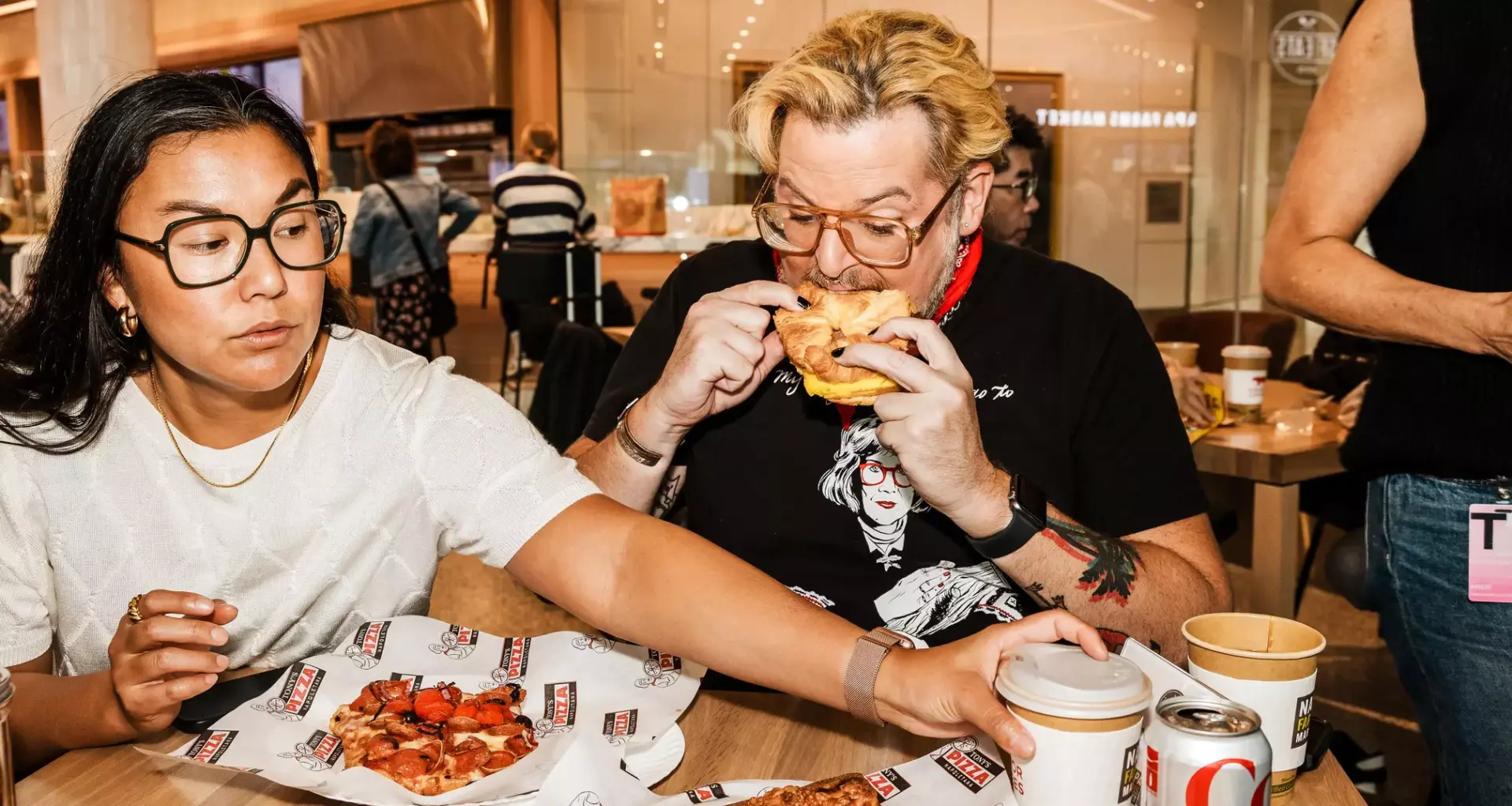
Aldy Butler knows how to run a restaurant. His father is Perry Butler of Bay Area comfort-food staple Perry’s (opens in new tab), founded in 1969. Everyone in the family does everything, so the younger Butler’s precise job description is a little hazy. “We’re not really a ‘title’ kind of company,” he says, noting that on any given week, he might be bartending at the Embarcadero restaurant or managing the Larkspur outlet.
SFO Package – Graphic Adjusted
The ultimate guide to SFO’s Terminal 1
When the family opened inside San Francisco International Airport’s Terminal 1 this year, Butler was prepared to dash to the airport as often as required. But the stringent security measures posed some surprise obstacles. Kitchen knives, for example, need to be chained to the workstations, and routine alcohol deliveries must go through the proper airport-approved channels. “We were bringing hats in,” Butler says, “and security had to check the boxes about five times.”
He knew the headaches would be worth it. That’s because opening a restaurant at SFO, which welcomes about 145,000 passengers (opens in new tab) on an average day, can be quite lucrative. While Perry’s debuted at Terminal 1 in June, it had operated inside Terminal 2 from 2005 until 2017. In its best year, that original airport location brought in $12 million — approximately twice as much as any of the company’s four standalone locations in San Francisco and Marin County.
When the third time really is the charm
But landing an opportunity at the airport can require perseverance. Whereas opening a typical restaurant can be as straightforward as finding a space and negotiating a lease, opening in an airport requires working with a third-party company that’s been contracted, or is hoping to be contracted, to manage the facility’s concessions. Operators submit bids, which are reviewed by a panel of independent experts hired by SFO.

It took several years and three attempts for one of San Francisco’s most famous coffee roasters to make it into SFO. When Culinary Heights Hospitality approached Eileen Rinaldi of Ritual Coffee Roasters (opens in new tab) about an airport partnership, it led to Valencia Street Station (opens in new tab) — (opens in new tab) “an homage to Ritual on Valencia circa 2005,” according to Rinaldi — which opened inside SFO’s International Terminal in 2017.
Impressed with the result, Rinaldi and Culinary Heights put in a bid on a space in Terminal 1. It was rejected. So was Ritual’s next proposal. But the third attempt succeeded, and Ritual opened in a sizable space near security in October 2022.
The application process was intense, requiring Rinaldi and Culinary Heights to put together a highly polished packet complete with images and a compelling narrative. “You have to hire an architect, and it’s tens of thousands of dollars per application,” she says. Once the bid is accepted, it’s time to navigate construction, which can be more expensive than building elsewhere due to a unionized workforce and complex regulations, particularly around seismic concerns.
In a positive twist of fate, Rinaldi was happy the first two bids didn’t get accepted, because Ritual ultimately landed in a prime location. Once travelers pass through the TSA checkpoint, the gleaming beacon of caffeination is the first thing they see. The high volume and extra-early hours — it opens at 4 a.m. — make it challenging to staff, but “some people love it, because the time goes by so fast,” she says.
Pizza cutters under lock and key
For businesses selling anything more complicated than hot coffee and fresh-baked pastries, the challenges of opening at the airport can be even more daunting. Tony Gemignani knew he didn’t want to pass on the chance to open at SFO — but he also knew he wasn’t willing to compromise on the quality that has made him one of the country’s top pizzaiolos.
To make that possible, he needed a triple-stacked Forni electric oven at Tony’s Pizza Napoletana (opens in new tab), which opened in July inside Terminal 1’s SF Eats Food Hall. SFO was willing to accommodate the installation of the thousand-pound oven, which costs more than $30,000, as well as everything else Gemignani needed, including industrial-strength Robot Coupe food processors and long, aluminum pizza bubble poppers — all of which required extra security screening.
These days, the massive oven cranks out pie after pie from 6 a.m. to 11 p.m., and after only five months in business, the airport pizzeria is among the company’s busiest, Gemignani says. It’s a self-contained entity, too. “We mix all our dough there. We have the starters there,” he says. “We’re doing what we’re doing at our Slice Houses.”
Joining forces with Paradies Largardère (opens in new tab), a company that specializes in airport concessions, Gemignani created a menu that appeals to the broadest cross-section of flyers, spanning New York-style classics, doughier Sicilian slices, and California pizzas such as the Purple Potato, topped with agave pesto and feta. (Still, he admits, “cheese and pepperoni reign supreme.”) The company rolled out breakfast croissants and other Italian items like meatballs in tomato sauce, which are among the top sellers. Given the relative affordability — everything’s in the $10 range — Tony’s has a strong following not just among passengers but among airport workers.
For the most part, the airport pizzeria operates just like any of the star chef’s 50 other restaurants. But there is one significant handicap: “Pizza cutters are locked in a cabinet that you have to be supervised to open,” Gemignani says.
The benefits of a captive audience
Like Tony’s, Perry’s partnered with Paradies Largardère to open at Terminal 1. The partnership isn’t quite a licensing deal, since Perry’s vets and hires applicants for major positions like chef and general manager. But Paradies handles the day-to-day operations and management of the unionized workforce.
Perry’s lacks a commissary kitchen, so everything is made on-site. “There was a push to create a local, SF vibe versus the generic corporate food situation you see at a lot of airports,” Butler says.
With its art deco signage, comfortable booths, and nostalgic decor, Perry’s offers a classy, sit-down meal for travelers who aren’t in a rush. But even within the confines of the terminal, the axiom “location, location, location” applies. The restaurant is opposite the SF Eats Food Hall, which was unveiled four months after Perry’s opened. It was a boon for business, drawing increased foot traffic and awareness that Perry’s had reopened, Butler says.
The airport location is the only Perry’s to offer breakfast — “an ask/requirement” by SFO. As it turns out, the restaurant serves an “incredible” amount of tortilla scrambles, along with the burgers and Cobb salads that are top sellers across the company. It helps that Perry’s is open from 6 a.m. to 10 p.m. and that “there’s a captive audience the entire day,” Butler says.
Further, what’s bad for the traveler — inclement weather, carrier snafus, complications stemming from a weeks-long federal shutdown — can be great for restaurateurs. “You have people who cannot leave,” he adds, “and that helps business even more.”