
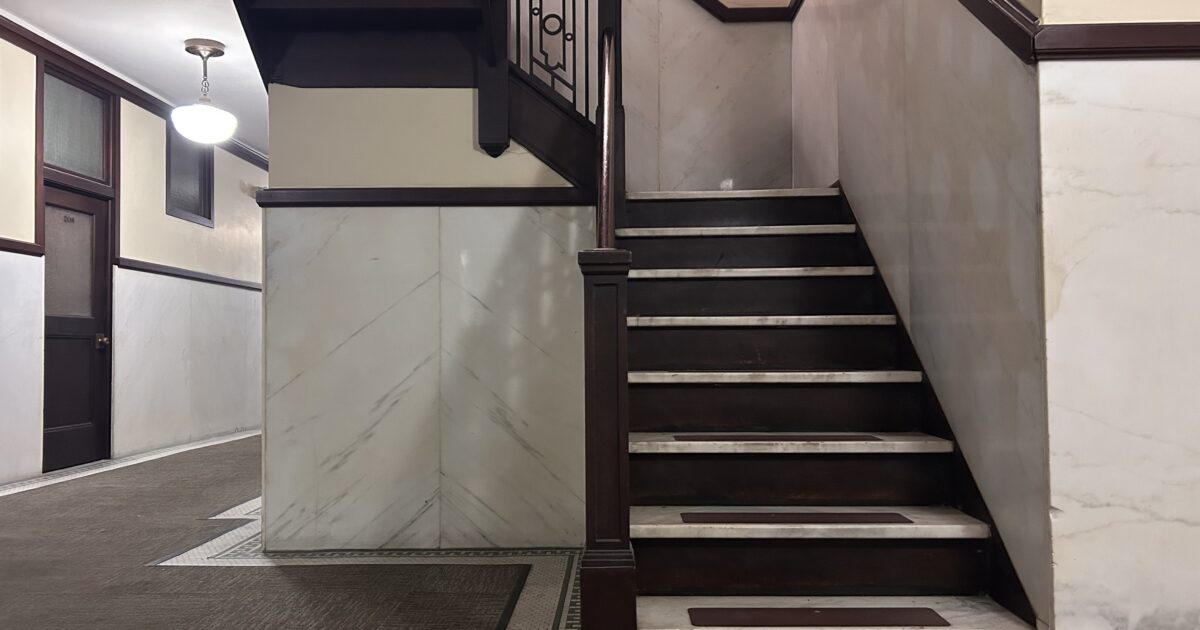
San Jose has taken its first tentative steps to soften longstanding building rules requiring all new apartment buildings — even relatively small ones — to include at least two stairways.
Housing advocates have campaigned for years to scrap such requirements for mid-rise residential buildings, arguing they significantly add to the cost of constructing new homes. But this reform push has run headlong into a century-old consensus among U.S. firefighters who say a single stairway is not sufficient to safely evacuate a building during a fire emergency.
San Jose officials are hoping to sort through the debate with the help of a newly commissioned study on the issue. Under the plan, city staff have been tasked with evaluating the possible consequences that might come from allowing developers to construct single-staircase apartments up to six stories high.
“I think it brings a lot of benefits,” District 3 Councilmember Anthony Tordillos, a key backer of the reforms, told San José Spotlight. “It means that we can build multifamily housing on more small parcels — close to downtown, close to our transit networks — that are currently really difficult to build under the current building codes.”
Today, nearly all large U.S. cities have building codes that require developers for apartment buildings taller than three stories to include two stairways and a connecting hallway.
It will be up to San Jose city staff to determine the details of the study, which the City Council approved 9-2 in October. The project was passed over dire warnings from councilmembers and fire officials.
“When you combine the two directions — ingress and egress — into one single stairwell that’s filled with smoke and water, you create a dangerous choke point that increases the risk for everyone involved,” District 7 Councilmember Bien Doan, a former San Jose Fire Department captain, said during the Oct. 28 review session of the study proposal.
He and District 5 Councilmember Peter Ortiz voted against the measure.
“There are definitely times when reducing requirements makes sense, but not when it comes to safety and saving lives,” Doan said.
A broad coalition of housing groups has been making the case that the fire safety features equipped in modern buildings — like sprinklers — make such fears outdated. They are pressing cities throughout California to adopt a single-stair policy for small apartments.
In September, their effort paid off when Culver City became the first to do so. The change allows developers to construct single-stair apartments up to six stories tall, but also imposes new safety requirements.
Housing advocates argue reforms like this represent a boon to housing production and affordability. They said floor space taken up by a second stairway makes mid-rise apartments significantly more expensive to construct. In addition, the extra stairways also constrain design choices for such buildings, making certain plots of land more challenging to develop into housing, they say.
A separate state-backed study on single-stair safety is already in the works. It’s the product of 2023 legislation championed by Assemblymember Alex Lee, who represents portions of San Jose. The study, overseen by the state fire marshal, is expected to wrap up in January.
“My home city of San Jose can show what cities across the world understand: that we can build beautiful, affordable, infill urban housing that doesn’t need massive lots,” Lee told San José Spotlight.
The housing advocates said their case has been bolstered by a study released earlier this year from Pew Charitable Trusts. The authors behind the report examined the safety record of single-stair apartment buildings in New York City and other locales where the design is common. It found these buildings faced no additional fire risks compared to similar apartments with two stairways.
Critics of the reform push remain unimpressed by the findings.
“We’re looking at data points that don’t necessarily correlate with our specific issues in San Jose,” Jerry May, a SJFD fire captain who leads the union representing the city’s firefighters, told San José Spotlight. May warns that given San Jose’s relatively skimpy firefighting resources — including department staffing levels that fall far below other cities of a comparable size — it’s possible single-stair apartment buildings could turn out to be more dangerous in the city than elsewhere.
“We’re not saying that we can’t do it,” he said. “But we are saying that you need to invest in your public infrastructure — which is public safety, more firefighters, more fire engines, more fire trucks and better fire hydrant systems in these areas — to be able to do it.”
In response, Ali Sapirman, a manager at the Housing Action Coalition and supporter of the single-staircase reform, argues that such doubts provide all the more reason for San Jose to follow through with its single-stair study.
“The city is moving cautiously,” Sapirman told San José Spotlight. “They didn’t just try to pass an ordinance …. They’re moving in the right way to make sure that this is confirmed safe.”
Contact Keith Menconi at [email protected] or @KeithMenconi on X.