
We work for you — reporting on the stories our community needs. Our team is keeping you in touch with everything that’s happening in our local food culture. Will you chip in today to support that nonprofit work during our year-end campaign?
As four people arrive on the scene on a sunny Saturday afternoon, they glance up toward the roof of a house. A look of puzzlement and slight bemusement overcomes one of their faces. On the side of this bungalow in Oakland, is a tall, slim apple tree bearing a lot of fruit, but half of the apples were growing over the roof.
For the next hour, the four people donning aprons use long poles – pickers with claw-like metal cages at the top to help grab fruit – to glean as much as they could. The owner of the house, who had contacted the group to arrange the visit, popped outside to say hello and encourage them to take as many apples as they could distribute.
The East Bay has an abundance of fruit trees, much of it in people’s yards. And each year, many household trees bear too much for one family to consume. This year, with recent cuts and pauses to SNAP and CalFresh benefits, the need to collect and channel that bounty to those in need around the East Bay has become even more acute. As the cost of groceries continues to increase, more families are feeling an economic squeeze; food insecurity in the U.S. is on the rise, while reducing food waste is an ongoing battle.
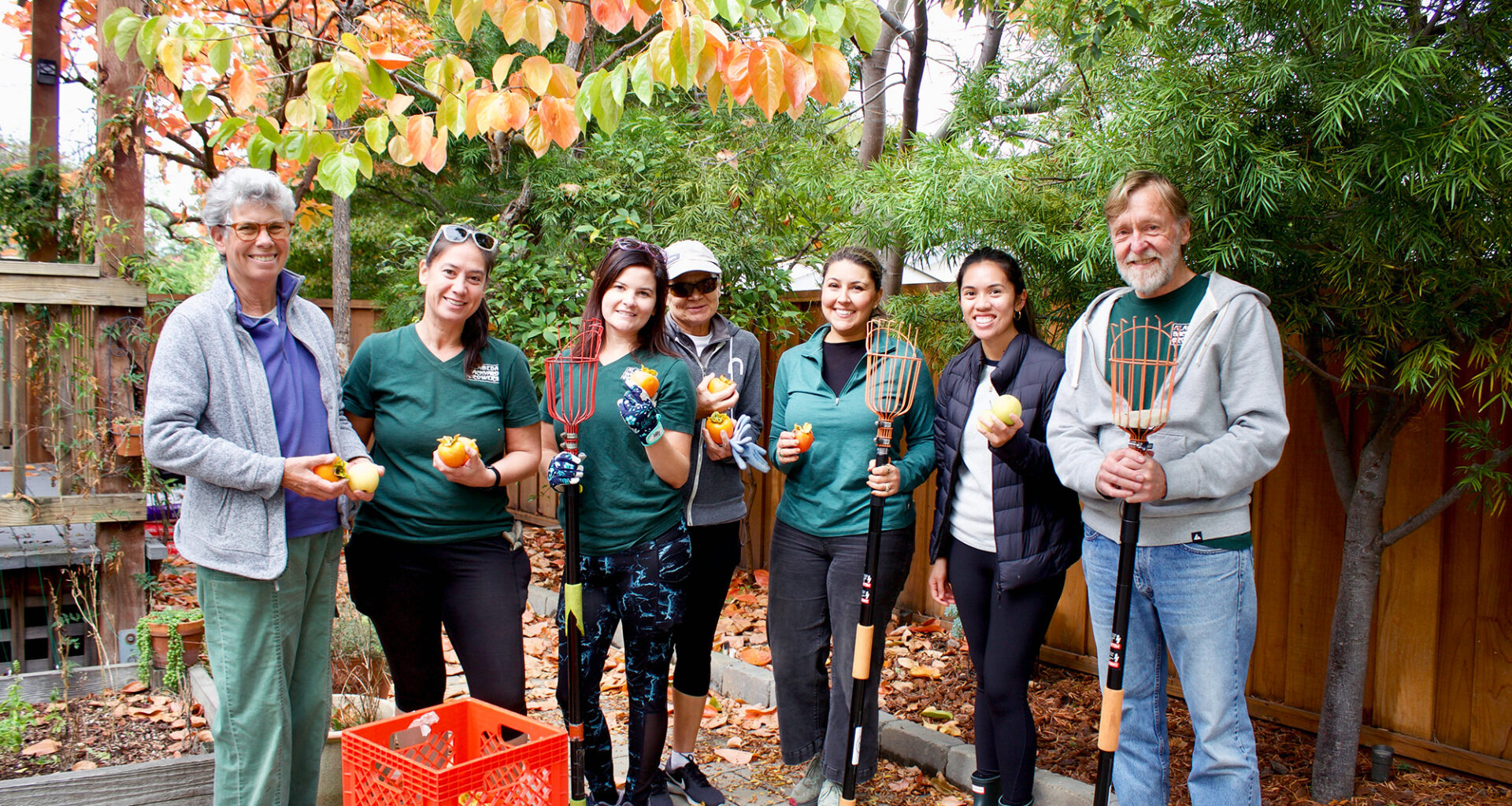
Meet the gleaners of Oakland and Alameda, who are attempting to alleviate some of these problems. There are currently two main groups in the area, both volunteer-run efforts to get ripe fruit to the right hands, mouths, and bellies.
“We’re largely picking from people’s private yards and bringing [the fruits] to the public,” said Lio Min, who co-leads the Oakland Gleaners with Laura Sanchez. “It feels good to physically contribute in that way.”
Sonja Simmons, a former Oakland resident who volunteered with Alameda’s Project Pick starting in 2015, founded the Oakland Gleaners in 2019 with encouragement and support from the Alameda group. Sanchez joined the Oakland Gleaners in 2023 and Min in 2024. The three of them were active, with a handful of other volunteers. They used borrowed fruit pickers from the Tool Lending Library in Temescal. When Simmons moved away, she left the group in the hands of Min and Sanchez. Now, they have a roster of 30 volunteers, have purchased their own tools, and are growing. Their initial goal was to glean 3,000 pounds of fruit this year; so far, they have gathered 7,500 pounds.
In Alameda, the Project Pick group is run by Alameda Backyard Growers. Its focus is on picking fruit that they then distribute to the Alameda Food Bank. The volunteers have gleaned more than 14,500 pounds so far this year, the most ever picked since the project started in 2011.
These two groups have been working to gather fruits, tree-by-tree, yard-by-yard, and neighborhood by neighborhood. Both have had record years, which they attribute to their own capacity and organizational structures, volunteers’ enthusiasm, and a good rainy season last year that has yielded bountiful crops.
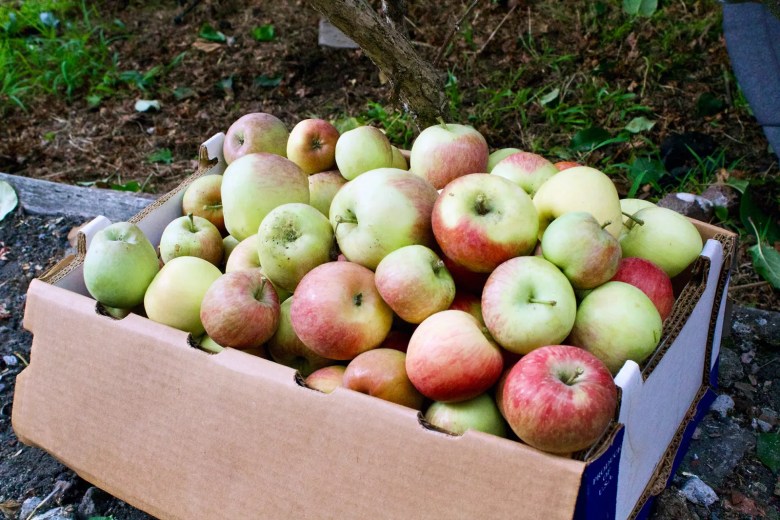 This box of apples harvest by Oakland Gleaners volunteers was donated to the Berkeley Multicultural Institute. Credit: Momo Chang for East Bay Nosh
Gleaning groups are not new – for years, people noted the abundance of either public or private trees, from the galas to plums to persimmons and tons of citrus. Some groups start and then close; as most are run by one or just a few people, so if anyone quits or moves away, the effort withers. For example, Berkeley’s project, previously a project of a mutual aid network, eventually ended as people moved away or burned out, according to several people. The Oakland Gleaners are currently overseeing Berkeley areas, and they also go as far as El Cerrito and other parts of the East Bay that aren’t covered by other gleaning groups.
Helping a dozen smaller groups in Oakland
The Oakland Gleaners have grown under Sanchez and Min’s leadership. They formed more partnerships with grassroots groups and nonprofits, including West Oakland Punks for Lunch, West Oakland Library, Oakland Unified School District’s central kitchen, and Berkeley’s Multicultural Institute, among others. They are currently partnering with a dozen groups that give away fruits as a part of their food pantry or at events.
Last year, OUSD’s central kitchen contacted them because they wanted to show a group of kids how to make plum jam. Another month, a teacher was doing an activity using apples, but didn’t have enough in their budget to buy more. “We were like, ‘Okay, we got you,’” Sanchez said.
For Sanchez, who grew up in Oakland and moved back to the Bay Area after a long stint living on the East Coast. She noticed the abundance of trees in Oakland as well as the visibly increasing inequities. “It’s hard to fathom how you can be living in a place with so much wealth and so much abundance and lack,” she said.
Min first learned about gleaning while living in Los Angeles. Like many who sort of fall down the rabbit hole of gleaning, they used Fallen Fruit, a website that shows where there are gleanable public (and sometimes private) trees.
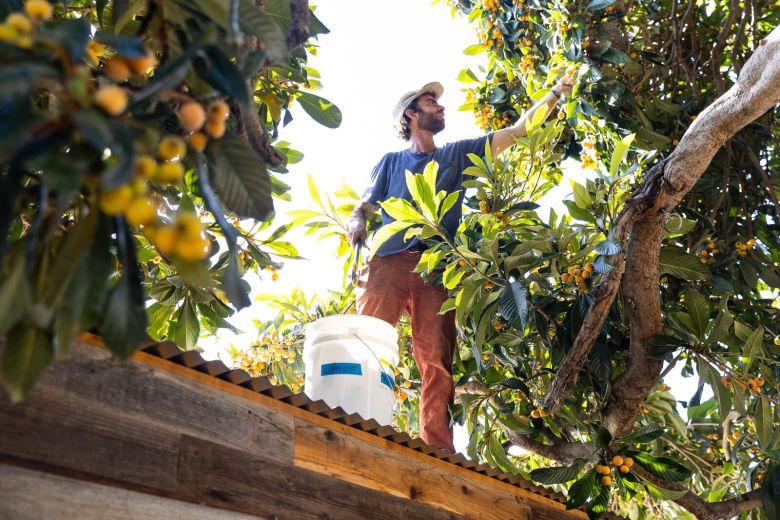 Daniel Goldberg, founder of Richmond-based Feral Ecology, partners and volunteers with Oakland Gleaners. Credit: Estefany Gonzalez for East Bay Nosh
One of Oakland Gleaners’ partners, who is also a volunteer, is Daniel Goldberg of Feral Ecology, based in Richmond. They will often let each other know about trees that need to be harvested. While Feral Ecology makes wines, such as loquat wine, their overall philosophy is similar. “It’s getting people together outside to pick fruit and what it means to us on a deeper level – the community- building and development of a culture around learning and engaging with nature in this way,” he said.
Min said that fruit, for the most part, is not an essential item that mutual aid organizations seek. But, it’s a sweet – and welcome – treat. “The beautiful thing about any gleaning project, or any food distribution or material distribution, is that you can immediately see the impact,” Min said.
Alameda’s Project Pick helps food bank
The Oakland group learned from the Alameda group, which has been around for a longer time. They shared a blueprint, email templates, as well as their volunteer safety training video.
Got a tree/plant ready to be Gleaned?
Contact the group if you have a bountiful tree that needs to be harvested
Alameda requires a current photo of the situation so they know how many volunteers, what to expect, and what equipment to bring
Oakland Gleaners requires that it’s enough fruit to fill two paper grocery bags
Even if you don’t have a tree, you can donate to help buy new tools and other things
Alameda’s Project Pick can also drop off anything that is perishable that the food bank would not normally accept; contact them for details
Alameda’s group has been running since 2011, and is a project of the Alameda Backyard Growers. One of the founders saw all the fruit trees in peoples’ yards and wanted to find a way to help others, according to Amy Kalkstein, Project Pick program coordinator, alongside Dena Andersen, who both volunteer their time. Alameda Backyard Growers also runs a free seed library, educational workshops and talks, and events like wreath or sauerkraut making.
All of the fruit gleaned through the Alameda project goes directly to the Alameda Food Bank (not to be confused with the Alameda County Community Food Bank). While the Alameda bank typically serves only people who live or work in the City of Alameda, they recently opened to anyone in the area due to the suspension of SNAP and CalFresh benefits.
This year, they have surpassed their initial goal of picking and donating 8,500 pounds of fruit – they’ve currently gleaned 14,500. Kalkstein said they will increase next year’s goal to 10,000 pounds because this year has been so successful.
They have a roster of 60 volunteers representing a wide range of ages, who go during the weekends or sometimes on weekdays. They pick mostly fruit, but do take vegetables, usually picked by owners and then donated through Project Pick.
“I loved the idea of minimizing food waste,” Kalkstein said about why she started volunteering in 2020.
Since the cut in SNAP benefits and cuts to food bank budgets, donating fruit isn’t just a cherry on top. It’s literally helping food banks save money and providing more resources.
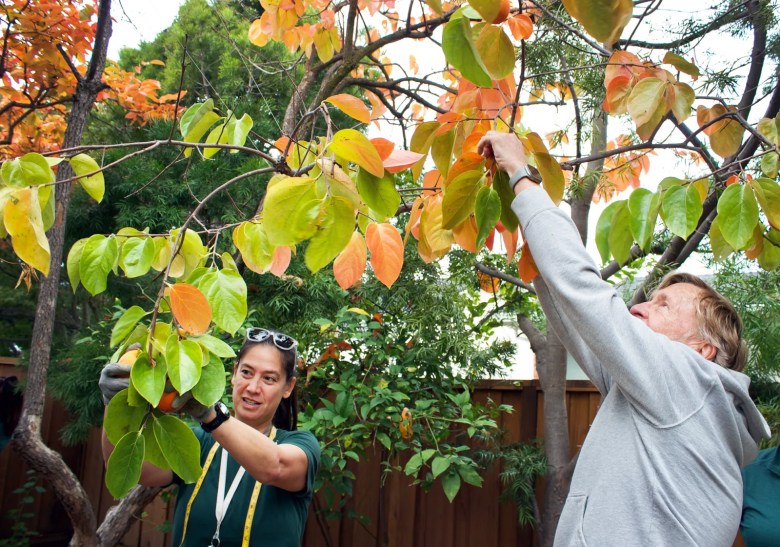 Amy Kalkstein (left) is the Project Pick coordinator in Alameda. Credit: Momo Chang for East Bay Nosh
“They are always excited when we show up with our van full of produce,” Kalkstein said. “It helps take some of the burden off. Anything we can bring them is icing on the cake to make things easier for them, and adds variety.”
Kalkstein, who also volunteers once a week at the food bank, estimates that an average milk crate full of fruit weighs 25 pounds, averaging $30 per crate if purchased. If you add up how much they have donated so far this year, it’s more than $17,000.
When the Alameda group receives requests for fruits they no longer pick – loquats and figs are a few that are more fragile and are harder to send to a food bank – they let the Oakland Gleaners know.
Occasionally, they will get some more unique items, like chayote. “It’s not something we’ve offered before. It’s nice to have a variety.”
Branching off to more projects and areas
Those apples picked on Saturday – about 30 pounds from the one tree in Oakland – were later dropped off at FrutaGift, a free fruit stand in the Fruitvale neighborhood. The Oakland group tries to distribute to groups on rotation so everyone gets something. Sanchez attended a different pick that same morning in Oakland, harvesting 250 pounds of Hachiya persimmons, which were shared amongst four groups, including an Oakland library and Food Not Bombs.
The Oakland Gleaners are looking for someone to help manage logistics for Berkeley’s trees and yards, since they inherited the Berkeley list. Min estimates spending a few hours each weekend picking fruit, and other hours working on logistics, sometimes totalling more than 15 hours a week as a volunteer. Min is a published author and says this work literally helped them get in the trees. “Writing work is very lonely. The gleaning feels like an outside calling.”
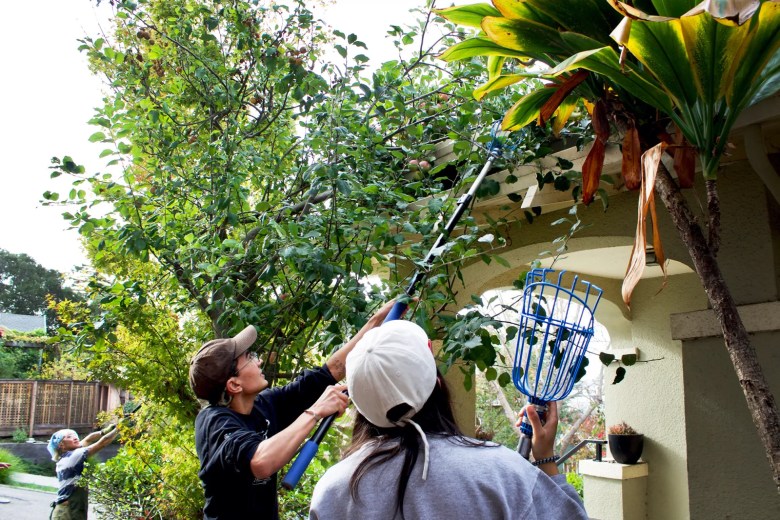
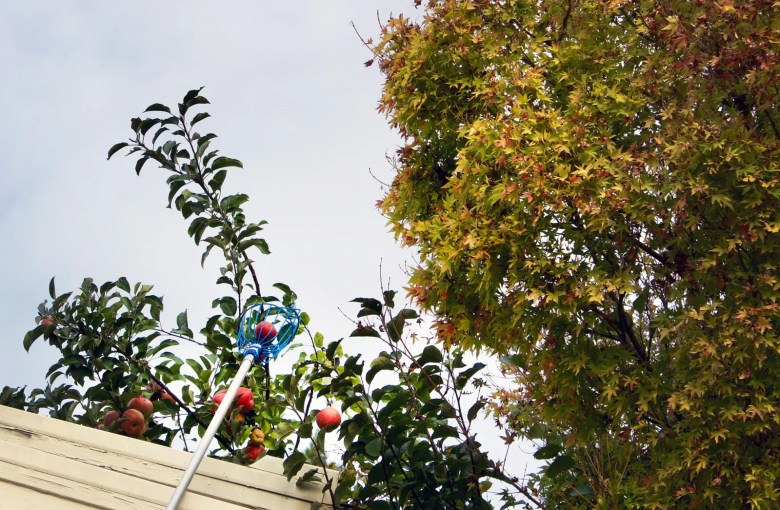 Volunteers for the Oakland Gleaners work together to get as much fruit off the trees as they can. Credit: Momo Chang for East Bay Nosh
For Kalkstein, it’s really about seeing it full circle. “I get to see the fruit that I helped pick out on the floor in the shopping area,” referring to the Alameda Food Bank, which recently opened in a new location, and organized like a regular grocery store, non-traditional by food bank standards. “The other day, we got delivered two pomegranates. A single one can be $5 in a store. Knowing that food isn’t going to waste, and seeing people choose fresh fruit that’s grown locally.”
But back to the fruits. Bunches of apples still dangled over the roof. The harvest was modest so far, filling a cardboard box. They saw the potential waste if they just left it as is. There was no extendable ladder on hand. The volunteers got creative, including using one picker to sweep branches over, while another used a picker to pick the ones that became accessible.
Apples started raining down, landing with a thud or bouncing off the soil below. They eventually managed to free the majority of the ripe apples and decided to call it a day, satisfied with filling a large cardboard box, and two small buckets of slightly bruised or cut ones, and one unsalvageable small bucket that squirrels had raided, which went into a green bin. Last, but not least, each volunteer took one and bit into it. The apples were crisp, sweet, and had a floral note different from most apples found in markets. “We always taste the fruit before we distribute them,” Sanchez notes.
Some volunteers picked through the bruised but still good apples to take home to dehydrate or make sauce or just eat, what Min calls the “gleaner’s tithe.” Min, Sanchez, and other volunteers have made fruit leather, jellies, lemonade, ice cream, and other things from the slightly damaged fruit, which they sometimes then bring back to public events to share
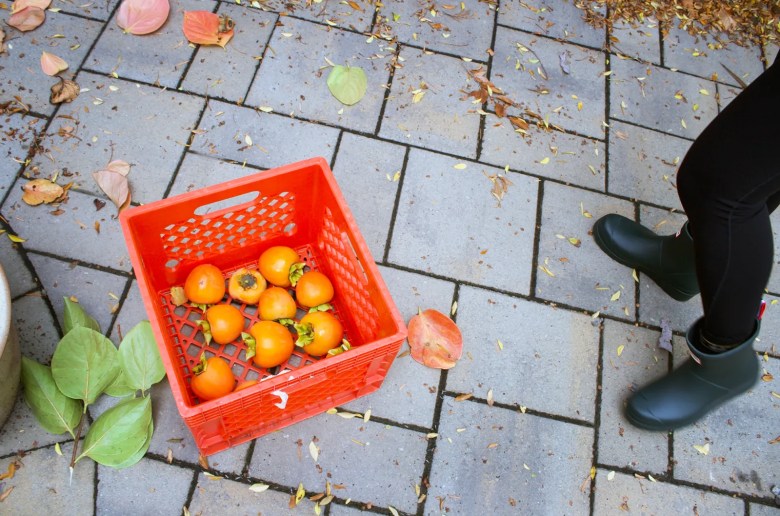 Credit: Momo Chang for East Bay Nosh
The Oakland Gleaners are also hoping to form a larger East Bay Gleaners group, since they are now technically beyond Oakland’s boundaries. Interest in gleaning groups appears to be growing, as seen in this callout to start gleaning groups in San Leandro and Hayward (the larger group did not get back to this reporter).
Both Min and Sanchez have many ideas – from making jam to other educational workshops and hands-on experiences. All of this is with the goal of getting unused fruit to people who need it, while also building community and a greater connection to our food and its origins.
Related stories
First look at Uqbar, West Berkeley’s new literary-inspired restaurant
November 20, 2025Nov. 21, 2025, 9:22 a.m.
100 turkeys. 1,000 plates. 23 years in, an Oakland community Thanksgiving keeps growing
November 25, 2025Nov. 25, 2025, 3:43 p.m.
Cafe and bakery fills empty BAMPFA space with avocado coffees and Indonesian-inspired pastries
October 30, 2025Nov. 1, 2025, 12:07 p.m.
“*” indicates required fields