
Editor’s Note: The usage of Hispanic, Latino/a/e/x and Chicano/a/e/x is in accordance with the preference and language of the sources and/or organizations included in this story.
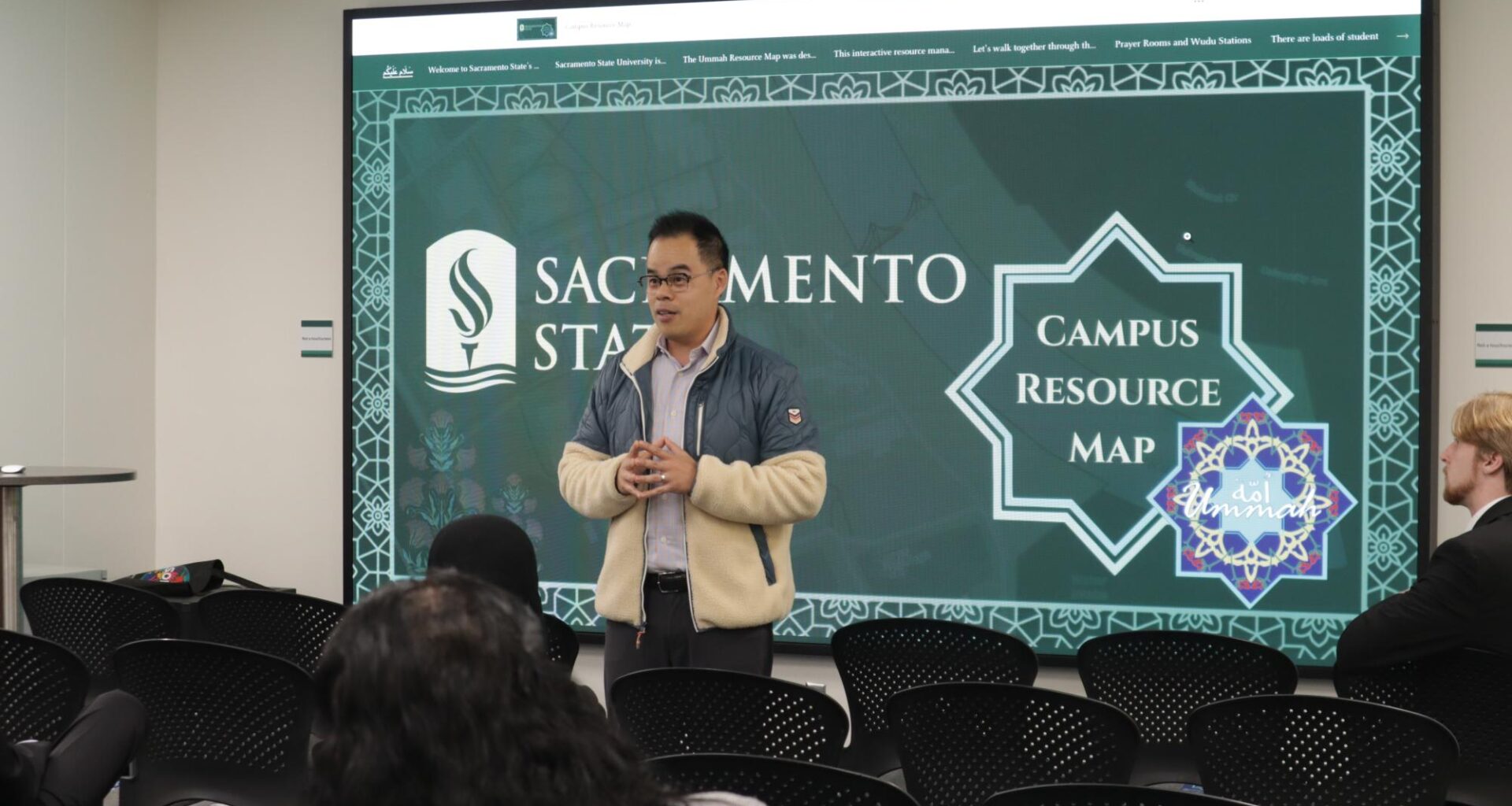
Sacramento State held a soft launch of the Ummah Belonging Map within the Library Data Tech Lab on Wednesday, Nov. 19. The interactive map is the first of its kind within the CSU system that identifies resources, organizations, faith-based spaces and cultural hubs that serve and support the Southwest Asian and North African, Arab and Muslim communities.
The Ummah Belonging Map is a part of a collaborative project between Sac State’s Department of Geography and Inclusive Excellence to help community members find places and resources that “foster connection, support and a sense of community.”
According to the Belonging Maps webpage, each map includes two parts: a campus map and a regional map.Each map includes a commuter calculator and highlights community centers, halal restaurants, religious sites, Muslim-owned businesses and more.
Hanieh Molana, an assistant professor of geography and Inclusive Excellence faculty fellow, said the goal is to update the maps every semester. The Belonging Maps project was created in late January and led by Molana along with Ian Brown, a senior geography major and Inclusive Excellence intern. According to Molana, Sac State alumna Darcy Francis was responsible for the creation of the Ummah campus map and logo.
Michael Nguyen, the vice president and chief diversity officer of Inclusive Excellence, introduced the new maps during the soft launch event. He said the namesake Arabic term “ummah” means a family-like community that transcends racial boundaries and differences, emphasizing unity, belonging and shared humanity.
RELATED: First-ever SWANA festival celebrates culture with regional treats and music
“This is one of the most exciting things for me to be able to share; not only something that is beautiful visually, it’s something that’s accessible,” Nguyen said, “which is what geographers are so wonderful at helping us do.”
Molana said the Ummah Belonging Map was the first map they began building but took around six to seven months to complete and was thus the second to be released. According to Brown, the first soft launch occurred Sept. 26 for the SOMOS Belonging Map, which Molana and Brown created for the Latiné community.
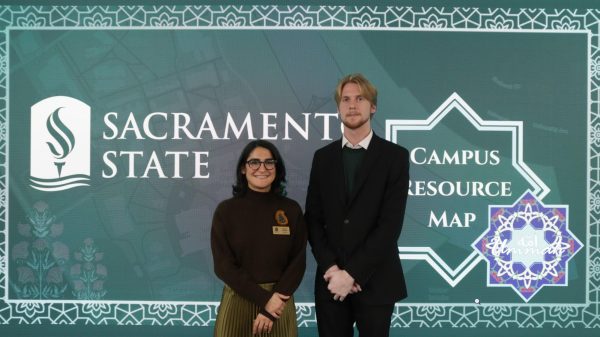 Hanieh Molana (left) and Ian Brown (right) pose in front of the Ummah Campus Resource Map front page on Wednesday, Nov. 19, 2025. Molana and Brown are the creators of the Belonging Maps project. (Lizeth Tello)
Molana said that the maps were difficult at first due to limited data and knowledge of community resources. She said that, through networking and communicating with members of the relevant communities, they were able to expand their dataset in order to bring the map to life.
“It’s a little unreal because you’re like, ‘Wow. People enjoy this, and they feel uplifted by it,’” Brown said. “They love it. They want to help. They want to contribute. That’s amazing.”
RELATED: Honoring Native American history and how to support the community
Freshmen civil engineering majors Ahmad Elokda and Ben Tran attended the soft launch together and said they both think the Ummah map will be a great resource for all students.
“It’s great.It’s so easy, and it’s so clean on the eye as well,” Elokda said. “It’s really important when you have something like this that’s easy to manage.”
Elokda and Tran both said they appreciated the time, effort and care put into the project to make resources more accessible to multiple communities. They both said they plan to use the map to become more involved.
“It shows that people really care about the diversity, about the culture, the inclusivity of other people in the community, what their needs are – and that’s a great feeling to have,” Tran said. “That you’re supported by people who don’t speak the same language, don’t look like you, but they still support you no matter what.”
According to Molana, the next addition will be for the Black community, called the Ubuntu Belonging Map. Molana said it is anticipated to be released next semester.
She said it felt like a dream to work on the first two projects, and it is her goal to eventually expand the maps’ coverage to areas beyond Sacramento.
“It was a little scary at the beginning,” Molana said, “but it’s a labor of love, so we’re excited for this.”