
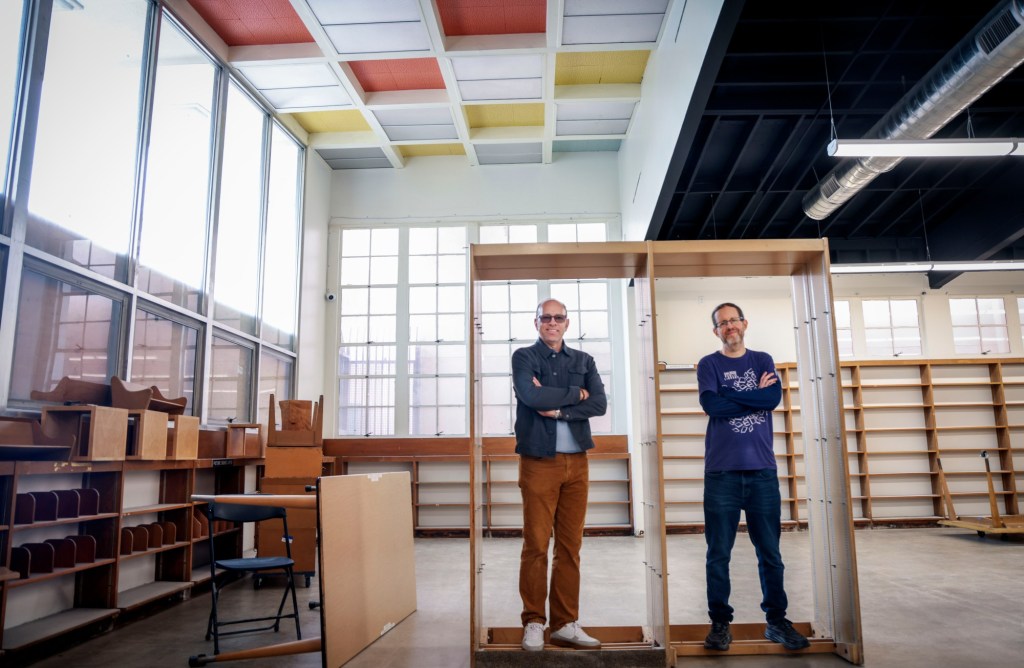
When Patrick Stewart walked into the vacant building that would become the new Library Shop Mission Hills bookstore, he was hit by two feelings: It’s perfect. And oh, boy.
The empty bookshelves lining the walls spoke volumes.
But things needed to be spruced up and brought up to code. The building had housed the Mission Hills library from 1961 to 2019 and then sat unused for about five years, not counting the occasional squatter.
“We saw a lot of potential,” said Stewart, the chief executive officer of Library Foundation SD, which supports the library system through outreach, philanthropy and advocacy. “To be able to be in a community that is super, super supportive of the library, and super supportive of the Library Foundation, I think you couldn’t be in a better environment, a more welcoming environment, a very literary environment.”
After months of construction, shopping for inventory, ditching the dropped ceiling to expose the more interesting curved rafters, sanding and sealing the concrete floors and booking the first readings and events, the foundation is opening the bookstore on Dec. 1.
Scott Ehrig-Burgess, the shop’s manager, said this store will have a similar vibe to the The Library Shop at the San Diego Central Library, which he described as “a super cute, fun, independent bookstore with a focus on stuff for library lovers and book nerds.” But the Mission Hills shop will be curated for its neighborhood, with a different mix from what is sold downtown. “The usual indie bestsellers and books that are hand-sold by our staff. There’ll be a lot of local authors,” he added.
Opening week features a conversation with Cory Doctorow and an open house for local authors.
“Celebrations continue all week long with events, author visits, storytimes, discount deals and games. Proceeds support all 37 branches of the San Diego Public Library,” the foundation website says.
Built for books
On a recent sunny Wednesday, Stewart’s voice sounded tinny as it bounced off the concrete floors and bare walls.
The children’s area, where little hands once tugged at “The Story About Ping” and Shel Silverstein’s poems, will become the new reading zone. The middle area of the library, which once held desktop computers on hefty tables, will again have tables, this time with books for sale. A flex space that can fit up to around 100 chairs will be at the back for readings and events. Shelves will continue to wrap around the walls.
The exterior got fresh paint, but what didn’t change was the bones of the building, with its sloping roof and façade brightened by many windows. Even the font of “Library Shop Mission Hills” will match the old logo, Stewart said.
For the building to again hold books is “a perfect transition,” Ehrig-Burgess said.
It almost didn’t.
When the library outgrew its roughly 4,400-square-foot space on West Washington Street and moved into its new building a few blocks east, the old library’s future was in limbo. Should it be torn down? Should it be repurposed? Could part of it be salvaged, but its shape reimagined as housing?
The community, including the Mission Hills Town Council, requested that any replacement save the building, which was designed in the Googie Modern style by Robert Bradt, a prolific local mid-century architect who also worked on a Hotel Del Coronado addition, several banks, Marine Corps barracks and multiple San Diego public schools.
“Any proposed future development (such as business or mixed-use with ground floor retail, restaurant or office/co-working space with extended hours) should preserve the original architectural intent by maintaining the existing façade and also be compatible with the historic character of the neighborhood,” the town council asked.
Turning it into a bookstore checked several boxes, Stewart said. The Library Foundation wanted to add a second shop, but commercial real estate is expensive in San Diego. “At the same time, the city was trying to figure out what to do with this space.” The city is charging the library foundation below-market rent, which helps the shop direct revenue to the library system. “It’s not like a commercial venture. It’s library-centric,” he said.
Selling books for revenue
Books as a revenue stream? That might seem like a lot to wish for in 2025. But it works. Sales at the foundation’s downtown shop have steadily increased, from $153,000 in fiscal 2022 to $222,000 in fiscal 2023 to $300,000 in fiscal 2024, tax records show.
Libraries sometimes sell used books to raise funds. Some libraries also have built-in gift shops. But running an independent bookstore where new, not secondhand, books are sold is, well, novel.
“Library Shop SD runs two neighborhood, independent bookstores whose net revenue supports the Library Foundation SD. Both locations — in Mission Hills and at the Central Library — serve as excellent ways to engage San Diego Public Library patrons, many of whom go on to become vocal advocates for the Library. This is a new model that, as far as we know, is not found in other library systems or library foundations,” Stewart added.
One more perk from shop sales is that unlike other donations to the foundation, which might come with stipulations, revenue from book sales is unrestricted.
Another revenue stream will be ticketed author events. On Dec. 1, there will be a public event and a reading and Q&A by Doctorow, the author, journalist and tech skeptic. Tickets are $30.
“I think that’s the perfect event to launch this,” Ehrig-Burgess said, “because I think a lot of people are concerned that we’re kind of losing a lot of the great things about our culture, and intellectual freedom. And this book pushes back against that. I think also opening an independent bookstore in the year 2025 pushes back against that, too. To kind of say, ‘We’re still here. We still have these things that we care about and they can still be supported.’”
Beyond fundraising, a bookstore creates community, Stewart and Ehrig-Burgess both said.
“Being able to present both local authors and touring authors consistently throughout the week, throughout the month, is going to be super important, not just for us. I think it adds to San Diego,” Stewart said.
Down the street and around the corner, there are coffee shops, restaurants and a record shop. Steward painted this picture: “We’re going to come see the reading. Then we’re going to go out for drinks or dinner. That kind of thing,” he said. “It creates another reason to come to Mission Hills. Another of the many awesome reasons, but to add this into it? This is going to be wonderful.”
Neighborhood bookstores are important in the way that libraries are important, Ehrig-Burgess added.
“You can’t really have those kinds of conversations in a coffee shop. You can talk to your friends, but the whole community doesn’t get together and have debates about important topics,” he said.
Like a library, a bookshop is “a community space. And we plan to have authors who represent all viewpoints and a diverse set of experiences, and just expose the neighborhoods to all these different great ideas. Some ideas great, some not so great, but we want to have conversations about that, right? Which, again, aligns with the mission and the values of the library, which is an organization that we support through the sales of the shop.”
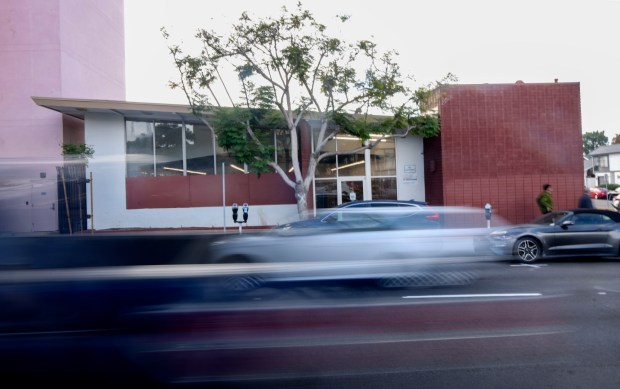 Library Shop Mission Hills will revive the old library building along Washington Street in Mission Hills. (Sandy Huffaker / For The San Diego Union-Tribune)
The bigger picture
Other bookstores have also opened in San Diego in recent months: A Barnes & Noble in La Jolla, an independent shop in downtown called Hey Books!, launched by two bookstore veterans. Also in Mission Hills is the Feminist Bookstore, which opened earlier this year.
The new library bookshop will add to the mix, with some overlaps and some differences.
Asked if it is a particularly good time to open a bookstore, Ehrig-Burgess answered with an emphatic no.
“I’ve been an independent bookseller for 30 years, so I’m probably a little cynical. I think there’s never a good time to open an independent bookstore,” he said. “But there are times that the world needs more independent bookstores, and I think we’re in a time where the world needs more independent bookstores.”
The staff, he said, is “super excited to step into the void.”