
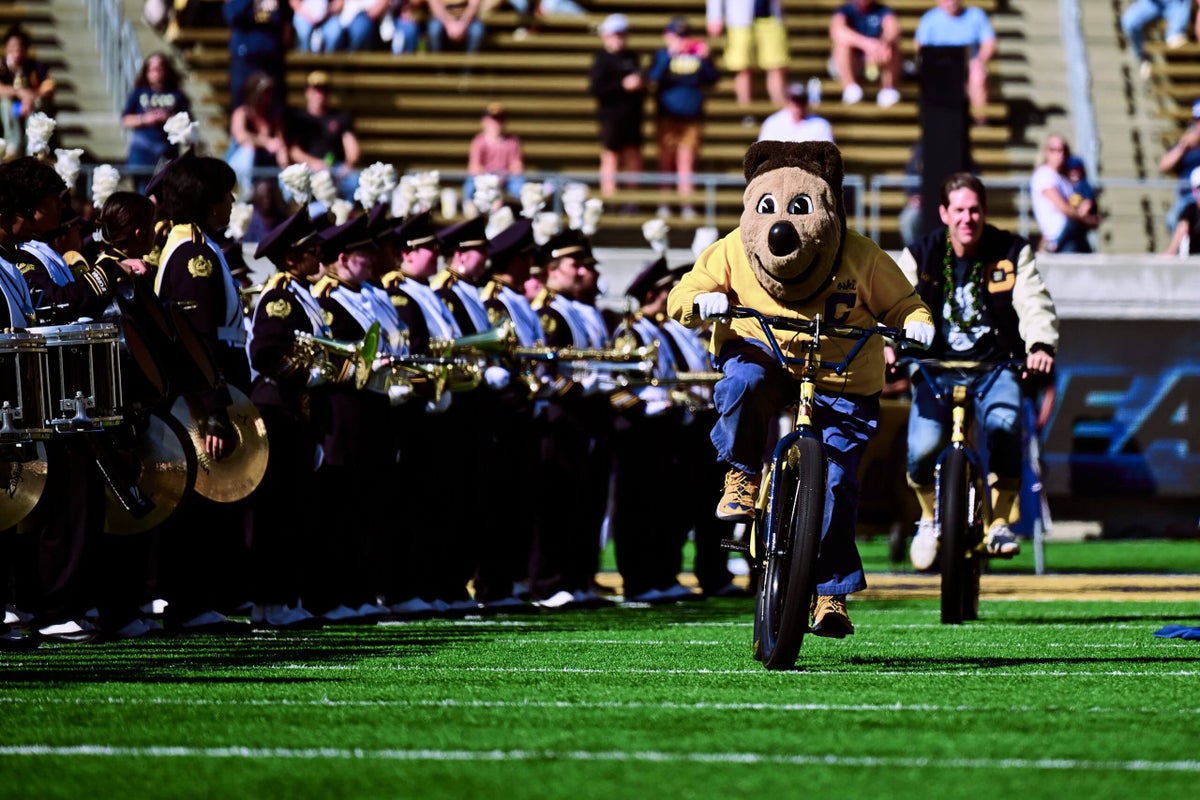
BERKELEY, Calif. — Ron Rivera equates his return to Berkeley to his first year as an NFL head coach in 2011, where he took over a Carolina Panthers team coming off a 2-14 season. He was transparent about realities then as a first-time head coach taking over a middling franchise, and he is doing the same now with California fans who want nothing more than to feel part of the current college football establishment.
Three weeks ago, he sat in a meeting room inside the stadium wearing a Hawaiian shirt and slapped the elongated table in front of him as he delivered these five words: “We should not be irrelevant.”
When asked why, the 63-year-old former Cal linebacker said, “We’re one of the top public institutions in the world. We’re expected to carry that mantle of excellence.”
Excellence is synonymous with Cal, and almost everything in its orbit, from academics (with 63 Nobel laureates associated with the school) to Olympic sports (59 current or former student-athletes competed at the 2024 Summer Games in Paris). Forbes recently ranked the university as the No. 1 public school in the country, stating that more than 500 Berkeley graduates have gone on to earn a PhD in the last three years, more than any other college on its annual top 25 list. The city of Berkeley, home to the Free Speech Movement, has a reputation for being one of the most progressive urban areas in America.
And to many Cal graduates, the product on the field every weekend each fall is as important as the ballooning list of Nobel laureates. It matters here, too.
“Somebody asked me recently, ‘What will success look like here?’ And I said, ‘community’,” Rivera said. “Community involvement gets behind you and helps you accomplish what you’re trying to do.”
The most impactful and outspoken part of the Cal football community in the last year has been the Calgorithm, die-hard Golden Bears whose self-aware social media presence filled with self-mockery about the stereotypes of the liberal enclave of Berkeley launched them into such a level of popularity that they were getting mentions on ESPN’s “College GameDay.” Perception isn’t reality, and it’s fun to have fun.
So their AI-generated memes of Marxist smiling bears or propagating Cal wins with “a woke agenda” immediately soothe game week vibes before opposing fans can even start pounding away on their own keyboards. While some members are public, several choose anonymity so they can feel free to post without fear of repercussions from their employers.
Their goal is the exact same as Rivera’s: To see Cal ascend to a Power 4-level program with proper funding, support and a roster filled with players who can contend for a conference title annually.
It’s why Rivera fired head coach Justin Wilcox on Sunday after a shambolic 31-10 loss against rival Stanford in the 2025 Big Game, where the Bears had more penalties (13) than rushing yards (12). It’s why he named ex-Washington State coach Nick Rolovich, who was fired from his previous head coaching job at Washington State for his refusal to take the COVID-19 vaccine, the interim.
“Smart kids do, in fact, care about football,” said Bears fan Trace Travers.
In the nine months since he’s returned to campus, Rivera, 63, has come across several protests or demonstrations. They happen often here. When he has, he’s done what he always has: looked on and listened. This year, they’ve ranged anywhere from the war in Gaza to data privacy concerns to funding for science studies. It’s not unlike what he saw 40 years ago when, during his last year at Cal in 1983, students had anti-apartheid sit-in protests, marched for nuclear disarmament during the final years of the Cold War and marched in labor solidarity for unionized student workers on campus.
“To me, Berkeley stands for the right, the opportunity, the challenge, the chance to do the right thing,” Rivera said. “I’ve listened to some of these rallies. I’ve been to some of these protests. It’s funny because I listen sometimes, and I go, ‘Wow, I disagree.’ And then other times, I go, ‘Wow, that made me think.’ That’s what it’s all about.”
Part of the conversation at Cal is literally the city of Berkeley, and all the boilerplate viewpoints those outside the city and campus have about it. The Free Speech Movement of the 1960s took root here. It remains one of the city’s foundational pillars. A few hundred paces down the path from where Pat McAfee sat next to Cal legend Marshawn Lynch on the set of “GameDay” last fall sits the Free Speech Movement Cafe on campus.
“There are a lot of people on the East Coast who don’t know that Cal and Berkeley are the same thing. And that’s on us, at some level,” said school Chancellor Rich Lyons. “Cal was always the athletics brand, and Berkeley was always the academic brand. But we are both of those things.”
Lyons hired Rivera in March, giving him full autonomy over the program’s coaching staff and its financial resources for roster building. Soon after he was hired, high-profile donors threatened to withhold name, image and likeness funds if Wilcox still answered directly to former athletic director Jim Knowlton instead of Rivera. Knowlton eventually retired this summer, a week after the House settlement was passed. Cal athletics, like most departments that opted into the $20.5 million stipend, will have to invest wisely into the primary money-maker: football.
“This is a defining moment,” Lyons said. “There are a lot of irreversibilities ahead. If you’re not in the game, then you may be out of the game for quite a long time.”
Like so many athletic departments nationwide, Cal’s is mired in a significant budget deficit. The 2024 fiscal year report stated that Cal athletics spent $29.7 million more than it earned. As part of the UC system, the university is benefiting from UCLA leaving the Pac-12 and going to the Big Ten. Starting in 2024, the UC Board of Regents mandated that UCLA pay Cal $10 million a year for three years in the wake of its move.
For the first time in decades, fans believe decision-makers at the top want to prioritize football. They also remain a bit guarded, and understandably so.
Fernando Mendoza, the Heisman Trophy frontrunner in 2025, used to wear Cal blue and gold, but now he’s wearing a non-Stanford shade of cardinal red, leading undefeated and second-ranked Indiana toward a College Football Playoff berth. Former running back Jaydn Ott, a cult figure in the Calgorithm’s explosion last year, left for Oklahoma. One of its top receivers, Nyziah Hunter, is now at Nebraska. Tight end Jack Endries left for Texas.
Rivera points to recent rapid ascents at Indiana, Vanderbilt and Virginia as examples of schools that historically have struggled but can turn things around with everyone rowing in the right direction.
“These schools have had huge reengagements with their alumni. They’ve gotten them to make the investment. You’ve got to look at it as an investment,” Rivera said. “We’re not just throwing money away. We’re not just paying players to play, we’re bringing in players to beyond just that. That is to win football games and help create opportunities to go beyond being relevant. That’s to become part of the conversation.”
On the morning of the Nov. 1 matchup against Virginia, that same area where “GameDay” is not full of rabid fans, as it was a year ago. It’s quiet. It’s 10 a.m. There’s a big screen showing the first slate of Saturday games. A few tailgate canopies are set up. Some devoted members of the Calgorithm show up in Halloween garb, honoring the holiday from the night before. Costumes range anywhere from the Pope to an admiral of an 18th-century sea-faring ship, aka the “Admiral Bear.”
Fourth-generation Cal alumnus Nick Kranz isn’t in costume, but he’s snacking on a breakfast burrito. He’s one of the lucky ones. He was here as a student from 2003 to 2007. He saw the Lynch era, which was also the Aaron Rodgers era and the DeSean Jackson era and the Jeff Tedford era.
An anonymous sticker-maker recently handed out some stickers of Oski, Cal’s mascot, portrayed as Karl Marx, the 19th-century revolutionary socialist. Kranz takes a bite of his burrito and then, half in reality and half in jest, explains what it might take for Cal football to prosper. After all, the Calgorithm played a vital role in crowdsourcing and raising NIL funds for the football program in 2024 prior to the House settlement being passed this June.
“I think that’s very much the ethos now: Everybody has to do their part to save Cal football,” Kranz said. “We have to turn to communism to save Cal football, not out of ideology, but out of desperation. A lot of this effort is about trying to preserve something that is a unifying sense of community for the campus when we don’t have a ton of those things here.”
Dr. Todd Rogers works at Harvard’s Kennedy School of Public Policy. He recently co-wrote an op-ed in “Time Magazine” entitled, “Why All Americans Should Be Football Fans.” Rogers has been studying and researching how humans can strengthen social connections through fandom, specifically football. Rogers argues that in spite of the heated state of politics in America, football is one of the last reliable social unifiers. A political affiliation that might otherwise turn off one person from another, knowing you bleed the same colors for your football team, is as disarming as any other shared commonality, including religion.
“Turns out sports co-fandom is, like, an outrageously powerful depolarization tool,” he said.
Those in charge at Cal hope the Golden Bears can serve a similar role. But it’s not that simple. There is some frustration among the fan base of the college football program located in one of the most progressive corners of America.
And it’s going to be further magnified in the final week of the season.
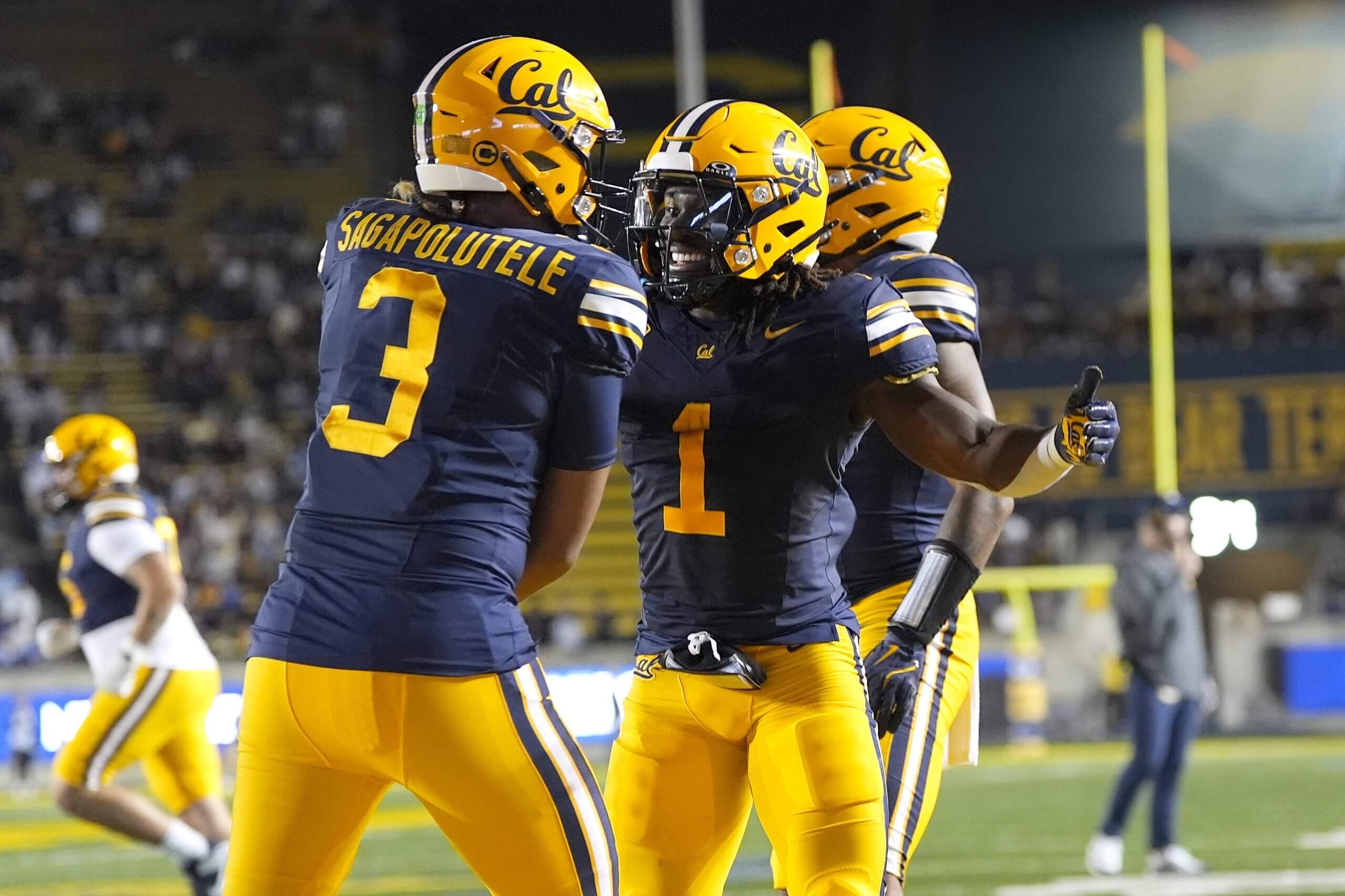
Freshman phenom quarterback Jaron-Keawe Sagapolutele (3) has said he wants to stay with the middling Bears, despite being a hot target for schools looking for a quarterback. (Thearon W. Henderson/Getty Images)
On one of the most-trafficked college football threads on Reddit, a user posted Cal’s announcement last December that it had hired former Boise State and Auburn head coach Bryan Harsin as offensive coordinator.
“better delete that pinned tweet buddy if you want to last there,” wrote one commenter.
The pinned post on platform X is Harsin congratulating Donald Trump on his election night victory in 2024. Outside of reposts from Cal’s main account or other assistant coaches this year, Harsin has also reposted conspiracy theories regarding the COVID-19 vaccine.
The idea of a staunchly conservative coach calling plays for the football team in Berkeley is certainly quixotic. Wilcox also hired former Washington State coach Nick Rolovich, who was fired in 2021 after his refusal to take the COVID-19 vaccine, which at the time was mandated by the state of Washington.
Nick Rolovich asked a question and the “whirlwind” of the last few days is referenced.
“I’ve had bigger whirlwinds.”@CalBearsOn3
— Matt Moreno (@MattRMoreno) November 25, 2025
Rolovich, who was a senior offensive assistant on staff, was named interim head coach for Cal’s regular-season finale against SMU after Wilcox’s firing. Rolovich routinely shouts out the Calgorithm on his X account.
Calgorithm, never underestimate your power in recruiting. Mike Leachesque witty creativeness, the under appreciated humor of the Bay, and a Golden Bear Soul. The battle has just begun, yet the fun continues. Carry on. You are appreciated.
— Nick Rolovich (@NickRolovich) June 4, 2025
Harsin and Rolovich — both candidates to succeed Wilcox full-time — declined multiple interview requests from The Athletic for this story. Rather than browbeating the odd cultural fit of two qualified football coaches with the large portion of the fan base, leaders at Cal are using these current examples to further dispel the perception that Berkeley is only for those on the left or far-left, or that different beliefs aren’t an automatic barrier between people. One of Lyons’ priorities after taking over as chancellor was to challenge the “caricature of Berkeley.”
“Every institution wants to be understood for what it really is and what it stands for,” Lyons said. “Some of the caricatures are lines written 60 years ago, if not before that. It’s just not up to date. It’s not who we are, right? Berkeley has evolved a lot.”
The week Rivera was hired, New York Times opinion columnist Bret Stephens wrote that universities like Cal are “essentially factories for Maoist cadres” taught by exclusively left-leaning professors. Lyons retort to such claims that Cal only produces anti-American anarchists or anti-capitalist zealots is that the university was ranked No. 1 in the country in newly funded venture-backed businesses in 2025.
Berkeley is many things, Lyons proclaims, chief among them a place that allows people to be themselves and speak for themselves. Turning Point USA, the conservative group funded by the late political activist Charlie Kirk, arrived on campus last week for an event that had over 900 participants.
The birthplace of the Free Speech movement was, once again, under the microscope as an estimated 150 protestors gathered to challenge the event. In October, a UC Berkeley computer science lecturer went on a 38-day hunger strike in solidarity with Palestine.
“When people say, ‘What is the most distinguishing thing about Berkeley to you?’ For me, it’s that Berkeley grabs you by the shirt or the coat and it shakes you and it says, ‘You have more degrees of freedom to live your life than you realize. Now go use them,’” Lyons said. “It’s a tolerance for different views and different ways of living.”
Rivera said outsiders who haven’t experienced life in Berkeley don’t truly appreciate it for what it can offer.
“This is a safe space,” Rivera said. “You should be able to come to this campus and speak about the truth. But the only problem with the truth is, there are three versions: yours, theirs and somewhere in between. We have to keep an open mind. We have to continue to do that.”
When broached with the topic of having multiple coaches on staff who are outspoken with their own political views, Rivera said, once again, that here everyone can think for themselves.
“Shouldn’t they be able to?” he said. “That’s what I wish people would understand. Everybody’s entitled to their opinion. It doesn’t mean they’re right or wrong. That’s just their opinion.”
Kranz acknowledges that Cal, for better or worse, is a very political place. And he was able to view these hirings through the lens of what his alma mater represents: The power to speak one’s mind.
“Does the wide campus community align with those beliefs? Absolutely not, but we’re going to separate out your job from your opinions,” Kranz said. “There was no real campaign that these guys shouldn’t be here, or they shouldn’t be hired. It was like, ‘OK, they’re hired. That’s fine. I’m going to tell you how I feel about their opinions. Because I’ve got my free speech to tell them how dumb I think they are.’ But they’re still allowed to be here. I’m not going to campaign for them to be fired.”
Rivera declares that results, not differing views, will ultimately determine whether or not Cal football gets Memorial Stadium more than half-full for the next highly ranked opponent coming to town. Results will further galvanize fans and stimulate involvement from the community of Berkeley.
“Sports,” Rivera said, “are the doorstep to everything.”
Case in point: Before he walked to the Chancellor’s box when Cal hosted Virginia, Lyons was approached by a stranger who handed him a gift. It was a small sticker. It’s of Lyons grinning while riding a bike. There’s an old blue plastic milk crate attached to the front of the bike. Inside the crate is Oski, Cal’s always-grinning oval-faced bear mascot, draped in a blanket.
An homage to the movie, “E.T. the Extra-Terrestrial,” it also could be interpreted as a metaphor for where this unique fan base in this unique place believes it can soar: to new, previously unreached heights with Lyons — a staunch advocate for Cal football since taking over in 2024 — aiding in its hopeful take off.
The fan did not give their name.
“A member,” Lyons said, “of the Calgorithm.”