
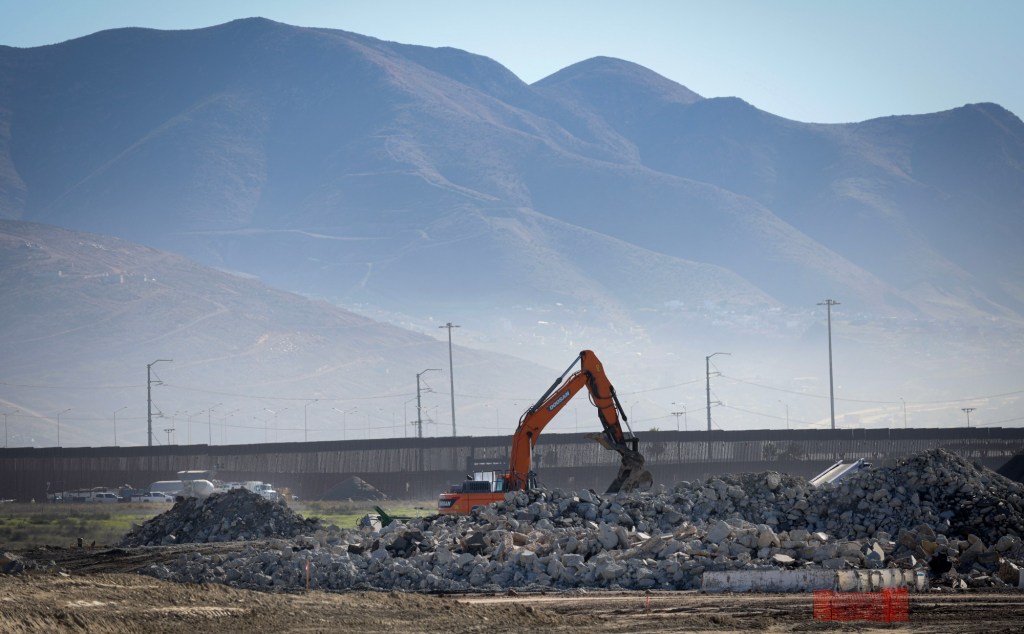
Dozens of trucks drive daily into a 120-acre construction site in eastern Otay Mesa, each loaded with rubble taken from several demolition projects throughout the region — including the old Terminal 1 at San Diego International Airport.
Concrete and other materials are being crushed on-site to build the base for the Otay Mesa East border crossing facility. The long-awaited port of entry is expected to process thousands of passenger vehicles and commercial trucks a day when it opens.
The use of recycled materials is expected to save the project about $500,000, according to María Rodríguez Molina, director of mega projects, border and goods movement with the San Diego Association of Governments, or SANDAG. The agency is sponsoring the project alongside Caltrans.
“We’re always looking at ways to save cost and time, and it’s always good to recycle material that you’re already demolishing in other sites and bringing it here,” she said.
Rodríguez Molina said it was “great timing” that the demolition at Terminal 1 is happening around the same time when the materials are needed.
The demolition of the old terminal started shortly after the new Terminal 1 opened in late September, while the construction of the port of entry facility kicked off on Nov. 3. “That worked perfectly for us,” she said.
Materials from the old terminal are diverted from landfills by being sent to recycling yards, a spokesperson with the San Diego International Airport said.
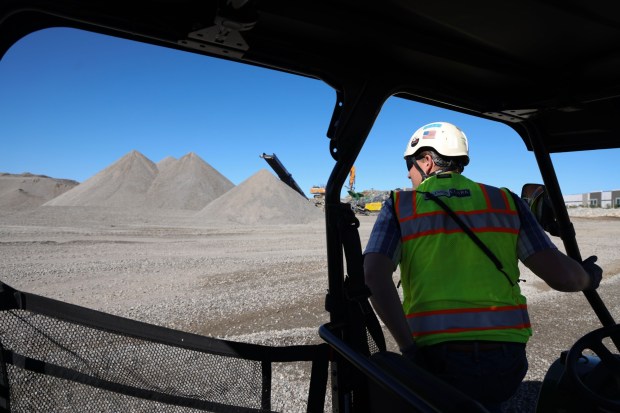 Recycled materials obtained from the demolition of San Diego International Airport’s old Terminal 1 are being used to build the new Otay Mesa East Port of Entry. (Sandy Huffaker / For The San Diego Union-Tribune)
A representative from a construction company involved in the Otay Mesa project confirmed this week that the main source of the materials is the old terminal.
Rodríguez Molina said she estimated that about 100,000 cubic yards in demolition waste will be sent to the Otay Mesa construction site to be recycled in the next three to four months.
“That gets taken throughout the site in the locations for the new buildings,” she said. “Water gets added, it gets very compacted, and that’s the new base for the buildings.”
The new port of entry, a project more than 20 years in the making to reduce wait times along the border, is now expected to open in 2028.
From a distance, part of the facilities forming the Mexican side of the port of entry are already visible behind the U.S.-Mexico border fence.
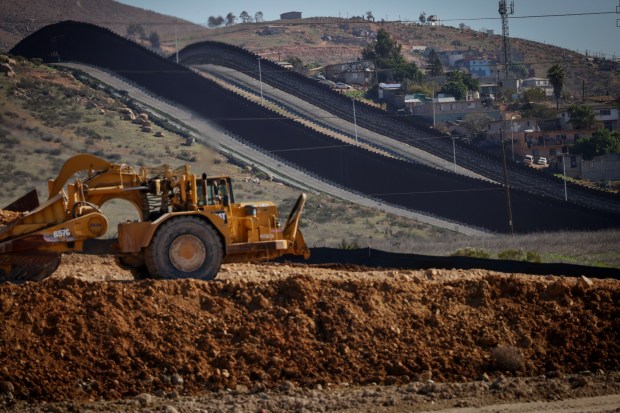 Construction is under way at the Otay Mesa East Port of Entry Tuesday. (Sandy Huffaker / For The San Diego Union-Tribune)
Mexico has invested $356 million as part of the project, Mexican officials previously said. Work on the Tijuana side is nearing completion.
On the U.S. side, the project has experienced delays amid negotiations with the federal government, which will operate the port of entry. Key agreements were announced in the summer with both the Mexican and U.S. federal governments, making it possible to proceed with construction.
“It took many years and many agreements to get us to this point,” Rodríguez Molina said on Tuesday while standing at the construction site.
The $1.3 billion project included the construction of state Route 11. Other roads and freeway connectors in the area followed.
The next stage of the project is funded in part by $150 million from the Infrastructure for Rebuilding America, or INFRA, grant, $192 million from California’s Trade Corridor Enhancement Program, and $15 million in local funds. SANDAG is expected to fund the remaining $271 million through bonds.
“Those bonds will be paid back with the tolls that we’ll be collecting in the future, so it’s a project that partially pays for itself,” Rodríguez Molina said.
Different from existing vehicle ports of entry between San Diego and Mexico, the Otay Mesa East crossing will require a toll in exchange for faster crossing times into the U.S. The revenue will be split between the U.S. and Mexico.
“We’ll be using dynamic tolling to manage the length of the queue, so we’ll be able to guarantee a 20- to 30-minute average wait time at this port of entry,” she said.
The initial design of the Otay Mesa East facility accommodates five lanes for commercial trucks and seven for passenger vehicles. The facility will be able to handle about 12,000 cars and 1,500 trucks per day.