
Will the boom in artificial intelligence become as transformative as the internet, or will it go poof in a stock market crash like the dot-com frenzy?
Or is something else far different in store?
Universities from San Diego to Boston are reeling, unsure how to best handle one of the most disruptive and confusing moments in the history of higher education.
Many Wall Street experts say the AI surge could shatter. But the mere potential of AI’s computing power has companies pressing universities to reshape their curricula so they can train students and upskill people already in the workplace.
A cautious but robust response is unfolding in San Diego County, a science mecca whose colleges and universities serve more than 200,000 students, including many working adults.
Their emerging programs could eventually do such things as help air traffic controllers keep planes safe, enable CT scan technicians to take better images, and make it easier for financial analysts to spot fraud.
Point Loma Nazarene University has already opened a lab whose AI-enhanced biomechanics tools are helping the San Diego Padres study the performance of their pitchers. Southwestern College is rolling out a class that will teach students to use AI to help software engineers recover from cyberattacks. And California State University San Marcos is teaching students how to monitor equipment on huge wind farms.
“Qualcomm told us that every one of our engineers and computer science students should have some kind of AI minor or certificate on their transcript to show they really understand the AI world,” said Jackie Trischman, dean of science, technology, engineering and mathematics at Cal State San Marcos.
This is a stress test for academia, which is accustomed to moving slowly, especially when it comes to changing its curriculum to accommodate emerging technologies.
Larry Smarr, an emeritus computer scientist at the University of California San Diego who played a key role in getting the government to place supercomputer centers on campuses in the 1980s, suggests that faculty pause, exhale, then embrace the change they face.
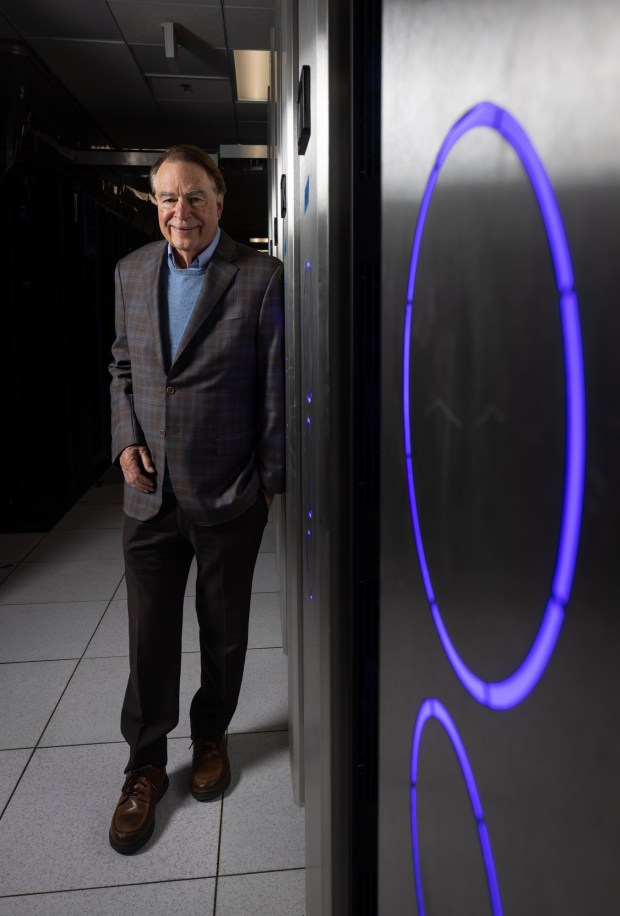 UC San Diego professor Larry Smarr in the San Diego Super Computer Center on Nov. 19 in La Jolla. (Ana Ramirez / The San Diego Union-Tribune)
“This moment reminds me of when I floated down the Colorado River in a big rubber raft with other people,” said Smarr, 77. “We saw violent rapids ahead. There was a 10-foot to 15-foot wave we had to go through.
“I thought we were going to capsize. We didn’t. We ended up in very calm waters.
“People shouldn’t be afraid of AI. Change is chaotic,” he said. “But this one is not hard to use. It’s a personal assistant that could lead to the biggest increase in productivity ever.”
Smarr is among the scientists who help promote an important innovation at UC San Diego.
About five years ago, the school’s supercomputer center began offering AI tools to students and faculty across all disciplines. The program started small. By last year’s spring quarter, 6,000 students across all disciplines were using AI tools in 60 courses.
They used AI to analyze enormous data sets in areas such as engineering, physics, astronomy, biology and sociology.
Universities aren’t going it alone. They’re forming alliances so they can collectively train AI-savvy workers.
One of the newest is the San Diego Cyber Clinic, which includes Cal State San Marcos, National University, San Diego State University and the Cyber Center of Excellence.
The clinic says it is teaching students cybersecurity and AI so they can help protect businesses, hospitals, schools and energy grids from attack — skills in high demand. There are currently about 5,000 cybersecurity job openings in the San Diego area. The clinic was created last year with a $1 million grant from Google.
The clinic is also addressing a major problem — scientific literacy.
The Union-Tribune interviewed a dozen local educators, many who said that — beyond the casual use of ChatGPT — a lot of students and much of the general public aren’t sure what AI is, how the tools are used, and which jobs are likely to require significant AI skills.
Lots of worries also surfaced last year in a Pew Research Center survey of nearly 5,300 employed U.S. adults. Slightly more than half of them said they were more worried than hopeful about the future of AI use in the workplace.
Southwestern College in Chula Vista recognizes the problem and has begun talking to UC San Diego, San Diego State and Cal State San Marcos about the AI features that will be incorporated in the bachelor’s-level programs that the schools will begin teaching at the community college next year.
Southwestern is also hoping to recruit other highly reputable schools, including the University of San Diego, which is developing a large presence in AI. The private Catholic university already has an online Master of Science in Applied Artificial Intelligence program.
Difficult days lie ahead, and they’ll be especially bleak if AI doesn’t, over time, create as many jobs as it eliminates.
“New technologies cause realignment in the economy, which can be very painful for some people,” said Steven Swanson, chair of the department of computer science and engineering at UC San Diego.
“They often require us to have moments of moral courage.”
A blunt reality was offered by Michelle Fischthal, vice chancellor of institutional innovation and effectiveness in the San Diego Community College District.
“AI is not going to take away your job,” she said. “It will be done by the people who know how to use it.”