
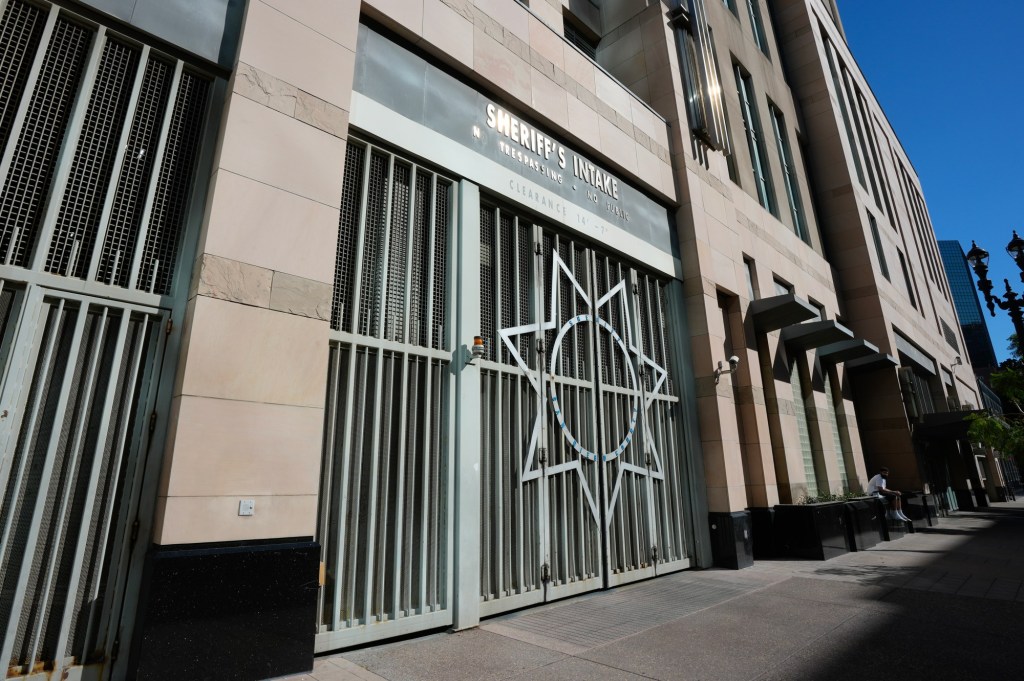
When someone dies in a San Diego County jail, the public typically learns only the basics: a name, an age, the charges that brought the person into custody and, months later, the medical examiner’s official determination of their cause of death.
Unless a family files a lawsuit, rules governing the release of medical information make it nearly impossible for most people to know whether a person showed signs of illness or received adequate care, and whether their death could have been prevented.
The death of 82-year-old Karim Talib earlier this year shows why the public needs answers to these questions.
Talib died on July 28 inside the San Diego Central Jail. An initial press release from the Sheriff’s Office acknowledged the death but offered few details. His next of kin could ask the Sheriff’s Office for his medical records, but my colleague Jeff McDonald and I tried unsuccessfully to find Talib’s family.
The county is facing a class-action lawsuit over jail conditions, and an attorney in that case was able to gather sworn declarations from three men in cells near Talib who said they watched him decline in the days before his death.
Getting such information so quickly is exceptionally rare in a jail-death case.
One of the men, Maurice Vasquez, told the attorney Talib arrived in a wheelchair and appeared confused. He was wearing only a shirt and a diaper.
“The day after Mr. Talib entered Unit 7/E, the entire unit began to smell like feces,” Vasquez wrote.
People in nearby cells yelled to deputies that Talib needed help. According to their accounts, he lay in his own waste, barely moved and did not respond when spoken to.
“Once I was in the dayroom, I went to Mr. Talib’s cell and observed him lying down with his eyes open and his diaper filled with fecal matter,” Vasquez wrote. “Mr. Talib looked like he was dead.”
Another man, Larry Lightning, said he watched staff wheel Talib out of his cell “with feces on his shirt, diaper and his wheelchair” so the cell could be cleaned by incarcerated workers. When he was returned, “it appeared that Mr. Talib had not been given a shower or otherwise cleaned while he was out of his cell,” Lightning wrote.
Last week, the Medical Examiner’s Office released its findings: Talib died from heart disease complicated by a bacterial infection that had spread to his kidney.
The autopsy report notes he had been transported repeatedly between the hospital and the Central Jail. Court records show his attorney believed he was not mentally competent to stand trial.
Lightning wrote that two days before Talib died, he overheard a nurse mention that Talib had been in the jail’s medical unit before he was moved into administrative separation, a housing status akin to solitary confinement.
“I found this alarming,” Lightning wrote. “I had previously been housed in a medical unit at Central Jail, and in my experience a medical unit has staff that could have given Mr. Talib help that he was not getting in AdSep.”
Lightning said he never saw anyone change Talib’s diaper. Mental health staff attempted to speak to him but he never responded.
“Because Mr. Talib had not been speaking to anyone while he was in AdSep, I was concerned that staff would not know whether anything was wrong with him,” Lightning wrote.
I’ve reported on deaths in the county’s jails for more than a dozen years and have read more than 250 autopsy reports during that time. Some offer detailed, careful narratives of the circumstance surrounding a death. Others offer only the barest outline. Talib’s falls into the latter category.
But a medical examiner’s job is narrow: determine the medical cause and manner of death. Talib’s report describes the extent of the infection, the type of bacteria that caused it, the damage to his kidney and how it interacted with his heart disease.
Unless it’s clear that neglect directly caused a death, it’s not the medical examiner’s role to say how Talib developed the infection, whether jail conditions contributed to it, whether staff overlooked warning signs or whether he received appropriate care.
And a 2017 state law complicated what information could be publicly available in an autopsy report.
The legislation, AB 2119, was initially intended to help medical examiners obtain psychiatric records after a death. But it was amended late in the legislative process to say that any medical information obtained by a medical examiner is confidential and cannot be disclosed.
Prior to that law, autopsy reports often provided a more complete picture of facts surrounding a death.
Ruben Nunez’s autopsy report, released nearly a year after his July 2015 death, said that at Patton State Hospital, he had been diagnosed with “psychogenic water intoxication,” a psychiatric condition that caused him to drink water uncontrollably. His water intake at Patton had been closely monitored.
Days after he was transferred to the Central Jail for a court hearing, he died from water intoxication.
If his autopsy were released today, information about his medical history would have been redacted.
Separately, the Sheriff’s Office can withhold information under the California Public Records Act’s investigative exemption. Once a jail death is labeled an active investigation — whether by homicide detectives or internal affairs — the department can block release of relevant non-medical records: surveillance video, cell-check logs, incident reports, interviews with people in nearby cells.
The exemption is optional, not mandatory — a requestor can argue that releasing records is in the public interest. But in practice, it functions as a shield. Records remain sealed for months or years, long after any real investigative need has passed.
A new development could change some of this. As of Nov. 1, the county’s Citizens’ Law Enforcement Review Board has authority to review medical care in jail deaths, a significant expansion of oversight powers. But that new authority doesn’t apply to deaths CLERB is currently investigating, like Talib’s, and it’s yet to be seen how CLERB investigators will present medical findings.
In prisons and jails, a person’s care is entirely in the hands of the institution. When someone dies in custody, the public deserves to know whether their environment contributed to their death.
In Talib’s case, witnesses described a man in visible distress, unable to care for himself and seemingly ignored.
The autopsy confirms the medical consequences of that decline. But the circumstances leading to those findings — what staff saw, what care he received, why he was moved out of the jail’s medical unit — remain unknown.
State law could be clarified to allow medical examiners to include their own summaries of care without releasing raw medical records. Law enforcement agencies could choose to release investigative files once initial fact-finding is complete, rather than months or years later.
None of these changes would violate personal privacy. What they would do is give the public and lawmakers a better understanding of the level of care people receive in government custody.
Karim Talib’s death shows why that matters. An autopsy can tell us what killed him. It should tell the public whether his death could have been prevented.