
We work for you — and we’re matching your donation 1:1! Our journalists attend city council and school board meetings, follow tips and make the calls to keep you informed on the important issues in Berkeley. Will you chip in today?
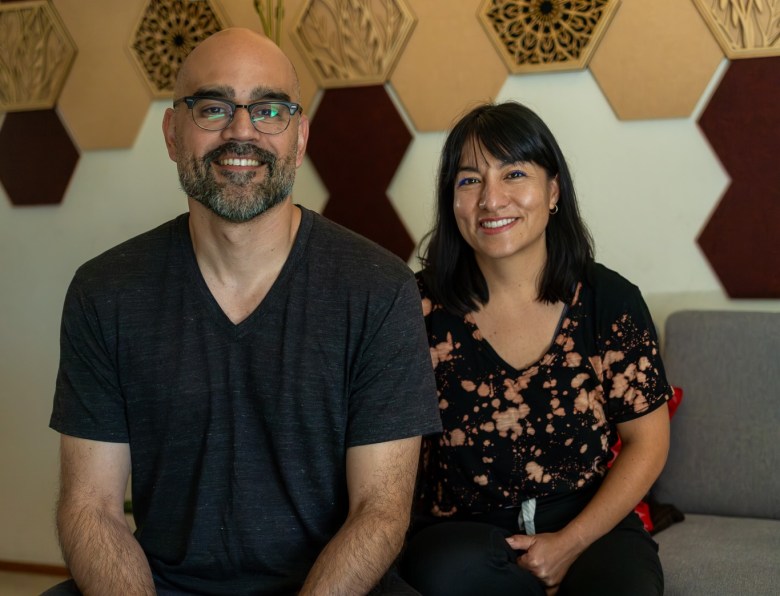 Marco Casasola and Cristina Ibarra at their home in South Berkeley. Credit: Sara Martin/Berkeleyside
As told to Nathan Slavik, and lightly edited for length and clarity.
Amplify Berkeley is our new series featuring stories told by Berkeley residents in their own words. Got a story to tell? Let us know.
Marco Casasola: I grew up in L.A. My brother and sister are both older than me and got into Cal. So once I got in, my parents were like, “You’re going to UC Berkeley.” So I didn’t really have a choice and moved here in 2000.
The thing that carved a path for me was the UC Berkeley music department. The practice rooms were also being used by a program called the Young Musicians Program (YMP) that taught local kids. Since I was in that practice room all the time, I met teachers who were also gigging musicians in the area. I started playing with them and slowly started doing gigs.
The Cheese Board was my first gig, playing piano. And then I got connected to the jazz community, the music scene, and I became very enamored with the people and the scene and the style.
Berkeley, and South Berkeley especially, has a long and in-depth history of music. The Ephesian Church of God in Christ is right here on Alcatraz. The famous Hawkins family — which included siblings Edwin, Walter and Lynette Hawkins, among others — were members there and that’s where that gospel scene was born. Their music has received national acclaim and is still played today at churches throughout the whole Bay Area.
Also, for blues and R&B, down the street is Johnny Talbot. When Sly Stone was a radio disc jockey in the Bay Area, he would play Johnny Talbot records. A big part of Sly’s sound comes from him listening to Johnny Talbot: that heavy funky guitar style of playing.

One of the teachers I met in the Young Musicians Program, Darrell Green, said, “I should hook you up with Faye Carol.” She moved to the East Bay from Mississippi and used to play with Johnny Talbot’s band.
Faye told me that before they put in the BART tracks, all of MLK was night clubs and they were gigging every night of the week. Then they built the BART, and that basically closed down all those venues, so that whole scene dried up.
She needed a piano player, and I studied under Faye and played for her from about 2005-2013. She had a program called Music in the Community at the Black Repertory Group Theater for kids after school. I was the piano accompanist for the program for many years, as well.
One of the kids that was showing up said, “Our church needs a piano player, you should come.” That’s how I got introduced into the Church of God in Christ denomination. I started playing with them and saw how deep the church scene was. I decided I wanted to be a church musician and learn the organ.
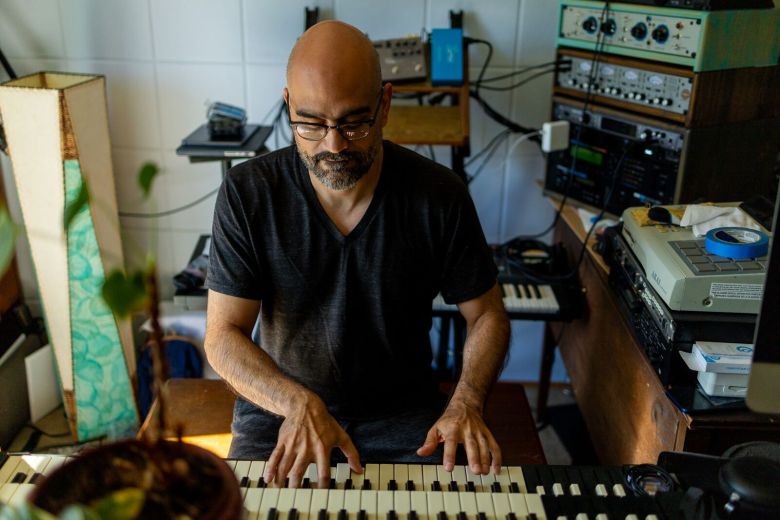 Marco Casasola found his musical community in South Berkeley after moving to the city from L.A. to attend school in 2000. Credit: Sara Martin/Berkeleyside
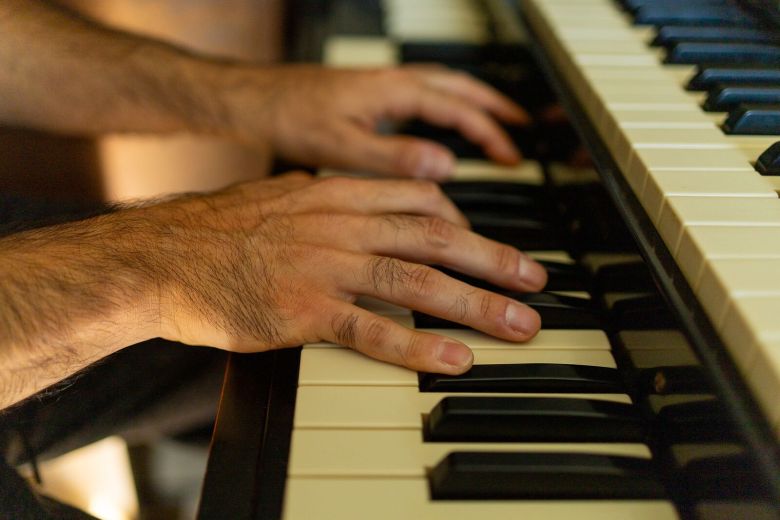 Casasola plays at his home studio in South Berkeley. Credit: Sara Martin/Berkeleyside Credit: Sara Martin
I’ve grown so much learning from others, especially in the church scene. There are so many great organ players that I could stay here for the rest of my life and still be learning. These people are second- and third-generation musicians. Their parents played these instruments. They’ve been doing this since birth. They’re just living and breathing the music.
It might not be as big as L.A. or New York in terms of the amount of people, but the Bay Area is still a musical powerhouse. Nonetheless, the impression I get is that the music scene’s not what it once was. A lot of musicians that grew up here in Berkeley and the greater Bay Area have moved away. But they take this Bay Area sound with them, and it’s really beautiful to hear how this local sound is permeating the world in so many creative ways.
It’s so beautiful how you can hear someone play and tell that, “Oh, they’re from Oakland.” Or someone starts playing at a different church, and you say, “They are starting to sound very ACTS Full Gospel.” It’s really a testament to how many different pockets of sound there are here in such a relatively small amount of space.
Another great place is Missionary Church of God in Christ on Allston Way. It’s a small church but has a rich tradition. The pastor, Cornel Wheeler, is brothers with Carl Wheeler, a legendary organ player who plays for tons of artists like Frankie Beverly & Maze, and Tony Toni Toné. He’ll play organ for their services along with other anointed musicians, younger and older.

Back in 2004, another musician, Eric, asked if I wanted to become roommates. We looked for a place, found this South Berkeley apartment near Ashby BART, and moved in. Rent was just $860. It’s gone up somewhat since then, but the rent control really helped keep it to what I think is a fair price. My roommate stayed for maybe seven years before he moved out, and I stayed because I was very content.
South Berkeley feels like home. The first place I ever played at was The Firehouse across the street from the Black Repertory Group theater on Adeline Street. I think right now it’s an art studio that sometimes has live music events. But back then, jazz jam sessions were hosted there. Walking by there always brings up those early days.
Later, Rasa Caffe opened up at that same spot on Adeline. I got to meet the owner who also grew up in South Berkeley. I feel like it’s the personalities that make this place special, and he’s a good example. For years we would never interact. And then finally we really talked and he was so weird and friendly — and I mean weird in the best way.
There are so many people here who are on their own vibration; very unique. They have this creative energy and just give off this spark of artistry. Maybe in L.A or somewhere else that would be frowned on, but here it’s normal. It’s awesome.
When I started dating Cristina and she moved in — she’s the much more social person — she’d be like, “Oh, I talked to James,” and I’d say, “Who’s James?” He lives right here in this building; we’ve lived next to each other for years, but we never talked. And then suddenly there was this whole energy chain of people saying hi. The energy has really shifted and everyone’s talking more.
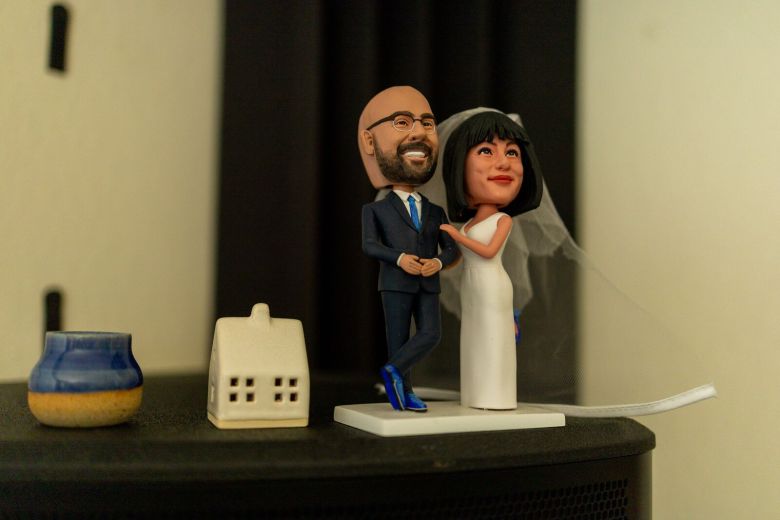 Marco Casasola and Cristina Ibarra enjoy many things about living in South Berkeley. But the couple has felt discouraged by the cost of homes. Credit: Sara Martin / Berkeleyside
Cristina Ibarra: We started dating almost 15 years ago. I used to joke that I lived on BART, because I was living in the Mission in San Francisco. Then I moved in here with Marco a few years ago.
One of our favorite things to do is just walk around the neighborhoods. It’s like walking through a botanical garden because everybody’s front yards are just so beautiful and so quirky. Everybody has a little library. It’s a very Berkeley aesthetic to look like the garden is wild, but actually, they put a lot of work into making it look like it’s totally not a lot of work. I’m a gardener so I just love all of that, and I love all the little tchotchkes and fairy doors that people have in their houses.
You could walk around the neighborhood forever and find a new story every day.” – Cristina Ibarra, South Berkeley resident
You could walk around the neighborhoods forever and find a new story every day. There are people who walk around and will talk to you about the future of AI, or the original Free Speech Movement, all in the same place. To me that’s what makes this place so special. There are these beautifully kept spaces where people can just discover — and discover each other, too.
Marco: There’s a big misconception about Berkeley, that there’s this unified progressive front — and it’s not like that. In some ways that’s good, but it also makes things more difficult. We have all these opinions and all these passionate people that can make working together slow.
For example, I got called to play music at the Cheese Board. I hadn’t played there in a long time and so I was excited, and I was biking over there. I was going down Milvia Street, which has a bike lane. They have these 2-inch-tall cement barriers sticking out on the bike lane. Leaves covering it made them hard to see, so my bike clipped it and I went flying into the air like Superman.
It made me want to complain to the city. They’re trying to do this good thing, to protect bikers, but it turns into this American Ninja Warrior obstacle course. I was pretty mad, but once I calmed down, I realized this is a good thing. Berkeley is trying out these new ideas, and then obviously the ideas need work or just need some fine-tuning. It feels like a metaphor: In Berkeley there are often the best of intentions, and then there are always unintended consequences.
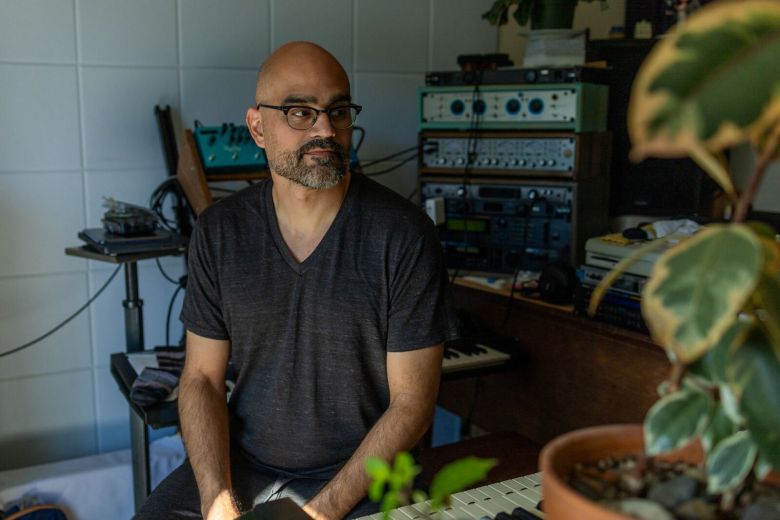 Marco Casasola at home in South Berkeley. Credit: Sara Martin / Berkeleyside
Cristina: Also a challenge is home ownership. We love this place. Marco’s been here for over 20 years, and I’ve been back and forth for the past 15. This location is amazing. There’s a park, there’s a library, there’s Berkeley Bowl, there’s the Thai Temple. This is home, but it’s just impossible to find anything remotely affordable. So we’ve been discouraged from that.
Some of the same things that make Berkeley wonderful are making it so new people can’t contribute to the city, can’t find a place here to put down roots, can’t find room to grow.
If people can’t have their kids and their grandkids here and put down roots on that level, it’s really tough. I was on the Civic Arts Commission for two years and learned about how it took years to get artists included as part of the city’s affordable housing plans, and it’s going to be another 10 years before any of those things come to pass.
It’s kind of indicative of what Marco’s saying, that things happen very slowly because there are so many stakeholders. So it’s a hopeful thing, but it’s also a hard thing to realize that in Berkeley you are working for change that you might not see.
… We have a small favor to ask.
We work for you to provide free and independent journalism covering the stories that matter most in Berkeley. And we rely on readers like you to make our work possible. That’s why we’re asking you to contribute to our year-end membership campaign today. We’ve set a goal to raise $180,000 by Dec. 31 and we’re counting on readers like you to help get us there.
Your support will enable us to continue doing the work for you and our community to provide the reporting Berkeley needs. So, what do you say, will you join us in doing the work?
“*” indicates required fields