
For the first time since the San José galleon sank beneath the Caribbean more than three centuries ago, a set of carefully selected artifacts has been brought to the surface, giving a clearer window into one of the most fabled shipwrecks in the Americas. The pieces were uncovered during the second phase of Colombia’s ongoing research program and were unveiled for the first time on November 19, 2025, in Cartagena.
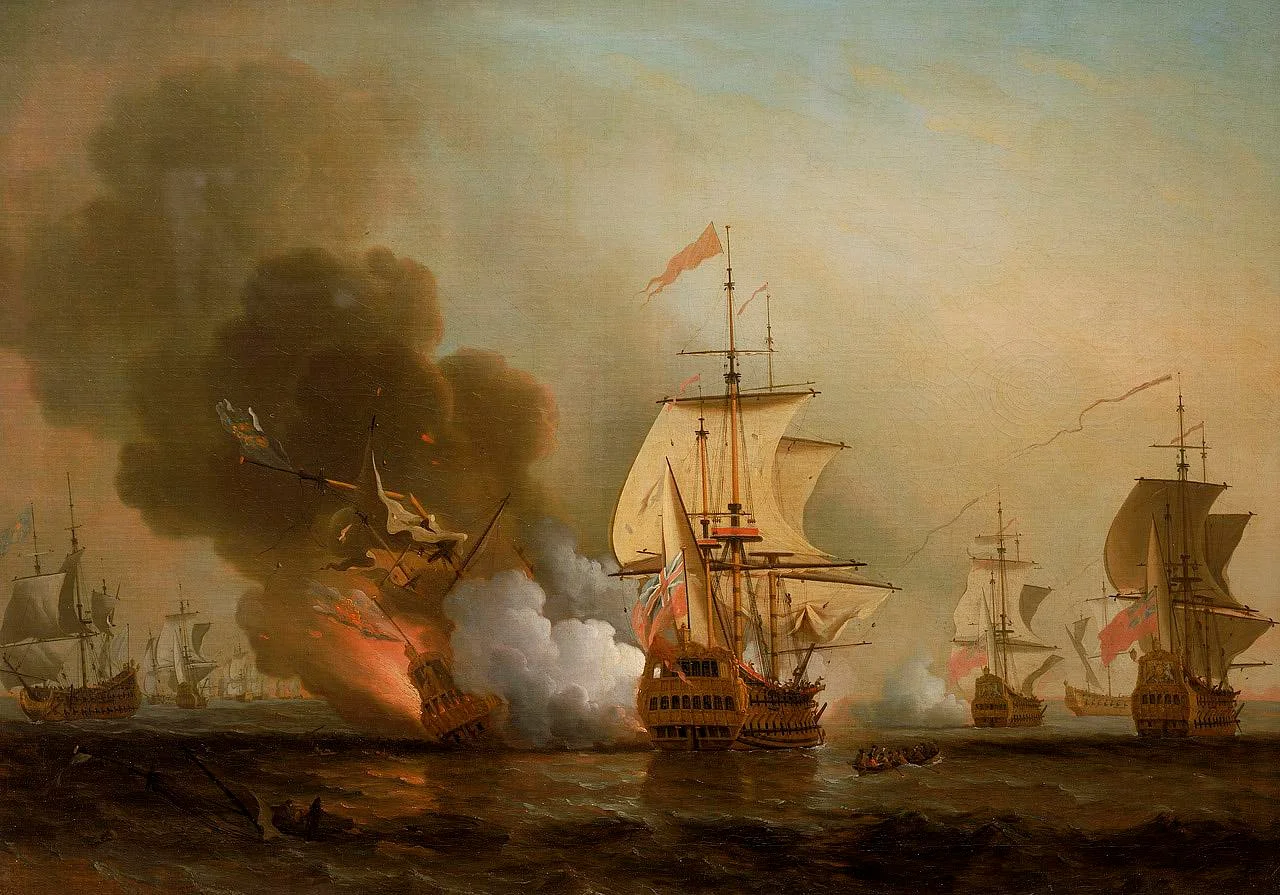 The Spanish galleon San José sank in the Caribbean in 1708 after a battle with British forces. Credit: Samuel Scott (1702–1772), Public Domain.
The San José was a 62-gun Spanish warship that sank in a battle with British forces in 1708 while leading a treasure fleet bound for Europe, carrying immense wealth from South America. Along with its estimated 200 tons of precious metals and gems, about 600 people lost their lives in that disaster. Discovered only in 2015 at a depth of about 600 meters, this site has become one of the most coveted archaeological sites due to its remarkable preservation.
The long-term project, Toward the Heart of the San José Galleon, first conducted a non-intrusive study to map the location of scattered artifacts and structural remains lying on the seafloor. This first phase confirmed that, despite the fame and intense international interest, the site remains undisturbed. The second phase focuses on direct analysis that requires the thorough recovery of the objects so that they can be stabilized and examined under controlled conditions.
The newly presented finds include a bronze cannon, a porcelain cup, three coins, and fragments of porcelain and sediment tied to these items. They were lifted using remotely operated equipment deployed from Colombian Navy vessels. In an effort to prevent deterioration, each object was quickly secured: the cannon was cooled in a refrigerated container, while the coins and ceramic pieces were placed in saltwater before beginning a long conservation process at the Caribbean Oceanographic and Hydrographic Research Center.
These pieces were selected by researchers based on strict scientific criteria, prioritizing durable materials like ceramics and metal, chosen to best support laboratory studies. Such analyses will contribute to establishing the composition, techniques of manufacture, provenance, and chronology of the artifacts. They may also offer new information on trade routes, shipboard life, and even the cause of the San José’s sinking, a topic that has long been debated.
Recovery and study of these objects should help the team delve deeper into history and lay the groundwork for future public exhibitions.
More information: Colombian Ministry of Culture