
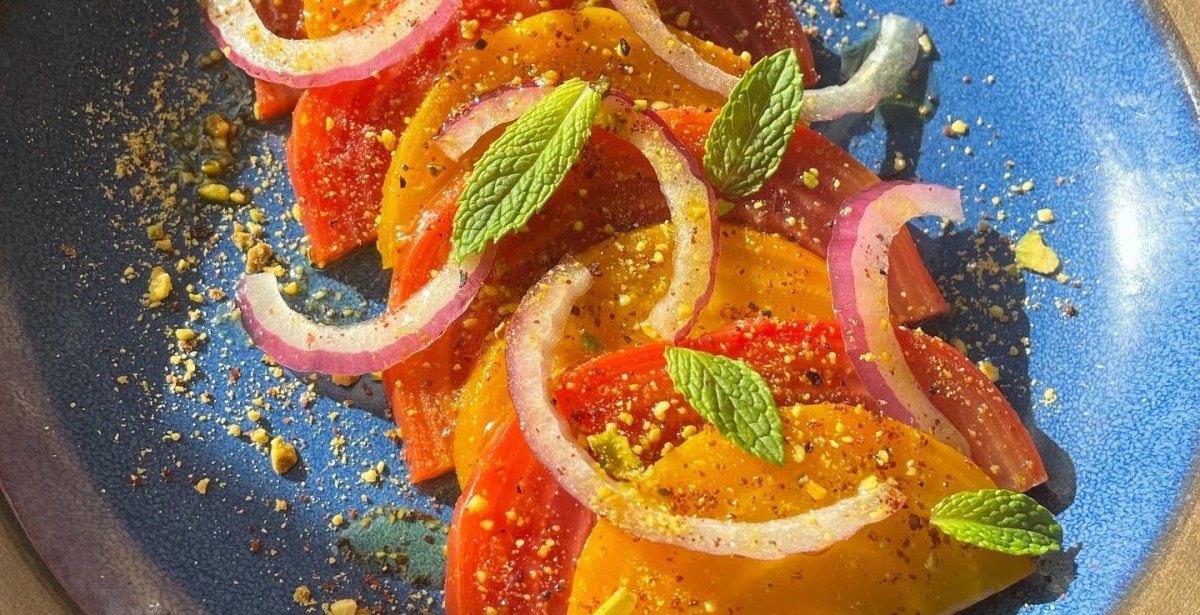
One of San Francisco’s most elegant waterfront restaurants quietly doubles as a beachhead of vegetarian cooking. Greens occupies a proud, many-windowed cathedral in Fort Mason, and chef Katie Reicher has helmed the kitchen here for a decade. She says she’s kept the ship sailing with lots of collab dinners, bringing in new-school pros like Lion Dance Cafe and the ever-popular Mister Jiu’s, serving food people really want to eat — vegetarian or not. “Vegetarian cuisine has never been more complex, never been more well-understood in the mainstream,” she says, “even despite all this crazy carnivore, MAHA, whatever the heck is going on in the world.”
She’s pointing to how the Bay Area’s relationship to vegetarian cooking — the whole world’s, really — has changed. In April, New York Times reported that Americans are no longer trying to eat less meat, citing a Cargill report that diners in the U.S. ate 7 percent more meat in 2024 than pre-pandemic levels. Then in August, three-Michelin-starred Eleven Madison Park ditched its fully vegan (or rather secret meat) approach to let “everyone participate around the table” — confusing messaging, as vegetarian cooking was, for a long time, seen as a way to ensure all diners could chow down. Even fine-dining chef Jeremy Fox, once upon a time wine country’s vegetable whisperer at Ubuntu, put out the cookbook On Meat in 2025.
Vegetarian cooking is a specific relic in the library of San Francisco cuisine. Arguably the country’s love of fancy, farm-to-table, plant-forward food was born here with the San Francisco Zen Center opening Greens in 1979. This is not about plant-based cooking, the stylish rebrand of vegan cuisine that struck the industry in the late-aughts, nor vegan cooking itself, either, which as author Alicia Kennedy captures in No Meat Required was born in East Asian diasporas — outside the restaurant realm. This is about cooking that puts those adorable, colorful carrots and asparagus from the Central Valley front and center.
People have associated the Bay Area with boundary-pushing vegetarian cuisine for a long time. Journalist Jonathan Kauffman wrote a love letter to San Francisco produce in 2016 for Lucky Peach. In the ’70s, vegetarian cooking in the Bay saw lots of cream and cheese applied across the canvas as a nervousness to appeal to mainstream diners throttled the scene. In the ’90s and aughts, restaurants skipped oil as restaurants like Raw Living Foods (later known as Organica) — rated two stars by the Chronicle’s then-critic Michael Bauer in 1995 — trended toward a raw food diet.

Lion Dance Cafe served vegan dishes in Oakland. Emma K Morris
Shane Stanbridge, who alongside C-Y Chia converted S+M Vegan into Lion Dance Cafe, remembers growing up as a vegetarian in the ’90s when it was considered a passing fad. This blended into that raw era of the early 2000s, “alfalfa sprouts and whole wheat bread and hummus and generally unseasoned things,” Stanbridge says.
Stanbridge and Chia are basically PhDs in the various eras of vegetarian food. In 2025 they released a new book verifying their status, Authentic, Not Traditional. Maybe obviously, both of them agree it was the technological advances of Impossible Foods and Beyond Meat in 2016 that caused people to pause and consider if there was room for them at the meat-free table. Notably, Impossible Foods kicked off its first wave of heme-based faux meat products through restaurant marketing programs, engaging well-known chefs like David Chang and Michael Symon to hawk its beefless beef. Later came a broader wave with fast-food and casual dining chains, not typically known for their discernment when it came to ingredient provenance, rolling out Impossible patties and even meatless chicken nuggets on menus.
COVID and the fresh wave of exposés on the meat-packing industry caused a lot of people to take their dietary choices more seriously. Think tank the Good Food Institute (GSI) reported that the U.S. plant-based food retail sales hit a record $7.4 billion in 2020 — nearly $4 billion more than 2017 levels. By 2023, even Dominique Crenn was experimenting with lab-grown chicken on her menu at Bar Crenn.
But simultaneously, the market was softening for meatless alternatives as those tectonic shifts also led to the rise in skepticism of anything processed once again, what Mark Bittman calls ultra-processed foods in his book Animal, Vegetable, Junk. In a strange crossover episode, the health freaks ditched vegetarianism to head back to meat, citing institutional distrust of vegan food companies. “I think ultimately people’s regressive emotions and wanting to latch on to familiarity in the pandemic [led to this return],” Stanbridge says. “And then even post-pandemic where people are sort of revenge eating what they may have deprived themselves throughout the last five years.”
In 2024, GFI showed more modest gains in the sector — $8.1 billion in U.S. sales — which analysts attributed in part to high inflation and declining interest in plant-based products. “People kind of felt like, ‘Oh, we survived this. Now we’ve got to celebrate and treat ourselves,’” Chia says.
While some chefs are observing what they see as a backslide in vegetarian consumption, chef Pujan Sarkar, who serves vegan and vegetarian tasting menus in addition to a standard coursed meal at Tiya, thinks vegetarian cooking might just be an underappreciated antidote to higher prices in restaurants. Economic pressure shouldn’t drive people toward imported wagyu but the opposite. Further, Sarkar says he’d like to see chefs delve deeper than beef. “[The next generation of chefs] have molecular brains. They know every part of the animal,” Sarkar says. “But do they know how to pull a flower from the ground?”
The vegetarian space continues to be exciting, even if not as profitable as before. Eleven Madison may shy away from its commitments, but cooks with experience in that kitchen — the team at Superiority Burger or Wahpehpah’s Kitchen, for example — serve tons of innovative vegan dishes. The GFI’s own analysts say their data indicates more U.S. diners would eat plant-based meat if it were cheaper and tastier (shocker). Those innovations aren’t slowing down.
Reicher is hanging in through the tumult, doing what she does best: showing that vegetables can — and do — taste good, when given that loving Bay Area treatment. “Now people just want really good food. They don’t care if it’s plant-based or not.”

Greens in San Francisco. Photo By Liz Hafalia/The San Francisco Chronicle via Getty Images