
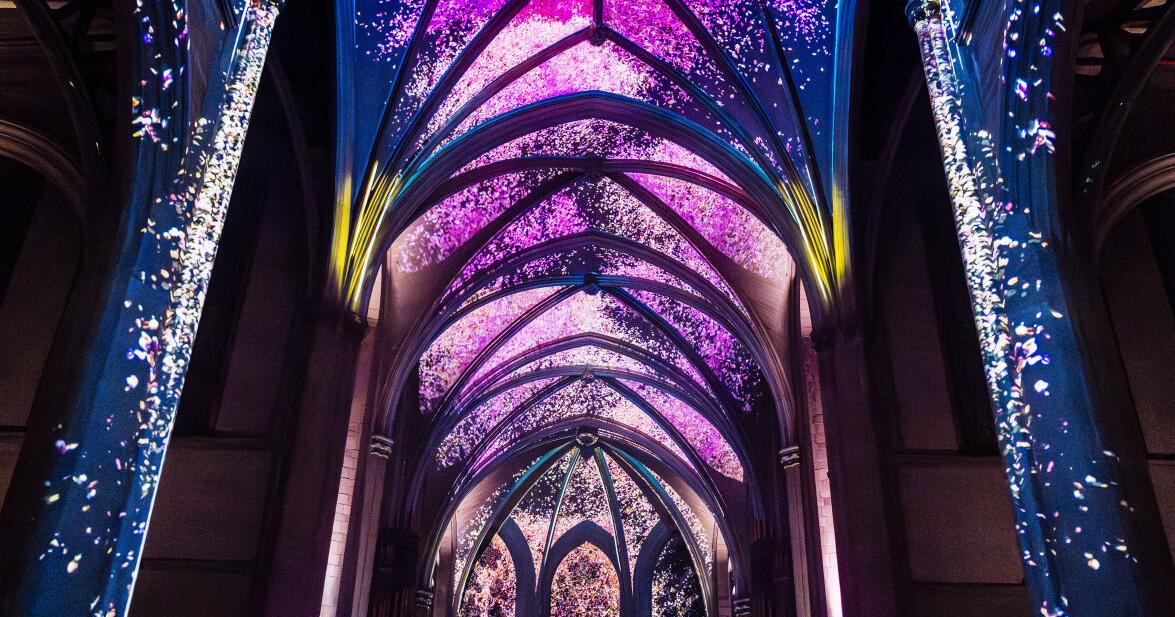

An illuminated Grace Cathedral for Midnight Mass on Christmas Eve, 2022.
Over Power Production
From its nascent days as a small, wood-frame, Gold Rush–era church near Union Square to the breadth of experiences offered from where it presides today atop Nob Hill, Grace Cathedral has been a bastion of San Francisco’s religious, cultural and social life for approaching two centuries. Most recently, Aura, a nonreligious immersive experience, opened in October at Grace, marking its only American venue. After enthralling visitors at Les Invalides in Paris and Montreal’s Basilique Notre-Dame, Aura, created by Moment Factory and copresented by Fever, has transformed the Gothic Revival cathedral into a light-filled sanctuary reverberating with captivating storytelling and music.
Grace, which celebrates its 175th anniversary in 2025, welcomes this latest experience, expected to continue for an extended period, to its extensive array of programing, which includes a traditional choir of men and boys, dynamic sermons from its historic pulpit, impactful social justice advocacy, a yearly artist in residence, weekly yoga and monthly sound bath experiences, thoughtful weekly Forum conversations with The Very Rev. Dr. Malcolm Clemens Young and an engaging guest, and a newly established, hugely popular girls choir.
The Very Rev. Dr. Malcolm Clemens Young, dean of Grace Cathedral
Melanie Duerkopp
Young, in his 10th year as dean of Grace Cathedral, recalls that one of his fondest memories is of his wife, Heidi Ho, who grew up on Maui, dancing hula at his installation as the ninth dean of Grace Cathedral. “Grace has given and continues to generate wonderful moments of joy,” says Young, “from the 1965 Duke Ellington concert, to our traditional Christmas concerts featuring the amazing choir of men and boys, to recent performances by Alonzo King [Lines Ballet] dancers, to our wonderful new girls choir — these young ladies are pioneers and their pride and joy show with every performance. These joyful moments illustrate that Grace truly is a Cathedral of courage, joy and wonder.”
At the close of this anniversary year, Grace is both celebrating an exciting future and recalling its compelling history, which springs from that Gold Rush–era chapel highlighted in the first moments of the Aura production. Going back to 1848, the year before newspaper headlines screamed “GOLD Found in California,” a group of San Francisco Episcopalians petitioned for a clergyman. The Reverend Jean Leonhard Ver Mehr, a Belgian, embarked to San Francisco from the East Coast aboard the George Washington. He arrived in September 1849 to find Trinity Episcopal Church already functioning. With the support and friendship of Trinity’s reverend, Ver Mehr organized a second Episcopal house and selected the name Grace, to accompany Trinity, in direct reference to the two major New York Episcopal churches of the time. A small “shanty,” as Ver Mehr called it, was complete by December 29, 1849.
A partially completed Grace, shown on September 29, 1955 with the orphaned north tower, which had been finished before the full nave.
San Francisco History Center of the San Francisco Public Library
By 1860, having outgrown its first, then a second slightly larger, more elaborate, wood-frame building, Grace moved uphill to the corner of California and Stockton streets. By this time, both San Francisco and the Grace congregation had grown significantly. The new church, designed by one of the City’s premiere architects, William Patton, was constructed notably of sturdy red brick. Patton, a transplanted Englishman, had emigrated to California during the Gold Rush and designed such praised San Francisco edifices as Temple Emanu-El (1866) on Sutter Street and the nearby Alcazar Theater (1885) on O’Farrell Street. Sadly, like Patton’s landmark Grace Church, which had been consecrated to overwhelming fanfare in 1862, these buildings did not survive the 1906 earthquake and fire.
After the earthquake, with so much of the City in ruins, chaos ruled. Images of post-earthquake San Francisco include the iconic view looking down California Street toward the shell of the Ferry Building, with the brick remains of both Grace Church and its downhill neighbor, St. Mary’s, visible. Grace would be on the move again, this time hoping to construct a much larger cathedral.
In pre-earthquake San Francisco, the apex of Nob Hill, home to the current Grace Cathedral, was occupied by some of San Francisco’s most fashionable, exuberant and costly residential properties, with homes for the Stanford, Hopkins, Colton, Flood and Crocker families among them. The 1906 calamity destroyed this grouping of Gilded Age gems, with only the shell of the Flood Mansion remaining.
After captivating Paris and Montreal, Aura opened at Grace Cathedral in October. The immersive sensory experience transforms the Gothic Revival space into a sanctuary filled with light, storytelling and music.
Courtesy of Fever and Moment Factory
Grace Cathedral’s site had been owned by the Crocker family and was occupied by a pair of side-by-side mansions. Railroad tycoon Charles Crocker owned the larger, more famous edifice, a Victorian built in 1876. Crocker’s third son, banker and philanthropist William H. Crocker, constructed a later Queen Anne–style house. Meanwhile, the entire block was surrounded by a granite and wrought-iron fence, portions of which remain today. Unlike their neighbor, silver baron James Clair Flood, the Crocker family decided not to rebuild on Nob Hill, and a dramatic gift by the family secured a new location for a much-desired Episcopal cathedral.
With the gift of land came the challenge of building in the post-earthquake frenzy. When the first architect of the new Grace Cathedral, Englishman George F. Bodley, died suddenly after having conceived of an initial design, the project stalled. This is how a young local architect, Lewis Parsons Hobart, came to this important commission. Hobart had studied under Bernard Maybeck at Berkeley, then in Europe at both the American Academy in Rome and Paris’ famous École des Beaux-Arts. In Paris, Hobart not only advanced his design skills, but also met his wife, artist Mabel Reed Deming, who just happened to be the niece of Mr. and Mrs. Charles Crocker. The influence of Paris is evident in Hobart’s design, which is deeply reliant on the example of Notre-Dame de Paris.
A Cathedral’s Rise
The great Gothic-inspired cathedral we know today did not rise quickly on its gifted site. The “crypt,” or lowest level of the church, was the first element constructed before the project picked up speed in 1927. That year, Hobart brought in consulting architecture firm Cram and Ferguson, who were viewed as the best American architects working in the Gothic tradition; they were involved at St. John the Divine, the landmark New York edifice. From the beginning, and as a direct consequence of the earthquake, Grace, unlike its stone counterparts St. John the Divine and Washington’s National Cathedral, was designed as a reinforced concrete structure.
Community events programming includes immersive sound baths such as this one on the cathedral’s labyrinth in 2024 to honor Earth Day.
Tankbris
In 1929, the small Chapel of Grace rose above the crypt. Ringed with stained glass windows designed by Easterner Charles Jay Connick, Hobart’s Chapel was clearly inspired by Paris’ Sainte-Chapelle, the tiny 13th-century chapel located within a stone’s throw of Notre-Dame. Connick, a prolific and talented American stained glass producer, relied heavily on blue glass, often referred to as “Connick Blue.” The cathedral’s west end and the first three bays of the nave were completed by 1933. Connick Studios also designed the stained glass windows in these cathedral sections. A fan favorite is their Fortitude window on the north side of the nave, which depicts Bishop Peter Rowe, the first Episcopal bishop of Alaska, dressed in a blue snow suit holding his snowshoe with an Alaska Native and an igloo in the background.
The north tower was completed between 1936 and 1941, but World War II halted all work, with construction not resuming until 1960. For a period the north tower stood orphaned, detached from the nave. Architect Hobart, who had died in 1954, would not see the church, his only religious commission, fully realized. By 1964, the final nave section and the south tower were completed, uniting with the dangling north tower. In these later sections, the stained glass installations included six pairs of windows on either side of the nave completed in 1966 by artist Marguerite Gaudin of Willet Studios, a modern contrast to the more traditional Connick windows.
The last of the three major stained glass window groupings in Grace were completed by the French studio of Gabriel Loire. These include the monumental rose window titled “The Canticle of the Sun” facing Huntington Park, installed in 1964, and a 1970 series called Human Endeavor. These 12 windows, six on each side of the nave clerestory, include themes such as education, exploration, law, medicine, industry, agriculture and labor. Pictured are Franklin D. Roosevelt, Albert Einstein, John Glenn and Thurgood Marshall, and gracing the fine arts window is architect Frank Lloyd Wright. Jane Addams, representing social work, is the only woman depicted.
Doorway to Treasures
One of the more dramatic moments of the final years of construction was the careful crane placement of the cathedral’s spire, covered extensively in the news. The other media-worthy event of this era was the installation of the Cathedral’s replica Florentine doors, the “Gates of Paradise.”
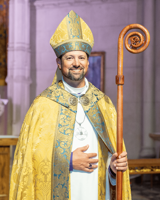
Bishop Rios, you have been in your role with the Diocese of California for about 18 months. Tell us your initial impressions of San Francisco …
A discussion of Grace Cathedral treasures is not complete without mentioning its connection to Florence’s iconic Duomo, the Cathedral of Santa Maria del Fiore. Many know the story of Brunelleschi’s great dome, but the doors of the Duomo’s baptistry are equally fascinating. Designed by Lorenzo Ghiberti and installed in 1452, the bronze doors depict Old Testament stories, rendered in 10 panels set in Tuscan settings. Many historians credit Ghiberti’s doors with launching the Italian Renaissance. During World War II, Ghiberti’s precious work was stored for protection and a mold taken with the intent to create a replica and place the original doors in a museum. The switch never materialized. Upon learning of the mold, architect Hobart coordinated a replica from it. This remarkable copy today adorns the entry to Grace.
Always evolving, Grace’s treasures are not static. For example, the recent installation of the hanging sculpture “Jacob’s Dream” is an outcome of the artist-in-residence program. American photographer David LaChapelle’s piece “Our Lady of the Flowers” is also on exhibit. Grace periodically hosts traveling exhibitions such as German artist Michael Pendry’s “Les Colombes” or “The Doves,” which were suspended gracefully in the nave, or elements of the AIDS Memorial Quilt, which hung on the 30th anniversary of the project.
Grateful to Help
Grace has always been known for its social and environmental justice work, hosting Bishop Desmond Tutu and Jane Goodall and inviting Dr. Martin Luther King, Jr., to preach in 1965. Indeed, it was outspoken Bishop James Pike who attracted Dr. King to mark the completion and consecration of the cathedral.
The ninth bishop of California, The Rt. Rev. Austin Keith Rios, who was installed in May 2024 after serving in North Carolina and Rome, is embracing this history of social justice in a new Diocesan Strategic Plan. “Our strategic plan tag line is ‘Rooted in Christ bearing fruit for the healing of the world,’” Rios tells the Gazette. “We have identified seven equal focus areas. The seventh is ‘sharing the love of Jesus beyond our doors.’ This is led by our deacons who take church outside the walls and bring [the] world’s concerns into the church. Social justice is about getting to know your neighbors in an authentic way to combine forces for good. The Diocesan Episcopal Impact Fund is a huge part of our outreach and our work to break the cycle of poverty and lift up our neighbors.”
Grace also responded early and with great compassion to San Francisco’s AIDS crisis of the 1980s. In 2000, the AIDS Interfaith Chapel was dedicated and was recently remodeled. The centerpiece is a triptych by New York artist Keith Haring, entitled “The Life of Christ,” completed weeks before the artist’s own death from AIDS.
In recent years Grace has hosted a Beyoncé mass, echoed with the sound of Bobby McFerrin’s 24-hour continuous “Circlesong,” swayed to the movement of Alonzo King Lines Ballet’s innovative dance and prayed in the aftermath of social unrest. Grace also provided a shining digital light during the pandemic.
Young is particularly proud of Grace’s response during COVID. “We were able to pivot to online services and programming as we had the infrastructure in place,” he says. “In fact, thousands watched our Christmas Eve service in December 2020, which was televised, and are still enjoying our digital outreach, which we continue. We are always grateful to help in times of crisis. After 9/11 so many were drawn to Grace that folks spilled out onto the great steps. To our regular congregants, the cathedral’s architecture may be large in scale, but it’s not so big that the congregation is dwarfed. It’s an intimate setting despite its grandeur.”
With so much tradition, history and community outreach, and with its two current dynamic leaders in Dean Malcolm Young and Bishop Austin Rios, Grace is planning strategically for its next 175 years. Whether you have entered Grace Cathedral hundreds of times or you are embarking on your first visit, Grace will inspire and revive you through a religious service, yoga or sound bath meditation, choral performance or Aura show — or just offer you a quiet moment of private contemplation. Grace welcomes everyone.
Bridget Maley is an architectural historian, writer and historic preservation consultant. She is a trustee at Grace Cathedral and a board member of the California Preservation Foundation. She lives with her family in Cow Hollow.