
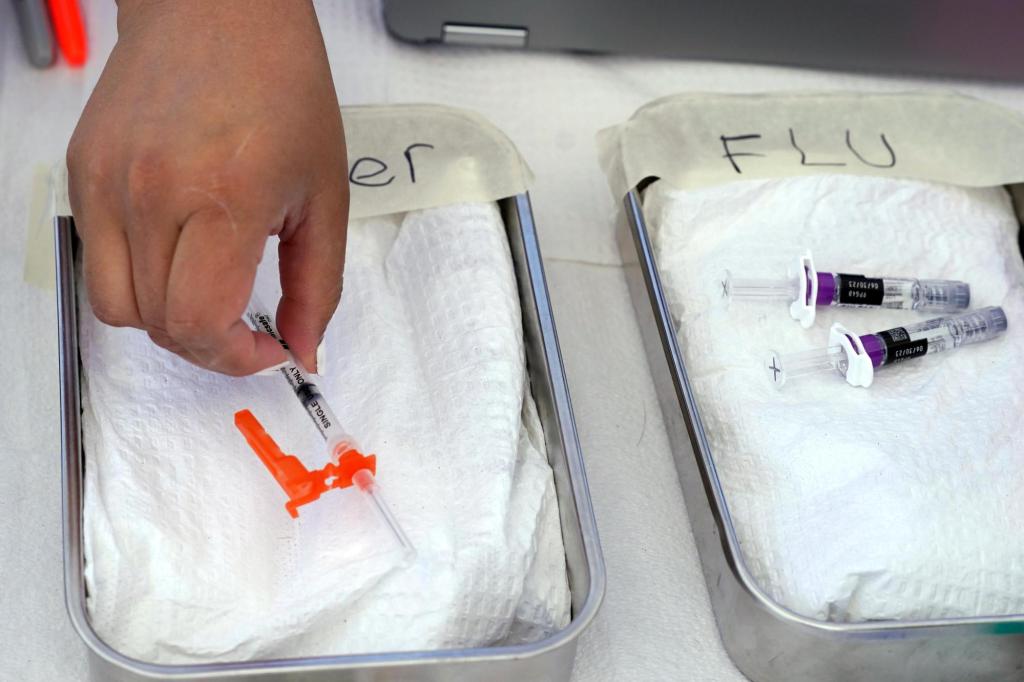
Fewer than one in four residents had received their flu shot as of Nov. 22, according to San Diego County’s most recent respiratory virus report. While that rate is about the same as it has been on the same date in the two previous seasons, experts warn that with a mutated virus expected to arrive this winter, going unprotected is particularly risky this time around.
Already, a subtype of the H3N2 influenza virus called “subclade K” has spread rapidly across Europe, also showing up in Canada and Japan.
While this variant has not yet carved itself a significant niche in America, experts warn that its arrival is inevitable.
As the European Health Security Agency said in its latest flu and COVID report published Thursday, 11.6% of flu tests came back positive in the most recent seven-day rolling average, compared to a rate of less than 5% in the same week last season. The trend has been strongest in children ages 5 to 14, with the test positivity rate jumping from 30.7% to 35.7% in a single week.
While age-stratified test positivity rates were not available for San Diego County, the overall rate through Nov. 22 is 3.1% overall, according to the region’s respiratory virus report.
Dr. Pia Pannaraj, an infectious disease specialist at Rady Children’s Hospital, said she is urging her unvaccinated patients to roll up their sleeves. There is still a little time to go before peak flu is upon us. The infection rate is generally highest in January.
“We still have probably two to three weeks to go, so if you get the vaccine now, it gives time for it to get to work over the next two weeks, and that will mean we’re ready when the flu does come our way,” Pannaraj said.
A mutated virus spreading far and wide is reminiscent of 2009, when H1N1 “swine flu” caused what was eventually deemed a global pandemic. This virus was termed novel, meaning that it had significant enough mutations that the immune systems of most people had little resistance, inundating hospitals and often forcing emergency departments to erect parking lot tents to handle the overflow of incoming patients.
Is subclade K a threat of similar magnitude?
Ian Wilson, a structural virologist and immunologist with Scripps Research in San Diego, explained that this latest threat is not quite of the same magnitude as the H1N1.
“Subclass K is a result of standard virus evolution that goes on with seasonal flu from year to year and is termed antigenic drift,” Wilson said in an email. “It is not the same scenario as in 2009 when a completely new pandemic virus appeared that we call antigenic shift.
“That involves major changes in the virus and without much (if any) preexisting immunity in the population. Subclade K is not unlike what we see with SARS-CoV-2, when new variants keep emerging.”
Some may note that subclade K is getting global attention because it has mutated enough that it is no longer a strong match for the H3N2 flu virus included in this season’s vaccine.
Many will cite this fact as the main reason why getting vaccinated is not worth the trouble.
“It’s true that the vaccine doesn’t give perfect protection,” Pannaraj said. “But we do have data already, mostly out of the UK, that shows that the current vaccine is about 70% protective against hospitalizations for children, and that’s actually a pretty good number.
“It’s only about 30% for adults, but even so, it’s still more than you would have without vaccination.”
Dr. Robert “Chip” Schooley, an infectious disease specialist at UC San Diego Health, said that vaccination still provides protection, even if a vaccine is not a perfect match to a circulating virus, because the body’s production of protective antibodies is not binary, either on or off like a switch. When stimulated, a range of immune cells are produced, targeting not just the example they were presented with by a vaccine, but also some that target a range of other related types.
“You create a broader array of antibodies, some of which are capable of binding to antigens that would be found on strains of influenza that are not the same as those in the vaccine,” Schooley said in an email. “The broader the repertoire of memory B-cells one develops with yearly vaccination, the better one gets at responding to broader trains of influenza.”
Vaccination, then, triggers something of a shotgun approach to viral defense rather than loading up a sniper rifle to go after just one particular threat.
“That’s a good analogy,” Schooley said. “Another would be that if you train a child to play music, as they learn to read music, they can play music that they’ve not seen before.”