
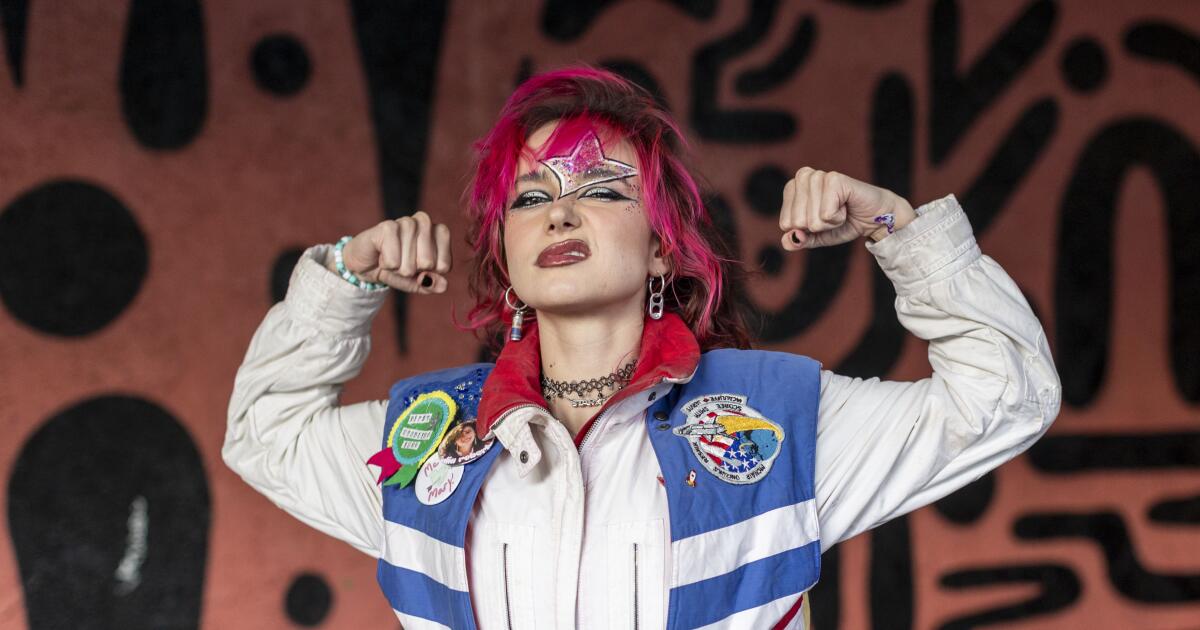
Nearly 10 years ago, high school student Maris pulled up to Missoula, Mont.’s Rockin Rudy’s record store in her ’05 Chevy Impala, a plastic bin full of burned CDs in tow.
At 16, the budding singer-songwriter was convinced that unless she wrote and produced an album on her own, she’d never be a real artist. So she recorded a handful of songs, bought 150 jewel cases and started spending lunch periods in graphic design class, where she had access to Photoshop. Serving as her own manufacturing plant, she packaged the discs, self-designed slips and handwritten notes while watching movies.
Maris recalled Guitar Center and Barnes & Noble declining to sell her music at their stores. But that day at Rockin Rudy’s, her luck changed, and the 12-track “Of the Sea” — the Latin translation of “Maris” — was the No. 1 CD at the record shop for two weeks.
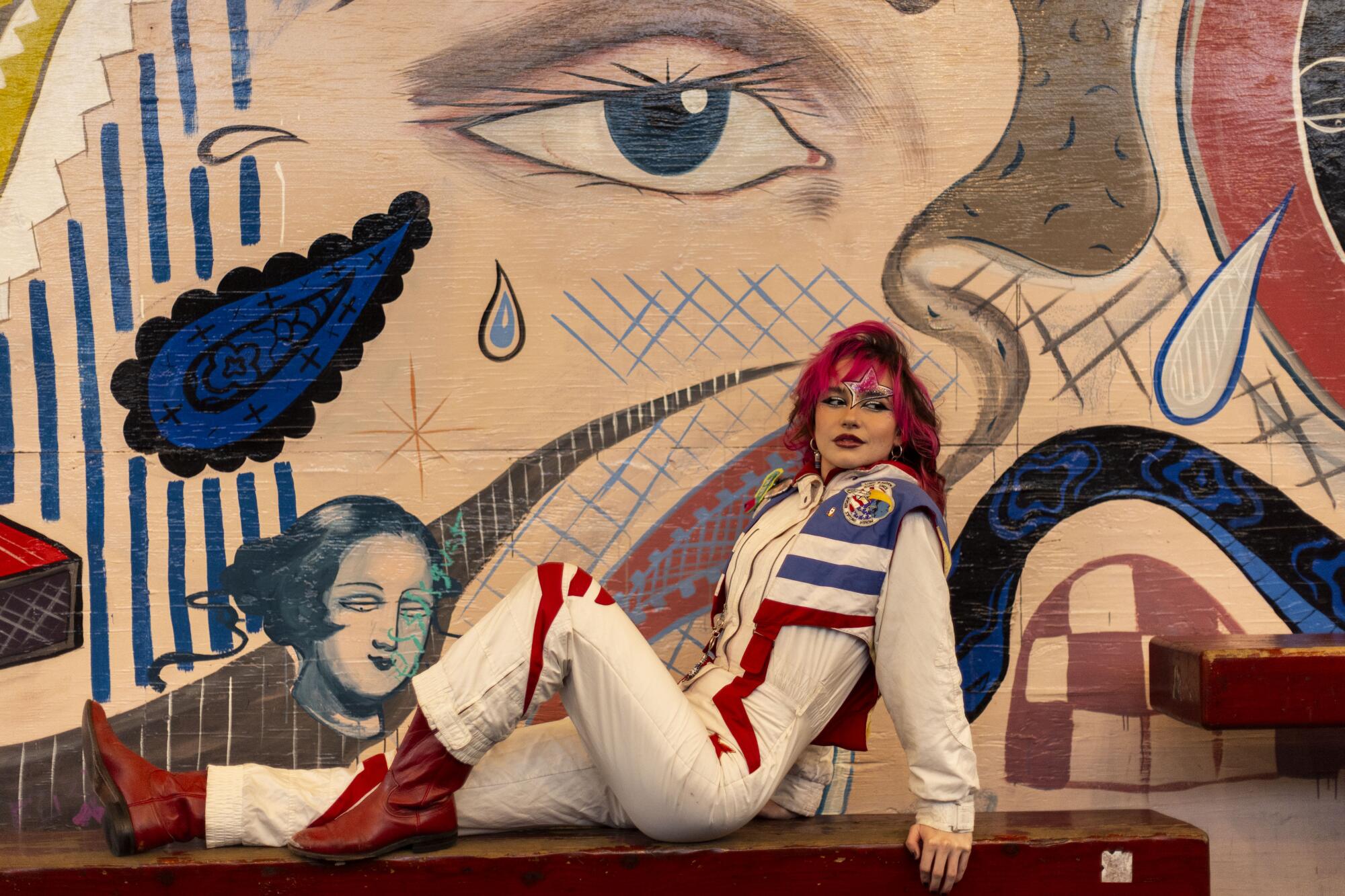
Maris, an L.A.-based singer and songwriter, closed her debut co-headline tour with Caroline Kingsbury at the Echoplex in October.
(Hon Wing Chiu / For The Times)
At 26, Maris said she hopes to never hear those songs again. But every time she visits Rockin Rudy’s, she buys a T-shirt as a thank-you for taking a chance on her.
“I try to be very evidence-based in the way that I approach the world,” she said. “And it gave me evidence: this is something that can work.”
Maris rounded the back pool table at Highland Park Bowl, her NASCAR cutoff tank and low-slung jeans rendering her unrecognizable as the high-femme pop star who took the Echoplex stage weeks earlier to close her first headline tour.
Billed as “the intergalactic sapphic pop show of your dreams,” the monthlong Give Me a Tour run was a joint effort with L.A. transplant Caroline Kingsbury, who featured on Maris’ retrowave track “Give Me a Sign.” The song, released in March, hit 1 million streams in a month. Since then, Maris has landed a co-sign from Elton John and a feature on “Rock Hall Rising.”
At her Echo Park tour closer, Maris sported her prized ’80s Bogner ski suit that she thrifted back home in Missoula — a rhinestone bustier and micro shorts layered underneath, for a routine mid-set striptease — and signature celestial makeup. The crux of the glam, an oversized star drawn on with glitter and eyeliner, evoked David Bowie’s iconic lightning bolt.
In its first iteration, Maris’ stellate insignia consisted of silver plastic stars from Party City, placed like tears to match the somber music she made at the time. Years later, on the New York punk music circuit, she switched to eyeliner, because she loved getting sweaty and smearing the black streaks down her face.
In L.A., where her music became brighter and more colorful, so did the emblem.

Maris moved to L.A. in 2021 to pursue pop music.
(Hon Wing Chiu / For The Times)
Many Maris superfans at the Echoplex show donned stars of their own. Some of them, the singer drew during the VIP meet-and-greet while Kingsbury doled out packets of glitter gel.
Kingsbury first tapped Maris to collaborate late last year. Serendipitously, Maris had been scouting for an “iconic vocalist” to feature on “Give Me a Sign.”
The pair put their duet and its accompanying video together in just a couple weeks, “then all of a sudden, we’re talking about going on tour,” Maris said.
Admittedly, the structure of the resultant Give Me a Tour run, wherein Kingsbury and Maris served as co-headliners rather than an opener-headliner pair, was untraditional — as was the open mic karaoke that replaced an opening set (Maris’ pitch). But it was sensible for Maris, who didn’t have a wealth of resources or history of ticket sales to reference, to dip her toes into headline touring.
“According to the suits, it’s really hard across the board for people to sell tickets right now,” the artist said. Splitting tour costs with someone else allowed her to gauge her reach with lower financial risk.
Of course, Maris was quick to add, her partnership with Kingsbury was also creatively driven. But for her, the business side of her trade is front of mind. It has to be.
“Me being super hyper-aware of all these things is the only way that it’s sustainable,” she said. “It’s all part of the game — the long game, the short game, the medium game.”
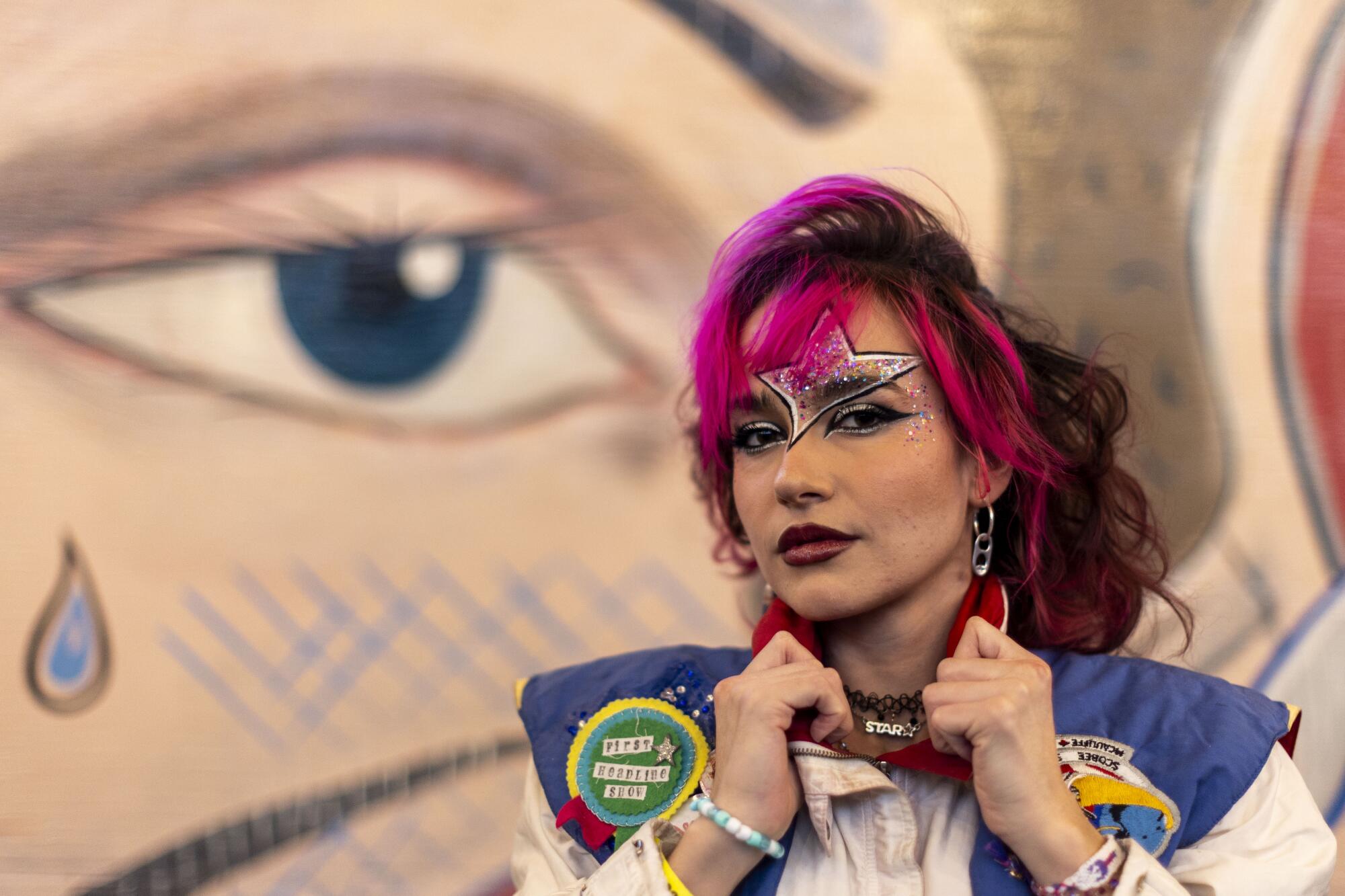
“As a business person, it’s conducive to me to be able to pitch my product, but as an artist, I really believe in what I’m doing,” Maris said.
(Hon Wing Chiu / For The Times)
Raised by entrepreneurs, Maris has always figured herself a salesperson as much as a singer.
During her New York stint, she worked a market research job that lent her a framework for engaging her fanbase. At the core of Maris’ strategy are her virtual “Star Seminars,” wherein her fans, whom she’s nicknamed “superstars,” are invited to weigh in on anything from her merch drops to her next-released singles.
When her Christmas song “Christmas Now” dropped in November, Maris polled her Instagram broadcast channel Star Club about whether to celebrate via Instagram Live or Google Meets. The former won by a landslide.
Some artists say a digital-driven music industry is a doomed one, Maris said, “but at the end of the day, social media has just given artists the opportunity to make their fans their label.”
It’s one of the reasons that, despite her fierce ambition and the allure of major label sponsorship, Maris is content to stay independent for now and maintain her creative license.
Such is the case with her “secret album,” a SoundCloud compilation of demos that operates as a fluid prototype for her eventual debut album. Generally, whichever songs get the most streams, she releases — with the caveat that as the “mayor of town,” she maintains veto power.
Along with enabling Maris to keep her finger on the pulse, the model has allowed fans to learn the lyrics of even her unreleased songs. It’s a likely explanation for why her pre-release performances of “Mary+I,” a song about the summer she spent stoned and celibate, felt like covers. Even those who didn’t know the words beforehand caught on by the second chorus.
Dylan Bauld, who’s produced several of Maris’ songs, called her secret album “one of the coolest and smartest decisions I’ve seen an artist make.”
Although it’s a gray area that not every producer would feel comfortable treading, Bauld said, the people with whom Maris works trust her instincts.
A few months back, Bauld played an acoustic show with Maris. It was an industry crowd, he said, and after watching many performers fail to get anyone’s attention, he figured their chances were bleak. But Maris was unfazed, working the stage as though it were her own.
“It was like a stand-up act,” he said. “She got everyone so hyped and laughing their asses off before we even played a note.”
In Bauld’s eyes, Maris is a unicorn of sorts, that kind of generational artist whose raw talent is matched only by their work ethic. For her, he said, nothing is lacking — it’s just a matter of time.
“I feel like I’m at the ground floor of something huge,” he said.
As she laments on the grungy “Super F— Mega Star,” Maris is still waiting on her big break: the smash hit, the major record deal or the high-profile tour opener gig.
But she got a taste of a breakout in July, when John played “Mary+I” on his “Rocket Hour” radio show. Well-known for championing new talent, John on the show showed early support for several rising stars including Blood Orange and Olivia Dean. When John’s team reached out to get Maris’ permission to feature her song, she thought the message was fake.
Instead, it led to that kind of moment Maris wished she could tell her 16-year-old self about. For Bauld, it was “a perfect way for ‘Mary+I’ to get attention.”
After the song’s last synth echoed, John capped off his segment by likening Maris to iconic performers like Lady Gaga and Freddie Mercury, concluding, “I’d love to see her on stage.”
The first time Maris watched Queen’s hallowed performance at Live Aid, she was mesmerized. With so little words, she said, Mercury communicated to his audience exactly what he wanted from them — and they listened.
“That is a true embodiment of what it means to be a performer,” Maris said. The singer’s years studying Mercury’s and other famed entertainers’ crowd work are manifest in her stage show, which she said is ever-evolving.
Among the bits in her current rotation are an inflatable guitar solo, a group stretch and a classic stage hop, which she started after she noticed people weren’t greeting a particularly raucous song with the energy she wanted.
“I was like, I need to get down there and show them how to rage, because that’s my job,” Maris said. “My job is to be so ridiculous that everyone else feels comfortable being as ridiculous as me.”
The singer doesn’t mind giving people a nudge, either. At a recent show in Columbus, Ohio, she spotted an attendee jiving at the back of the room as she played “Super F— Mega Star.” She called them up to the front, and in no time, people had formed the dance circle that Maris dubbed the “‘Super F— Mega Star’ pit.”
Val Hoyt, one of Maris’ collaborators, said she’s “not afraid to just belt at the top of her lungs or be like, ‘No, you’re at my show, you’re gonna jump. You’re gonna dance. You’re gonna be involved, whether or not you want to.’”
“By the end of the show,” Hoyt said, “she’s won that whole room over.”
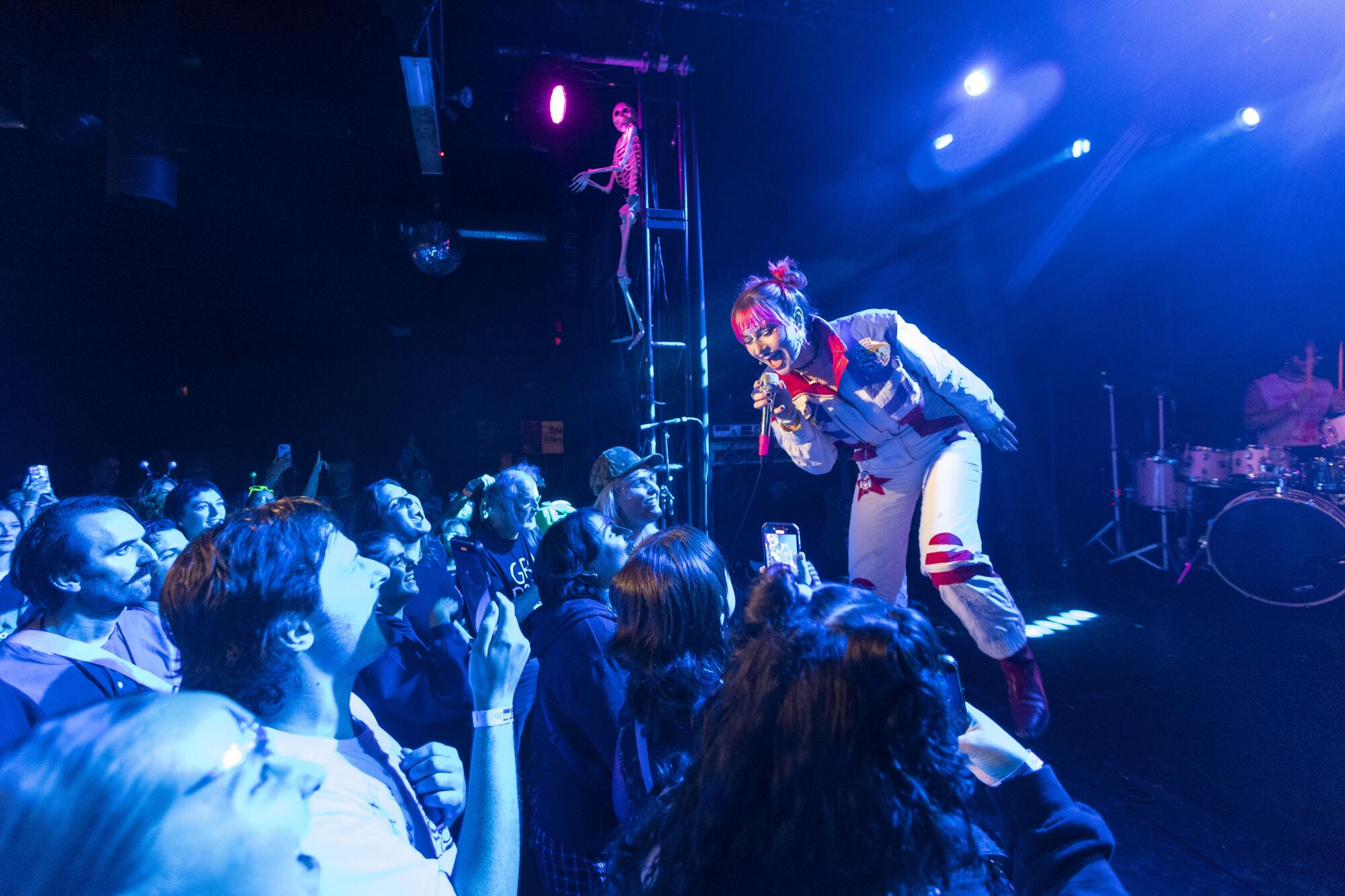
“My job is to make people feel good and like they can be themselves, so I can’t get uncomfortable. I can’t get self-conscious,” Maris said.
(Hon Wing Chiu / For The Times)
Maris may have memorized the pop star playbook front to back, but her mother, Dawn Maddux, said she was a performer from the jump. In one of Maddux’s staple anecdotes about her daughter, Maris as a toddler lugged her Barbie boombox out to where a construction crew was working on her parents’ house.
“She always had a little whiskey voice,” Maddux said. “She goes, ‘Good morning, builder boys! Do you want to hear my tunes?’”
Maris pulled similar stunts often enough for her family to christen them her “dance-abouts.”
“I’ve always been a little ham,” Maris said. “Maybe not always vocally talented, necessarily, but definitely always a ham.”
The vocal chops did eventually come, thanks to voice lessons pushed by her stepfather. But as much training as she got in that respect, Maris said her mother was her best coach. And she never pulled any punches.
“[Maris] would say, ‘Do I sound flat?’” Maddux said. “And I would say, ‘Yep, you do today. You have to work a little bit harder.’”
“But she is also a super hard worker, so it’s not like it was hard to keep her on track,” she said.
Maddux was no stage mom, but she was a happy tag-along. When Maris as a teenager flew out to L.A. to record a cover of “Jolene” for the Postmodern Jukebox project, Maddux came too. She even helped Maris pick out the green vintage suit she performed in.
So when Maris told her mother she planned to graduate early from high school and pursue music in New York, Maddux was in denial. She never even canceled Maris’ ticket from New York back home to Montana, thinking she could convince her daughter to change her mind. She cried the whole way to the airport after leaving Maris behind in the city.
“I remember thinking, if I’d known that this might happen, I don’t know that I would have had kids,” Maddux said.
In the years Maris spent in New York, and even her first few in L.A., Maddux fielded her daughter’s distressed calls home. The more often she rang, Maddux knew, the worse she was doing.
These days, Maddux said, Maris doesn’t call so much.
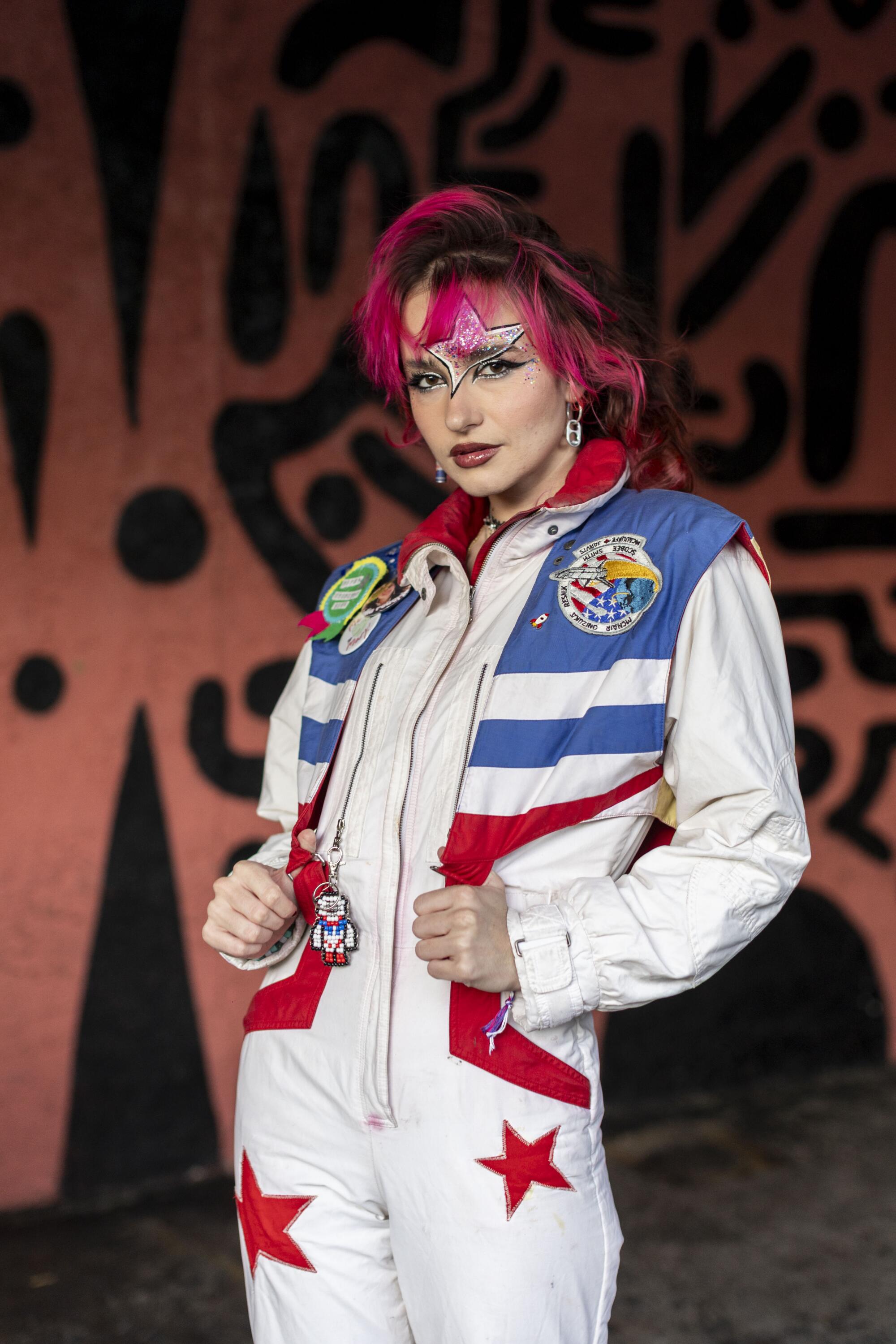
Maris poses in a vintage ski suit she thrifted back home in Montana.
(Hon Wing Chiu / For The Times)
Nursing a cider at Highland Park Bowl, Maris recalled the late nights she used to spend with Maddux, debriefing her shows over McDonald’s. She was relentless with her self-criticism, always finding some minor gaffe to ruminate on.
The singer said she suspects she’ll be battling that toxic perfectionism for the rest of her life, but she’s gotten better at banishing it to the backseat.
“There are things about the shows that I had to accept were not going to be the way that I wanted them to be ideally,” she said. Fortunately, she noted, fans aren’t compelled by perfection; they’re compelled by sincerity.
As an artist, Maris said she would release an album tomorrow. But as a business person, she’s committed to waiting for the right time — when she can pay her producers well, deliver her highest-quality work and sell out a true headline tour.
“The stars just have to align,” she said.