
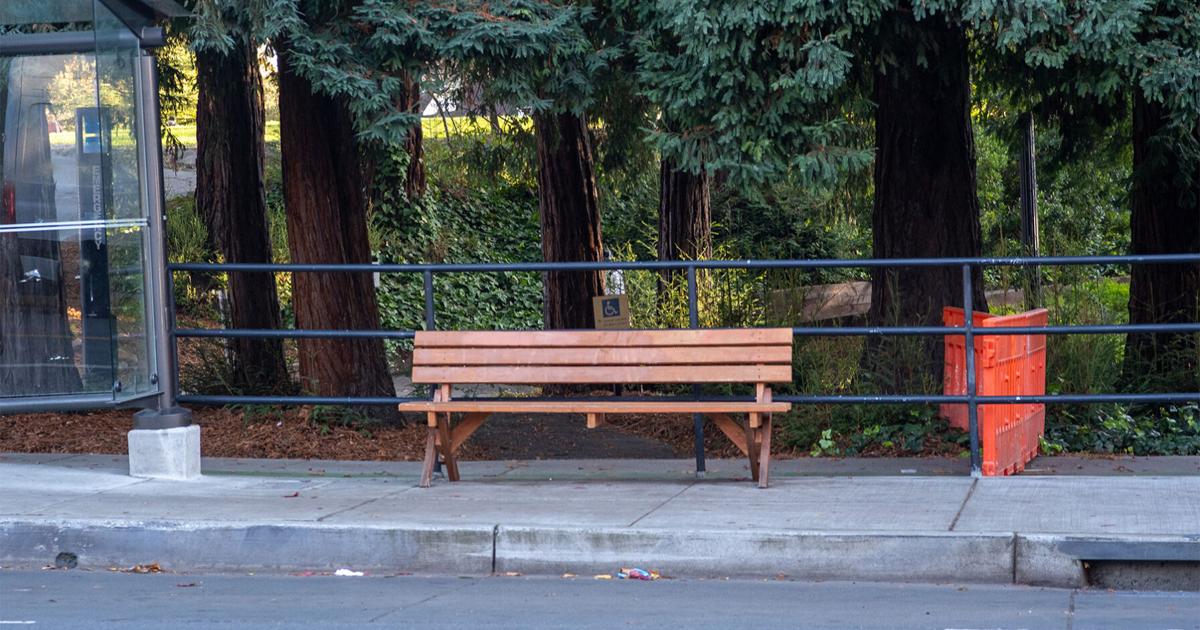
When UC Berkeley graduate Mingwei Samuel heard about an injured neighbor who was forced to sit on the curb while waiting for the bus, he strapped a handmade bench to his trailer, biked it to the stop and cable locked it to a pole.
Samuel posted the process to his X account in December 2023, kickstarting an outpour of community interest in installing additional benches at transit stops across the Bay Area. Since then, more than 130 “rogue” new benches have appeared at stations in Alameda, San Francisco, Contra Costa and Sonoma counties.
Dubbed the San Francisco Bay Area Bench Collective, or SFBA Bench Collective, the group of neighbors and community members aims to fill in policy gaps that leave Muni and AC Transit stops without resting places for riders during long wait times. The American Disabilities Act does not require transit agencies to install seating at stops or other facilities, according to the Federal Transit Commission.
“The mission is to make cities more accessible and more welcoming,” Samuel said. “Helping people build and install these benches is a way of having a positive effect in the world when it is so easy to get stuck in how negative things are going.”
The collective now consists of approximately 200 people across several Bay Area counties. Its website, sfbabc.org, exists to provide interested community members with the opportunity to “adopt” a bench, join the crew, report damage and provide an interactive map with the status and location of each installment. The digital map uses AC Transit’s public data resource center to measure the number of weekly boardings at each transit stop, and the SFBA collective encourages website visitors to propose new bench locations based on ridership demand.
The site also features a detailed “how-to” bench construction guide, including necessary tools, materials and visual aids. Benches are modeled after the “Duderstadt” design, which San Francisco residents have used to construct more than 210 public benches since 2012, according to the Transbay Coalition.
Each bench takes approximately two days and $100 in materials to complete, noted Carter Lavin, co-founder of the Transbay Coalition.Crew members construct benches in their yards and often transport the final product by bike, trying to avoid cars in “the spirit of things,” Samuel said.
“It’s absolutely wonderful (that the benches are improving) the lives of literally tens of thousands of people,” Lavin said. “They are making transit more accessible and making our communities more vibrant, loving, welcoming spaces.”
However, Lavin noted that the collective currently operates under a “legal gray area.”In an effort to legalize the installation, the Transbay Coalition worked with the collective to pass a permitting policy in the City of Richmond in May. The policy, cosponsored by Richmond City Councilmember Jamelia Brown and Vice Mayor Cesar Zapeda, stated that a lack of basic seating at bus stops forces riders to stand for extended periods and “undermines transportation equity.”
The policy also states that community groups will continue to fund bench installations through donations, preventing additional financial constraints for the city of Richmond.
The legalization process “gives permission … (to) pour out your love for your community members,” Lavin said.
Tracking the outcomes of Richmond’s permit policy in coming months will help motivate action in cities such as Berkeley, Lavin added.Meanwhile, Bay Area cities have yet to take up efforts to actively remove the benches, reflecting what Samuel calls a “begrudging acceptance” of the collective’s positive impact.Lavin also noted a relatively positive relationship between Bay Area cities, AC Transit and the collective thus far, “to the level that city staff and elected officials recognize that (bench installations) are a gigantic favor.”
Berkeley’s Public Works department confirmed it is responsible for maintaining all publicly owned infrastructure on city sidewalks, said city spokesperson Seung Lee. The department works with AC Transit to maintain existing bus benches and, in one instance, replaced wooden benches with permanent metal benches.
“In some sense, the big cities are worrying about other things,” Samuel said. “Building the benches ourselves provides the seating that people need.”
Local activist Darrell Owens said his initial goal with the collective was not to “replace public works” but to shine a light on the dwindling options for public seating in Berkeley and push City Council members to direct more funding toward the cause. While other residents have continued to install their own benches throughout the city,Owens noted that he has ceased operations in Berkeley since the City Council committed to installing benches when funding became available.
Owens said he hopes Berkeley will adopt and replace the benches installed by the SFBA Bench Collective, adding that pursuing a permitting policy is an “interim” step in the right direction. Lavin added that full legalization would allow bench crews to install tens of benches in a single weekend.
In the meantime, community members throughout the Bay Area can contribute to the mission in a variety of ways. Residents who are unable to attend bench building sessions can donate tools or money in a “huge urban barn raising” effort, Lavin noted.
“Their work is love and action. What they’re doing is a declaration of love for their community and for our community,” Lavin said. “The world is hard and can be more comfortable and accessible. There’s heroes among us, and any of us are invited to step into that. This is what the Bay Area is all about.”