
Officials in two Orange County cities are looking to tighten their campaign finance regulations while leaders in a third are raising contribution limits by thousands of dollars ahead of next year’s midterm elections.
In Aliso Viejo, city council members are getting rid of their $1,000 campaign contribution cap for council candidates, reverting to the state’s default contribution limit of $5,900, which increases with inflation.
In Cypress, council members are discussing going in the opposite direction, dropping the contribution limit from $5,900 to $500 and naming top contributors on mailers funded by political action committees – changes that are expected to be voted on early next year.
They also discussed publicly funded elections – something advocates say will diminish the influence campaign contributors and special interests have on policy making.
“Something I’m passionate about, many Cypress residents I’ve spoken with, believe there has been too much special interest money in Cypress elections and too little transparency over where that money comes from,” said Mayor David Burke, who proposes the reforms, at the Nov. 10 city council meeting.
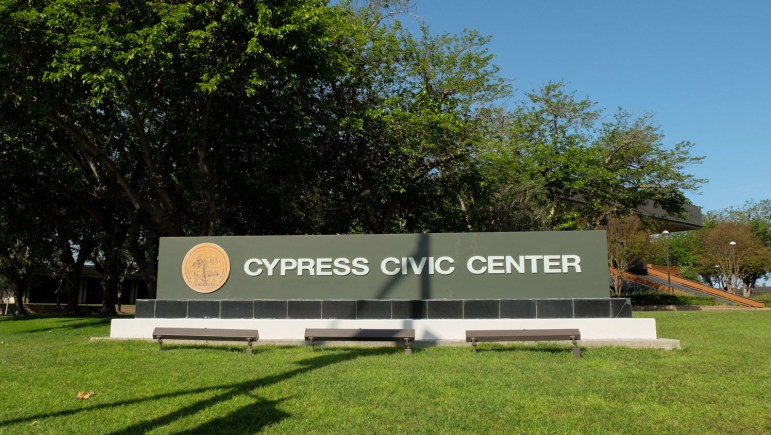 Cypress Civic Center on April 17, 2022. Credit: AYDA TUNCAY, Voice of OC
In the City of Orange, officials are reinstating a ban on candidate committees transferring money to the committees of other candidates.
It comes after city officials there narrowly lifted the ban last year while increasing the campaign contribution limits for regular elections from $1,000 per contributor to $1,500 and imposing a $25 fee each time a candidate running in local elections files nomination papers.
[Read: More Orange County Cities Overhaul Campaign Finance Rules]
Sharon Galasso, an Orange resident, said lifting the ban last year was harmful and compared it to money laundering.
“First, it gives elected officials and candidates an unfair advantage. They can now donate, not only personally, but also through their campaign committees, effectively doubling their influence in ways ordinary residents can’t,” she said at the Nov. 12 Orange City Council meeting.
“Second, it undermines donor intent. Voters who contribute to one candidate may unknowingly have their money redirected to support someone they don’t agree with and third, it invites abuse.”
Aliso Viejo Raises Contribution Limit
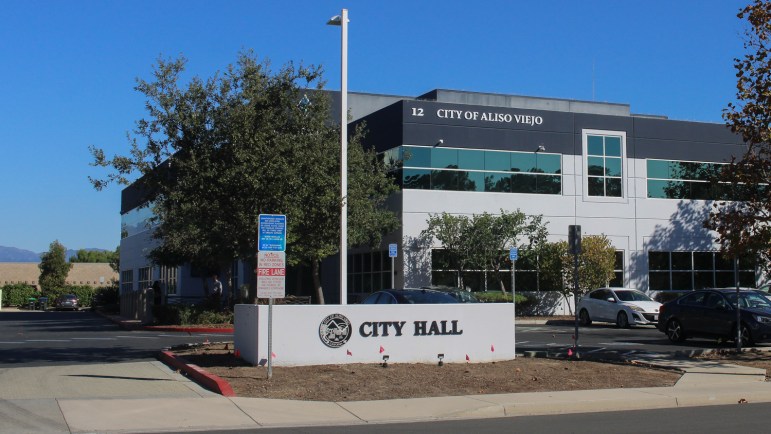 Aliso Viejo City Hall on Nov. 28, 2023. Credit: ERIKA TAYLOR, Voice of OC.
Aliso Viejo City Council members recently voted 4-1 to increase their contribution limit by nearly $5,000 at the request of Councilman Mike Munzing.
Munzing said the change was necessary to level the playing field between large independent expenditures and campaign donations, adding that his opponent in the last election got tens of thousands of dollars in support from political action committees.
“When I’m limited to $1,000 and $80,000 comes in on their favor,” Munzing said at the Nov. 19 city council meeting. “The only fair thing to do is to get us back to the state limit.”
An independent expenditure cannot be limited, unlike direct campaign donations, which are subject to state or city ceilings.
Mayor Tiffany Ackley was the dissenting vote, arguing that her colleagues were being “insincere” and that they have all benefited from independent expenditures and said mailers against her funded by political action committees had pictures of her kids on it.
“Local politics is meant to stay local. It’s meant so that you don’t have a buddy who can give you $5,900 and his wife can give you $5,900 and their two kids can give you $5,900,” she said at the meeting.
She said the current campaign donation limits aren’t “inhibiting anybody’s ability to win an election.”
Councilmember Max Duncan agreed with Munzing.
“As Mike says, when you’re getting attacked by $80,000 of I.E.s and you’re constrained to raising $1,000 to try to combat back, that’s not fair,” he said at the meeting.
In 2022, the city introduced an ordinance, capping single contributor donations at $1,000, when the state limit was then at $4,900.
[Read: Aliso Viejo Lowers Campaign Contributions Limit, Capping it at $1,000 Per Election Per Donor]
Orange Reinstates Ban on Inter-Committee Transfers
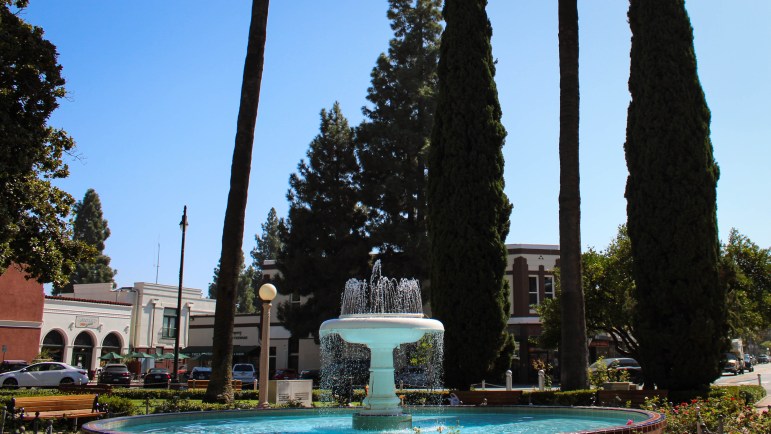 The Orange Plaza Circle in Orange, Calif. on Tuesday, Oct. 8, 2024. Credit: LAINEY MYERS, Voice of OC
Last month, Orange City Council members voted 4-2 on an ordinance to once again ban candidate controlled committees from transferring money to the committees of other candidates.
Councilman Jon Dumitru, who requested the ordinance, said the ordinance was about ensuring residents know who is trying to influence the council with contributions and preventing corruption.
He also said it was constitutionally sound.
“I don’t want to see undue influence. I don’t want to see people diving into corruption by circumventing that. It needs to be transparent,” Dumitru said at the Nov. 12 meeting.
Dumitru had previously supported lifting the ban last year.
Councilmembers Denis Bilodeau and Kathy Tavoularis were the dissenting votes. Councilman John Gyllenhammer was absent from the meeting.
Bilodeau said the ban won’t hold up in court and called it “solution looking for a problem.”
“The Supreme Court has ruled consistently that spending money to communicate political messages is a form of protected speech under the First Amendment,” he said at the Nov. 12 meeting.
“I don’t want to create barriers for people of limited means to run for these offices. And I think if another candidate wants to support me or another candidate, they should be able to write a check.”
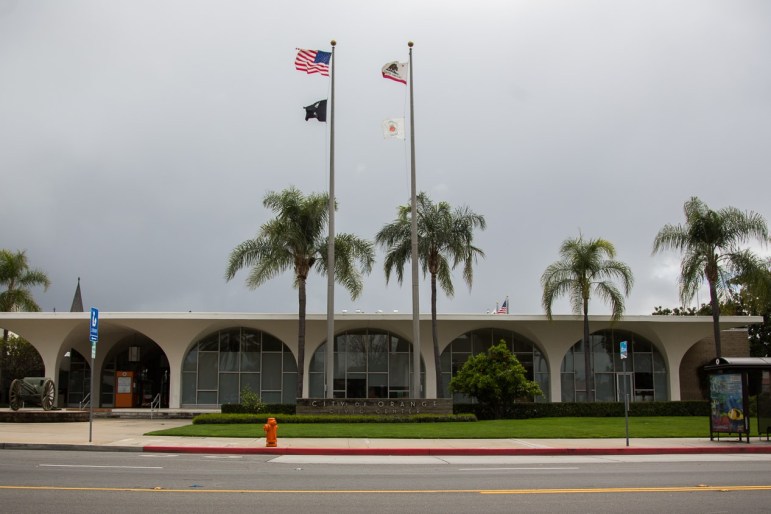 Orange City Hall on March 19, 2020. Credit: JULIE LEOPO, Voice of OC
Tavoularis said the ordinance was “politically motivated and disingenuous.”
“If you look at 2024 none of the candidates running took any campaign committee money from any other campaign,” she said.
Councilwoman Arianna Barrios said bringing back the ban on inter-committee transfers would help grass root campaigns.
“It’s actually a much more fair playing field for the person who’s trying to run for the very first time, or does not have all of that long history in terms of politics,” she said at the Nov. 12 meeting.
Cypress Looks to Curb Pay to Play Politics
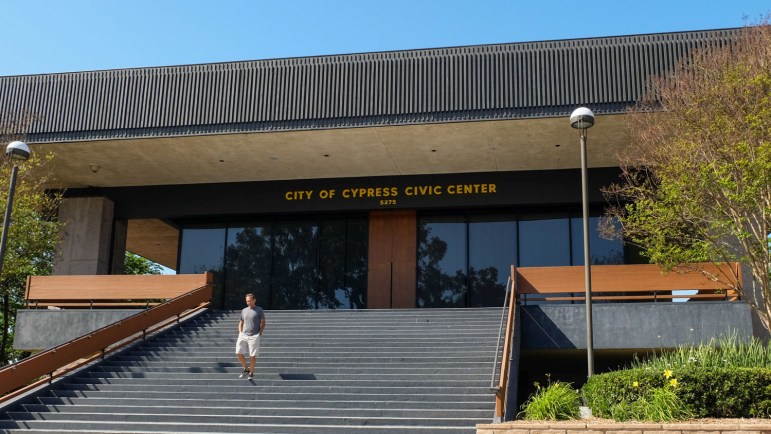 Cypress Civic Center on April 17, 2022. Credit: AYDA TUNCAY, Voice of OC
Cypress officials are also moving forward with their own campaign finance reform.
Council members voted 3-1 last month to direct city staff to create an ordinance including a $500 contribution limit and a requirement for top funders to be disclosed to bring back to discussion back in January.
Burke said the reforms would improve transparency and reduce “pay-to-play” politics in Cypress – when big corporations and special interest groups send large donations to political candidates they believe will vote in favor of their causes.
The first reform suggestion was to lower campaign contribution limits from $5,900 to $500; these limits would not apply to self-funding.
Several Southern California cities have similar limits, such as Irvine with a $620 limit and Seal Beach with a $500 limit, with the California Fair Political Practices Commission listing cities with campaign contribution limits.
Burke also proposed requiring the naming of top five contributors of independent committees on mailers, instead of just the committee name.
He brought up 2022 elections, where mailers sent out stated that they were paid for by the “Safe Neighborhoods PAC” which spent over $35,000 in support of several council members.
“From the mailers it wasn’t clear who was funding the PAC. It said ‘Safe Neighborhoods’ – does that mean police? Did that mean fire?”
One contributor, Chief Executive of Briggeman Land & Development Co, George Briggeman, was fined for political money laundering in council elections in Anaheim, Lake Forest and Cypress.
Burke also suggested looking into publicly financing elections, which allows for candidates to receive funding from the local government once eligible, stating that this practice curbs special interest funding and promotes local participation.
This could be achieved by matching funds accumulated by candidates, or setting a “lump sum” to be offered after candidates reach a certain limit.
City officials ultimately did not take action on publicly financed elections.
Councilmember Bonnie Peat was the dissenting vote, arguing the slideshow was not made available to council members 72 hours before the council meeting.
“I’m very disappointed. I don’t know how the process worked, but I’m gonna put it on you, Mayor, because the agenda went out on Wednesday – had no attachments to it,” she said at the Nov. 10 meeting.
Burke said the powerpoint had been provided in time.
The discussion comes after Councilmember Scott Minikus resigned on Oct. 1 to take an out of state job.
Councilmember Leo Medrano said he would like to see a new council member appointed before a decision would be made on the reforms.
“We should pause from this … and focus on the next few weeks, getting a new city council member in here, and then hearing that city council member’s perspective on this topic.”
Hosam Elattar is a Voice of OC reporter. Contact him at helattar@voiceofoc.org or on Twitter @ElattarHosam.
Related