
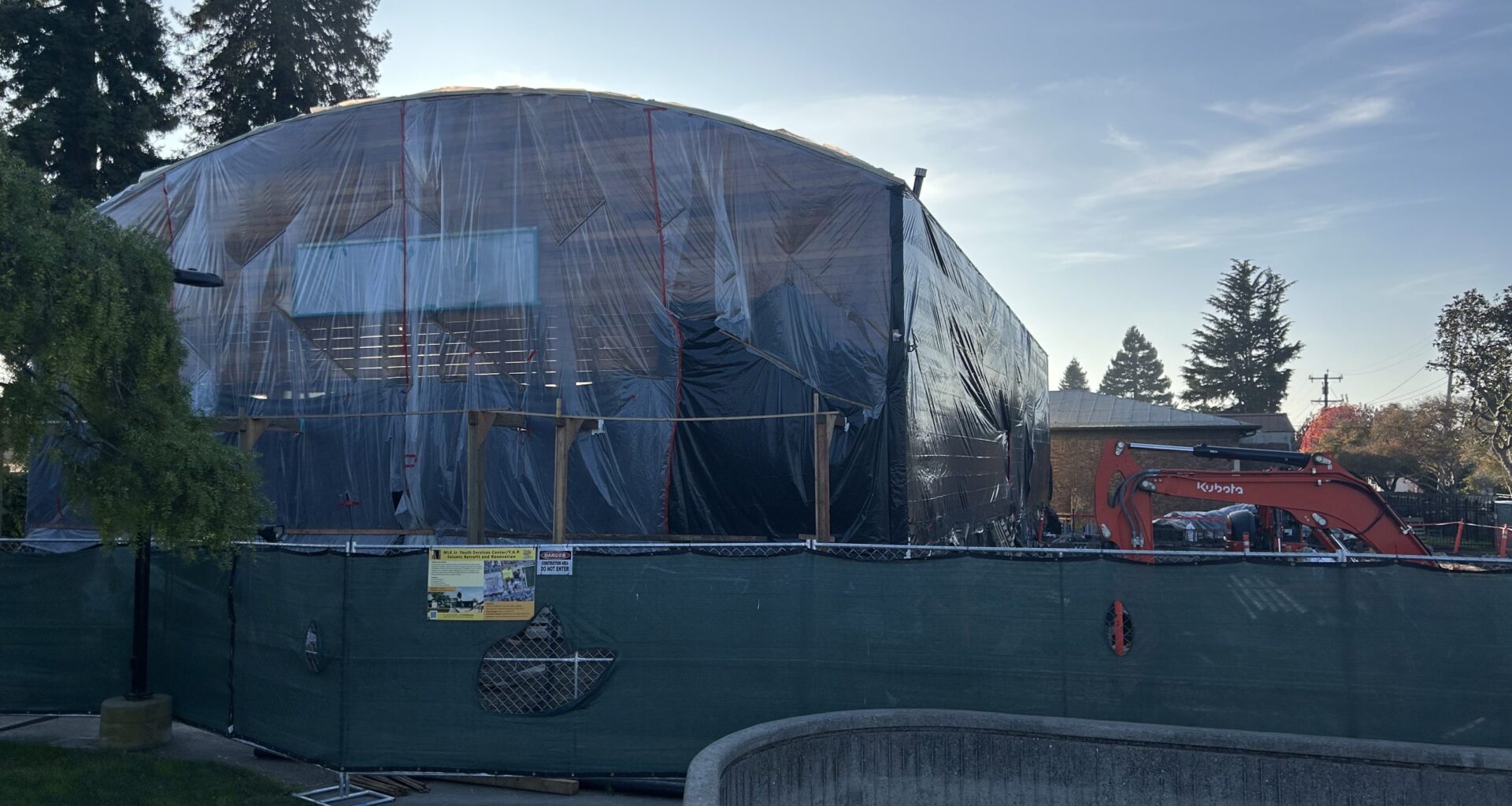
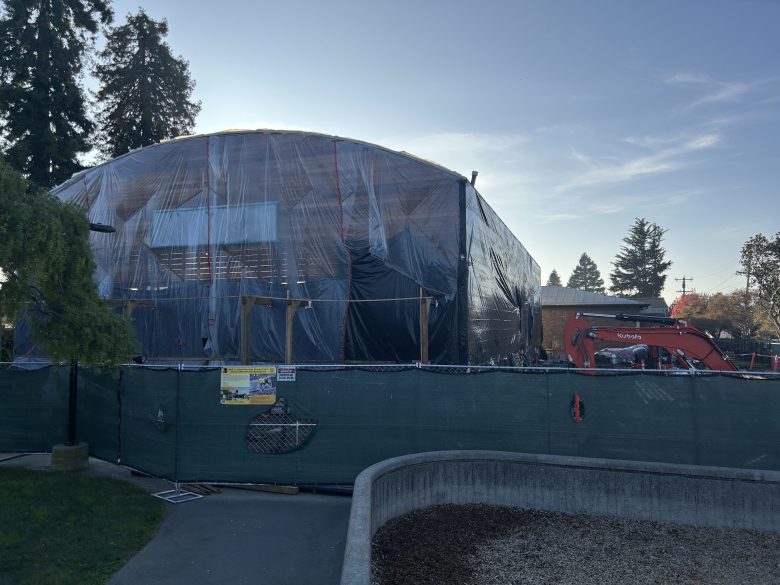
 The Martin Luther King Jr. Youth Services Center in South Berkeley is undergoing a seismic retrofit and renovation. Credit: Nico Savidge/Berkeleyside
When city officials made plans for an $8.2 million seismic retrofit at a South Berkeley community center, they were counting on a grant awarded by the Federal Emergency Management Agency to foot part of the bill.
But Berkeley has had to replace more than $800,000 worth of that promised federal grant with local money, after city workers learned the short-staffed regional FEMA office was expected to take two years or longer to provide the funding, Parks Director Scott Ferris told Berkeleyside.
The loss has forced the city to scale back plans for the renovation that broke ground earlier this year at the Martin Luther King Jr. Youth Services Center on Oregon Street, Ferris said, and pull funding from other local projects. Waiting for the federal agency to release the funding, he said, wouldn’t have made sense.
“You can add $800,000 in one year of construction cost increases,” Ferris said.
While it’s unclear whether the delay in processing the grant is directly related to the Trump administration’s efforts to downsize the federal workforce and slash FEMA’s disaster preparedness programs, the renovation project joins other local initiatives that have lost funding this year. The U.S. Department of Agriculture in the spring canceled a $1 million grant for a city program to plant trees in South and West Berkeley, and many local nonprofits have reported losing federal funding.
FEMA awarded Berkeley $1.2 million from its Hazard Mitigation Grant Program for the retrofit of the community center, which houses after-school and summer recreation programs for young people and is one of several facilities the city expects to use as shelters in the wake of an earthquake or other disaster. The project also includes a renovation and upgrades within the center.
Berkeley received more than $300,000 from FEMA in the first phase of the grant, which helped pay for the project’s design process, according to Ferris. But the city was informed through the California Governor’s Office of Emergency Services, which administers FEMA hazard mitigation programs, that the larger second phase of the grant would take years to deliver because the federal agency doesn’t have “enough staff to process” grants, he said.
A city report earlier this year described the $836,000 grant as being “indefinitely postponed.”
FEMA did not directly refute Ferris’ claims in response to an inquiry from Berkeleyside, or address questions about how long its staff take to process grant funding.
A spokesperson for the agency’s regional office, who did not identify themselves in email correspondence, indicated that Berkeley could bear some of the blame for the delay, writing that the city had sought an extension to provide design documents needed to evaluate the project’s funding. Ferris acknowledged parks staff requested the extension, but said they didn’t wind up using it, and submitted the documents on time.
“FEMA strives to complete grant evaluations and compliance reviews as quickly as possible while adhering to all applicable regulations and executive orders,” the FEMA spokesperson wrote.
Ed Chapuis, a spokesperson for the state Office of Emergency Services, also didn’t directly address Ferris’ claims about the Berkeley grant. Chapuis told Berkeleyside in an email that the office helps local governments develop and submit applications for federal funding, “though we don’t control FEMA’s timing to respond or make decisions.”
He continued, “Cal OES has regularly communicated with Berkeley to share the status of FEMA’s pending decision on their project.”
Chapuis noted that Berkeley has not withdrawn its request for grant funding. Ferris said the city could eventually receive the money from FEMA.
But in the meantime, Ferris said, the city had to drop a plan to install solar panels on the roof of the community center to reduce the cost of the renovation project.
Berkeley also had to draw more money than it initially planned from the 2016 infrastructure bond Measure T1, which was already set to provide $7 million of the project’s total budget, and from the city’s parks tax. The City Council approved a plan in September to reallocate Measure T1 funding toward the youth center renovation and other projects facing cost increases; the move reduced funding for other projects, including efforts to build new public restrooms.
The renovated youth center is expected to reopen in late 2026 or early 2027.
“*” indicates required fields