
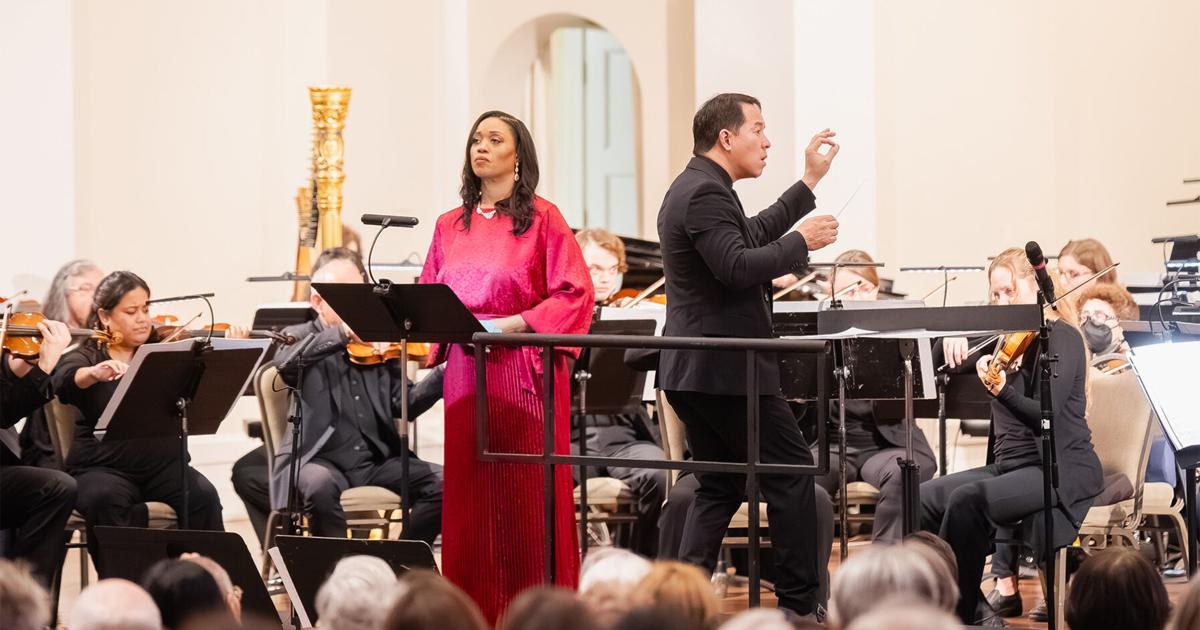
Just two blocks away from Sather Gate, a crowd of people gathered outside the First Congregational Church of Berkeley. Some dressed in three-piece suits, some in hoodies and jeans, but all showed up for the same reason: to watch the Berkeley Symphony — led by nationally recognized conductor Ming Luke — perform a series of beautiful classical pieces.
After flashing their tickets at the front door, the attendees shook hands and smiled at one another as friends introduced and reintroduced each other repeatedly. Nobody was really a stranger here, it seemed: from the parents holding their kids to the elderly folk making their way to their seats, it was clear that the mass of people was more of a community than simply an audience.
The mingling came to a close as the organizers announced that the performance was to begin, and three-time Grammy Award-nominated composer Juan Pablo Contreras took the stage. After thanking everyone for their contributions to keeping classical music in the Bay Area alive, he expanded on his composition, “Alma Monarca,” the introductory piece for the program. Drawing from his childhood experiences of riding a boat to an island church and searching the skies for butterflies said to hold the souls of the recently deceased, he described the magic of those deeply personal moments as the inspiration of his work.
As the symphony played, it was clear to see why: the combination of mellow violins, watery gongs and deep bass tones captured the experience of a boat lazily taking its passenger down the stream. Generally, it’s considered an insult to say “I almost fell asleep during that performance,” but how can you help it when all of these soft instruments coalesce so beautifully? Either way, I fought to stay awake through the trance so I could enjoy the music properly, and I was certainly rewarded for doing so.
Following Contreras’ piece, the symphony began playing Richard Strauss’ “Vier letzte Lieder,” or “Four Last Songs,” with Grammy-nominated soprano artist Laquita Mitchell. It’s difficult to describe what an excellent soprano performance sounds like, given that much of the musical power comes from the environment and ambiance of a live performance, but I’ll do my best. As the musicians concentrated deeply to support Mitchell’s voice, she belted out the German lyrics with such force that it commanded the attention of the hundreds of attendees, each word echoing just barely noticeably off the church walls. From songs describing the changing seasons to the sensation of falling asleep, her performance — supported by the acoustics of the church and symphony behind her — resulted in a shower of applause and standing ovations that only seemed to stop once she smiled, bowed and headed backstage.
A short intermission later, the symphony returned to instrumental pieces with “Sinfonia” by Missy Mazzoli, structurally and sonically similar to a small solar system, with musical loops occurring within themselves and within larger ones, too. Finally, the program ended with Dmitri Shostakovich’s “Symphony No. 9.” As the program directors stated, the piece was commissioned by Joseph Stalin to commemorate the victory of the USSR in World War II. However, rather than crafting a triumphant, dominating piece for Stalin, Shostakovich opted instead to make his ninth symphony a witty, almost silly piece as an indirect jab at the Soviet leader. At the time, critical reception and Soviet leadership found the piece unusual and even grotesque, but for this 21st-century East Bay audience, intermittent laughter at the more bizarre points of the piece showed that there was certainly something to gain by listening, even if passionate militaristic nationalism wasn’t stirred while doing so.
After the applause died down and the audience prepared to leave, the program directors reminded us of the importance of art and performance in the Bay, citing the recent threats to the Berkeley Symphony, such as ongoing financial trouble and a slow-to-return audience after the COVID-19 lockdowns. The message was clear: To keep future generations playing and listening to pieces like this, it’s going to take the support of the community at large.