
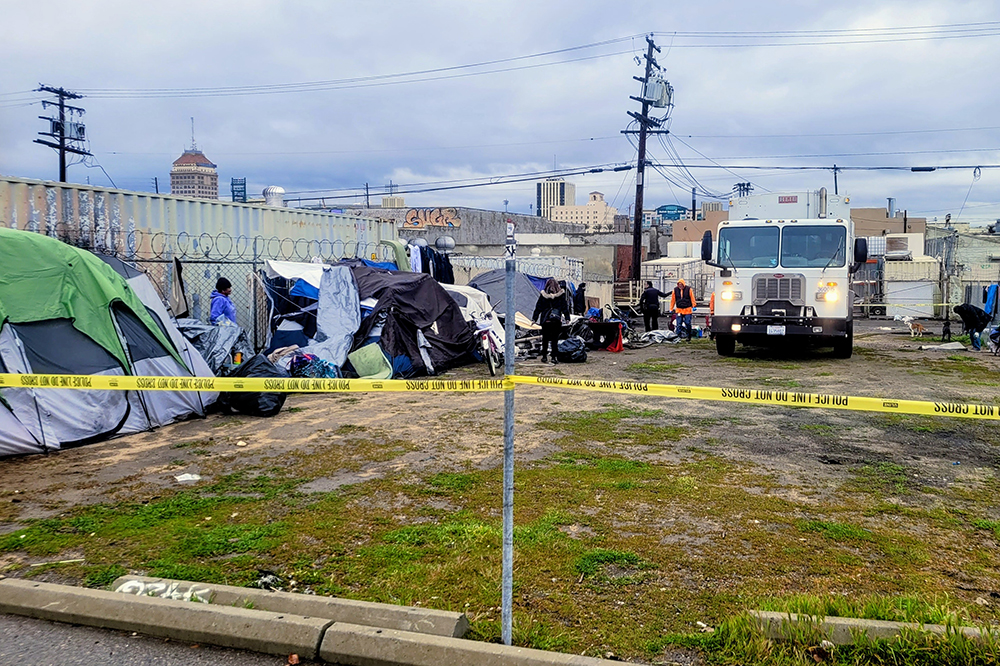
 A garbage truck enters an encampment where it will be used to crush and haul away the possessions of the people who had been staying there. Unhoused community members live in constant fear of losing all of their possessions. Photo by Bob McCloskey
Effort in Sacramento to Stop Fresno
SB 634, introduced by State Senator Sasha Pérez (D–Alhambra), was recently signed into law. As introduced in the Senate, SB 634 would have prohibited the criminalization of people experiencing homelessness for normal human activity such as sleeping.
The effort failed as that provision was removed due to pushback from cities such as Fresno and law enforcement. The final bill only prohibits the criminalization of those who assist people experiencing homelessness.
Although a city can continue to arrest, harass and force people to move and throw away their property, a violation of the Fourth Amendment of the U.S. Constitution, a city is not above the law. Currently, there is a class-action case on the Fourth Amendment issue, Brown v. City of Fresno et al., pending in the Fresno Superior Court system.
Lawsuits and Failed Policy
It is clear that enforcement of Fresno’s no camping ordinance has not solved anything. It has only “disappeared” the unhoused into jail and into constant temporary hiding.
Residents and businesses continue to call 311 to ask the Fresno Police Department (FPD) to endlessly force the homeless to move. Although they are moved temporarily, they often return to the same location soon thereafter, often without their survival gear because the FPD illegally confiscated it, in violation of the U.S. Constitution.
The mayor and the City Council should consider Kincaid et al. v. City of Fresno, a Fourth Amendment–based lawsuit that the City lost under the leadership of then police chief Jerry Dyer. Kincaid was a class-action lawsuit filed in 2006 on behalf of homeless residents whose personal property was unconstitutionally seized and destroyed by City workers during encampment “sweeps.”
The case ended in a settlement in 2008 (which concluded in 2013), with total damages awarded at $1,485,000. In 2025, in total disregard of the law, and again under Dyer’s leadership, the City is facing a similar lawsuit.
Misery and No Empathy
Besides creating a legal liability, the enforcement of the ordinance has made the poorest residents of Fresno more miserable. Fresno’s mayor and City Council seem to lack empathy for the unhoused residents of Fresno.
The City’s leadership has saddled more than 1,650 unhoused community members with permanent criminal records, and many with failure to appear bench warrants, making it almost impossible for them to ever get permanent housing.
Sweeps and harassment of homeless people often lead to severe negative health outcomes, including increased trauma, anxiety and depression due to displacement and loss of belongings, as well as higher risks of overdose and death from losing medications and harm reduction supplies. These actions also disrupt access to healthcare, increase physical injuries and fragment social support systems.
Sweeps can be a traumatizing experience, causing residents to feel dehumanized. The constant fear of future displacement, coupled with sleep deprivation, worsens anxiety and other mental health conditions.
The unpredictability of sweeps leads to chronic stress and the “anticipatory anxiety” of a sweep occurring at any time. Displacement disrupts routines, removes familiar social connections and can lead to a general deterioration of mental health.
Fresno’s Dangerous Ordinance
Fresno’s no camping ordinance and the policy and practice of sweeping encampments is dangerous and even deadly. Sweeps are linked to a higher risk of overdose, partly because they cause people to lose vital medications for opioid use disorder, sterile injection equipment and naloxone.
Studies show a significant increase in overdose deaths among those who are frequently displaced. People often lose critical medications for chronic conditions like HIV, hepatitis C or opioid use disorder, as well as essential medical equipment such as wheelchairs or walkers.
Displacement can lead to a higher risk of contracting infectious diseases, and involuntary displacement is associated with a significant increase in hospitalizations. The constant movement and lack of stable shelter can contribute to increased physical injuries.
Sweeps lead to the disruption of care and services and the loss of access to services. Sweeps in Fresno frequently occur without connecting people to alternative services or housing, forcing them to disperse and lose access to support systems.
The disruption of daily routines and relocation make it difficult for people to maintain connections with healthcare providers, leading to less effective management of chronic and infectious diseases. That leads to increased emergency room use, and, by disrupting ongoing care, sweeps can indirectly lead to increased use of hospitals.
Ordinance Enforcement Costs
While the City has recently cut back all departments by 5%, except the police department, City leadership is willing to waste public dollars on a failed campaign to “disappear” the unhoused. The costs of the no camping ordinance enforcement to taxpayers is high and a total waste of public resources.
To date, Fresno police officers have arrested more than 764 unhoused community members and cited more than 905 unhoused community members for violations of the no camping ordinance.
It has been costly for the taxpayers of Fresno, and the estimated cost to the court system and the prosecution (City Attorney’s office) for handling 1,600 misdemeanor (and criminal) cases in the Fresno Superior Court is difficult to determine due to a lack of publicly available, specific cost-per-case data for California prosecutors. The cost varies widely based on case complexity, whether the case goes to trial and other factors.
Based on general legal cost estimates, a single misdemeanor case can cost anywhere from $1,500 to more than $5,000. Applying a conservative average of $2,500 per case (assuming most are resolved without a full jury trial), the total estimated cost for 1,600 misdemeanors would be approximately $4 million. These costs do not include police time for arresting and citing people, booking costs and arraignment costs.
What is the City’s intent? Will the City continue to arrest and cite unhoused members of our community in a continued effort to make the homeless “disappear” at great cost to the taxpayers of Fresno?
Will the City prosecute the more than 1,669 pending no camping ordinance violations at great expense to the taxpayers?
Will the City continue to violate the Fourth Amendment of the U.S. Constitution? (The Fourth Amendment prohibits “unreasonable searches and seizures,” meaning that the government generally needs a warrant to seize property. This warrant must be supported by probable cause, an oath and must specifically describe the place to be searched and the items to be seized.)
Many in our community are saying that it’s time to end enforcement of the ordinance, comply with the U.S. Constitution and work toward a more humane and less costly solution.
Facebook
Twitter
Email
Print