
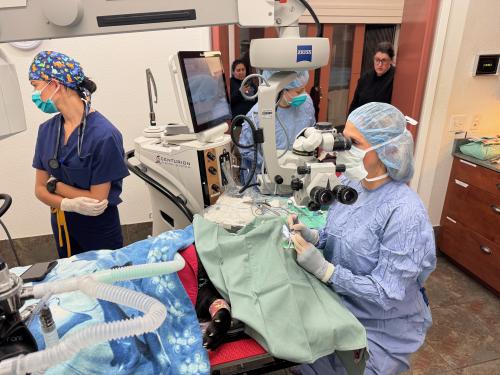
Based on his diagnosis, Edward would need cataract surgery on his left eye eventually. Because she knew Edward would not do well being farsighted in both eyes, Freeman set out to find a solution for Edward. She reached out to a former mentor of hers, Christopher Murphy, DVM, PhD, DACVO, who called a friend and human optometrist, Donald Mutti, OD, PhD. The two spent years working together to create intraocular lens measurements for various birds, including a falcon and an eagle.
“The amount of farsightedness in Edward’s eye without an implant would be extremely high,” said Mutti.1 “A high level of farsightedness in a person is about 10 diopters, units of optical power. My guess is that Edward was at about a level of 50 diopters, where he’d be able to see whether lights were on or off and maybe some gross motion, but there would be no capability for detail vision in Edward’s eye.”
Together, the vision specialists began working on calculating the specific measurements of Edward’s custom-made lens. Within the clinic, Freeman and a colleague performed high-resolution ultrasound and corneal measurements using a keratometer they borrowed from Micro Medical Devices. This helped them determine corneal dimensions and curvature. With the measurements, they were able to analyze and calculate the corneal curvature, length of the eye, size of the natural lens, and where the lens would sit post-surgery.1
The team settled on an optical power of 100 diopters for Edward’s lens after many different calculations and consultations with the lens manufacturer, an-vision. In comparison, cats are 53.5 on the scale, dogs are normally 41 diopters, and human lenses vary based on individual calculations.
Last month, Edward underwent his second cataract surgery on his left eye, and Freeman successfully implanted a custom-made lens into the left eye. At the time, it was determined the best course of action was to leave the right eye without a replacement since the eye was doing very well, and wolverine eyes are sensitive to procedures.
“Before the first surgery, he was very mistrusting of doing anything on the right side of his body,” said Dannemiller, about evaluating Edward’s vision. “After the surgery, we believe he can see a bit better, albeit aphakic, because he was more willing to present his right side during training activities. And now, after the second surgery, we notice improvements in his overall vision.”
Each day, Edward receives 2-3 drops, and with the help of his trainers, he voluntarily receives them. The team noticed that his vision had improved when he successfully outhunted Molly, a female companion he enjoys being around, for a small rodent that accidentally found its way into the exhibit.1
Wolverines can live 5-10 years in the wild and 15-20 years under human care. At this point in time, there are only about 30 wolverines in zoos and wildlife centers across North America, and they are listed as a threatened species under the Endangered Species Act.2 Habitat and climate change are the primary threats to the species, and it is estimated that 300 individual wolverines remain in the contiguous United States.
References
Groundbreaking Eye Surgery Performed on Wolverine at San Francisco Zoo. News release. University of California, Davis. November 26, 2025. Accessed December 2, 2025. https://www.vetmed.ucdavis.edu/news/groundbreaking-eye-surgery-performed-wolverine-san-francisco-zooNorth American wolverine receives federal protection as a threatened species under the Endangered Species Act. News release. US Fish & Wildlife Service. November 29, 2023. Accessed December 2, 2025. https://www.fws.gov/press-release/2023-11/north-american-wolverine-receives-federal-protection-threatened-species-under