
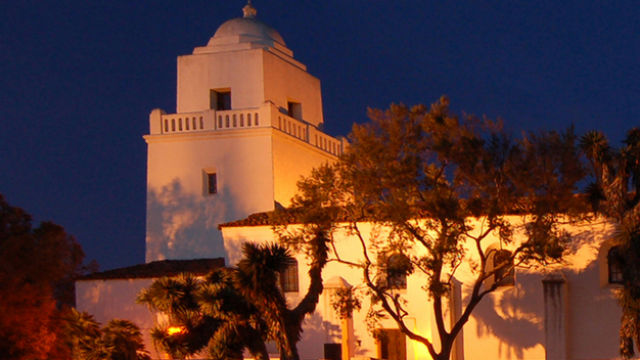
 Casa de Carrillo House in 2007. (Photo courtesy of SOHO/Sandé Lollis)
This first week of December in San Diego history highlights some of the city’s most important historic landmarks, connecting the modern city to its Spanish, Mexican, and early American roots.
On Dec. 5–6, 1932, several of San Diego’s earliest sites were formally recognized as California Historical Landmarks.
Fort Stockton, a Spanish and Mexican fortification later used during the Mexican–American War, was preserved for its military and civic significance. Overlooking the early Pueblo de San Diego, it served as a key defensive post during a period of political transition and unrest.
 A map of the area in 1820. (Photo via Wikipedia/Public domain)
Nearby, Presidio Hill—the site of California’s first European settlement and home to the Junípero Serra Museum—was designated to commemorate the city’s colonial origins and the work of missionaries and settlers who shaped early San Diego.
 The Junipero Serra Museum in Mission Hills at night. (Courtesy San Diego Museum Council)
El Desembarcadero, the landing site where Spanish ships first arrived in 1769, also received official recognition. Though the shoreline has shifted over the centuries, a marker on Point Loma commemorates this early point of access to San Diego Bay, a vital gateway for trade, settlement, and exploration.
 The historic marker. (Photo courtesy of Alvis Hendley, San Francisco via noehill.com)
Casa de Carrillo House, built in 1821 and considered one of the city’s oldest residences, was recognized for its role in domestic and social life, offering a glimpse into early California culture.
 Ship San Carlos landed (desembarcadero) in San Diego on April 29, 1769 (Photo via Wikipedia/Public domain)
Meanwhile, the Old Town Plaza, once the civic and social heart of the Pueblo de San Diego, was officially designated, preserving the central square where early residents conducted commerce, ceremonies, and daily life.
 First raising of the U.S. Flag in Plaza San Diego Viejo, with the Cosmopolitan Hotel in the background on July 29, 1846. The flag was raised by Lt. Stephen C. Rowan, US Navy Commander of Sailors and Marines. The site is a California Historical Landmark 63. (Photo via Wikipedia/Public domain)
These early December landmark designations helped safeguard buildings, plazas, and sites that might otherwise have disappeared under modern development. Today, visitors can walk among adobe walls, historical markers, and restored sites in Old Town and Presidio Park, tracing the paths of soldiers, settlers, and explorers who shaped the region. Interpretive plaques, museum exhibits, and preserved structures provide context for the city’s earliest chapters, allowing residents and visitors alike to experience living history.
 The view from Presidio Park. (File photo by Chris Jennewein/Times of San Diego)
Reflecting on these sites during the first week of December is particularly fitting. They remind us that San Diego’s history extends far beyond its beaches and skyscrapers. From early landings and military forts to adobe homes and civic plazas, the city’s early landmarks offer a tangible connection to its Spanish, Mexican, and early American chapters.
Preserved and celebrated nearly a century ago, these sites continue to teach, inspire, and anchor the region’s identity, allowing readers to step back in time and appreciate the layers of history beneath the contemporary cityscape.
Sources
California Office of Historic Preservation – California Historical Landmarks
Noehill: California Historical Landmarks – San Diego County
San Diego History Center archives (Presidio Park, Old Town, Early San Diego)
San Diego City Planning – Historic Preservation Program
Calisphere – University of California Digital Collections
Library of Congress – Prints & Photographs Division
San Diego History Center Digital Collections
Historical summaries on Fort Stockton (San Diego)
Historical references on El Desembarcadero (Point Loma landing site)
Historical summaries and archival materials on Casa de Carrillo House
Historical references on San Diego Viejo Plaza / Old Town Plaza
READ NEXT