
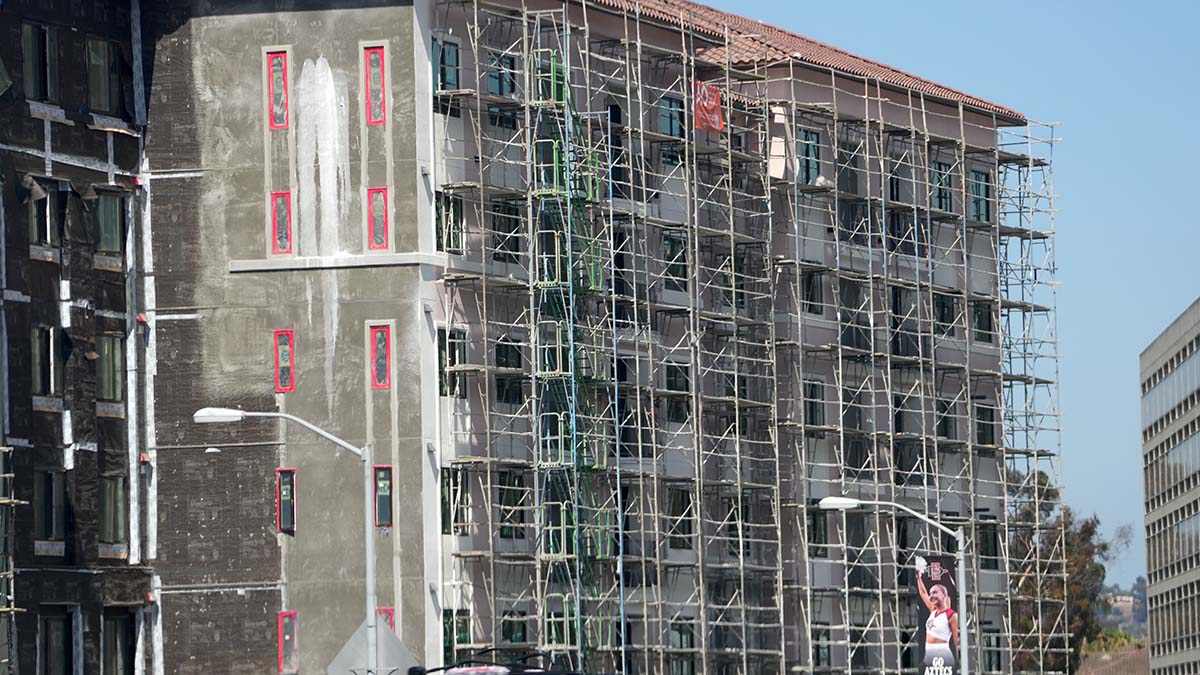
 Construction in San Diego. (Photo by Chris Stone/Times of San Diego)
The quarterly UCLA Anderson Forecast released Wednesday calls for the U.S. and California economies to “muddle through” early 2026 before beginning to grow again later that year.
“On balance, the forecast does not expect an immediate downturn or an immediate resurgence,” according to the UCLA economists. “Instead, both the nation and the state are poised to muddle through early 2026 before experiencing stronger growth in 2026 and 2027.”
The forecasters said tariff-induced inflation, policy uncertainty, and a weakening labor market are slowing the national economy, despite “optimistic investment in artificial intelligence infrastructure and rising income among high-wealth households.”
“The labor market is currently characterized by a state of paralysis and therefore gradual deterioration, marked by low levels of both hires and fires,” noted Senior Economist Clement Bohr.
And in California, the forecasters see a split economy: artificial intelligence, aerospace and other high-productivity sectors continue to expand, while construction, non-durable goods, leisure and hospitality, and government-funded services “face significant headwinds.”
The forecasters also expressed concerns about growing immigration restrictions, saying history shows deportations tend to raise unemployment among U.S.-born and documented workers because of reduced purchases of goods and services.
New construction in California is also facing headwinds due to workforce shortages tied to deportations, tariff-driven materials expense, and persistently high financing costs.
The forecast predicts the unemployment rate in California will peak at 5.9% early next year, average 5.5% for the entire year, and fall to 4.6% in 2027. Residential building permits are expected to rise from 101,000 this year to 121,000 in 2027.
“We continue to live in an era of elevated uncertainty,” concluded Bohr. “Not only does economic policy continue to fluctuate, as evidenced by shifting tariff schedules, but the longest government shutdown in history means that we have been partially blind as to how the economy has been unfolding over the fall.”
The UCLA Anderson Forecast is one of the most widely watched and often-cited economic outlooks for California and the nation. In March 2020, it was the first forecast showing the recession caused by the COVID-19 pandemic had begun.
READ NEXT