
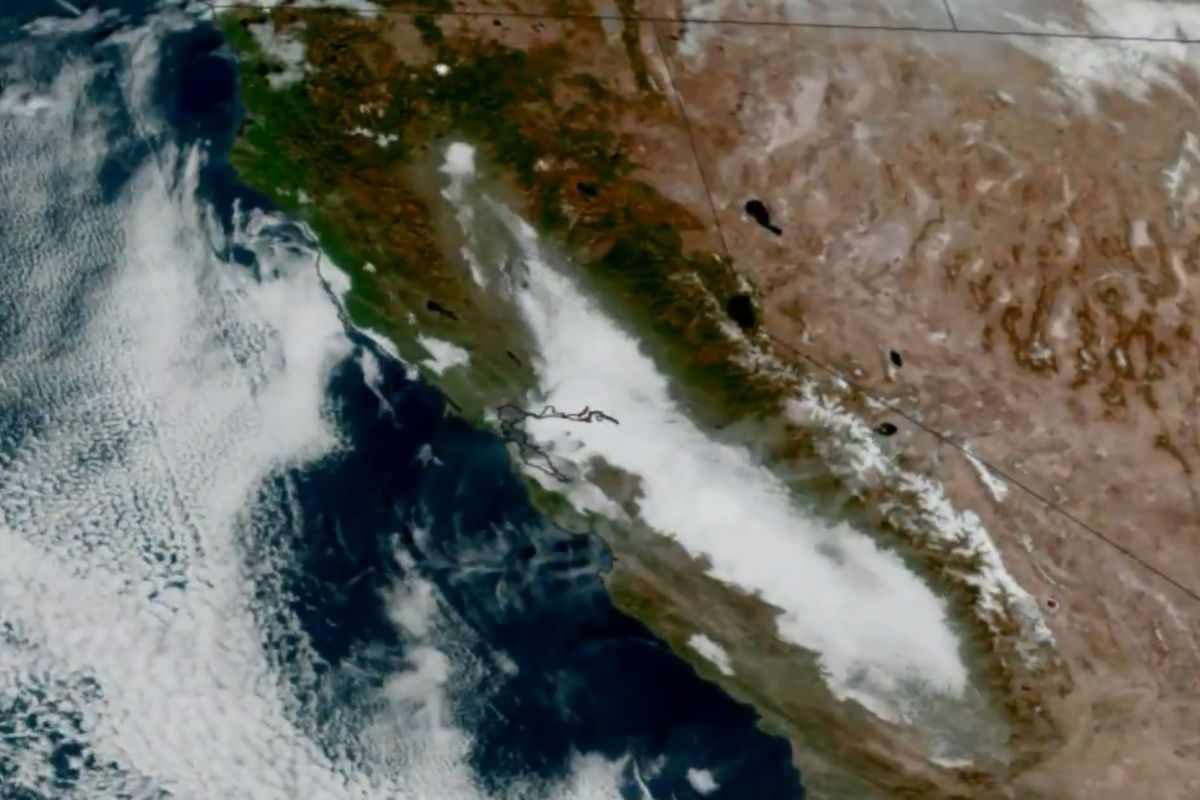
A thick layer of fog has smothered California’s Central Valley for several days, with satellite imagery capturing the sprawling haze from above.
Tule fog—a type of radiation fog—forms each year in the valley and is most common in fall and winter, according to the National Weather Service (NWS).
Why It Matters
Fog in the Central Valley area has prompted numerous weather alerts late November and early December, with officials warning of potentially dangerous travel conditions presented by the fog.
What To Know
The Los Angeles Times noted in a Monday report that tule fog had shrouded the Central Valley for more than a week.
The NWS explains that radiation fog is “a very common type of fog throughout the United States.”
Loading twitter content…
It says the fog develops overnight as air near the ground cools and becomes more stable. When temperatures drop enough for the air to reach saturation, fog forms—starting at or near the surface, then thickening as cooling continues. The fog layer also deepens through the night as the air above it cools, allowing the fog to expand upward.
“The most favored areas for fog development are sheltered valleys where there is little to no wind and locations near bodies of water. Wind would disrupt the formation of radiation fog,” the NWS says. Radiation fog is usually patchy, tends to stay in one place and goes away the next day under the sun’s rays. Thicker instances of radiation fog tend to form in valleys or over calm bodies of water.”
“The combination of a cool, moist layer of air from the Pacific close to the surface, clear skies above and light winds results in exceptionally thick fog on many nights from late October through February. This phenomenon is often visible on satellite,” it says.
What People Are Saying
The Cooperative Institute for Research in the Atmosphere said in a post on X, Monday: “Persistent fog and low stratus clouds have been plaguing California’s Central Valley for the last week.”
NWS Hanford said on X, Saturday: “Fog in the central valley typically forms as radiation fog, or fog that forms overnight as the air near the ground cools and stabilizes. Due to the unique geography of our region (bounded on three sides by mountain ranges), this fog has a hard time moving out of the region.”
What Happens Next
A dense fog advisory is in place from roughly Fresno south through to Bakersfield until 11 a.m. PST Wednesday, with the NWS cautioning that low visibility one quarter mile or less could lead to hazardous driving conditions.