
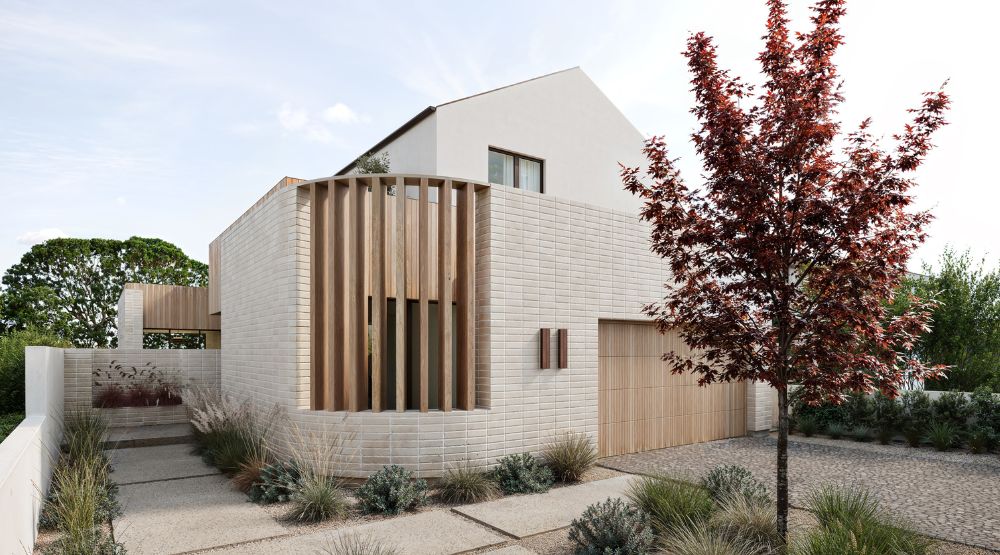
A rendering of AAHA’s courtyard home design. Image courtesy of AAHA.
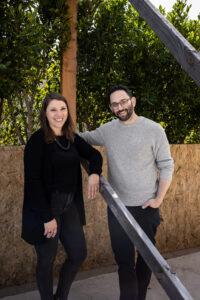 AAHA Studio’s Harper Halprin and Aaron Leshtz. Image courtesy of AAHA.
The Los Angeles fires destroyed thousands of homes earlier this year, throwing people into the emotional and physical quagmire of what they have lost – and what happens next. But one program – based on a previous effort to create affordable housing in the mid-20th century – looks to help people get a head start on rebuilding.
Called Case Study 2.0, the Los Angeles-based program offers a catalog of pre-approved, fire-resistant homes designed by 45 architectural firms (and growing). Launched by Crest Real Estate, the program aims to help homeowners build more affordably and faster than if they went through the usual process.
“The question wasn’t if we should help, but how,” said Steven Somers, CEO, Crest Real Estate, whose uncle’s home was among those that burned. “We quickly realized we are fortunate to have the network and experience to do something meaningful, and that’s when the idea for Case Study 2.0 was born.”
One of the first firms Crest reached out to was AAHA (pronounced ‘a-ha’), an architecture and interior design studio run by husband-and-wife duo Harper Halprin and Aaron Leshtz, who went to high school with Crest’s founders, brothers Steven and Jason Somers. After a traumatic event such as a fire, researching architects, contractors, etc. is overwhelming, Leshtz said. “This program puts people on second base.”
Both Halprin and Leshtz grew up in Southern California and the firm primarily works in the state. “We have a lot of connection to the community.”
Firms in the Case 2.0 program submitted designs based on two standard lot sizes, Leshtz added. AAHA envisioned a space for a typical client – families that need flexible, kid-friendly spaces that can adapt over time.
The small lots challenged AAHA to think about how to create defensible space around the home; the closer a home is to its neighbors the quicker fires can spread throughout a neighborhood, Leshtz said; something the city experienced in the Palisades and Eaton fires. Their home design for Case 2.0 is in a C-shape, with a courtyard in the center, to give the homeowners additional space away from their neighbors – and every ground-floor room offers outdoor access. It’s a five-bedroom, 3,500-square-foot design with an option for a basement (which also has a bedroom).
Related: Why one interior designer became an unexpected ally in insurance claims
Choosing the right materials for the design was paramount, Leshtz said, aiming to keep them simple and fire-resistant, to prolong the time it would take fire to spread through the home. Some of those solutions are “low-hanging fruit” – their design uses a brick exterior on the first floor and stucco on the second, for example. Other fire-resistant features include an eave-less design and gutter guards.
Some experts recommend keeping plants away from the exterior walls of the home, as they may help spread the fire, but Leshtz said it depends on the species. While some can dry out and become kindling, other plant species are more fire-resistant. Fire-hardening doesn’t have to be complicated or expensive.
This community effort is a bright spot in what’s been a trying year. Leshtz knew several people who lost their homes in the fires, including one of their projects that they had just finished and photographed last November. “The first six months of the year were quite an emotional journey,” he said.
“What began as a way to aggregate great single-family home designs and streamline the rebuild process has grown into something much larger,” with the response exceeding “anything we imagined,” Somers said. The program allows architects and builders to “tap into material discounts we’ve negotiated and collaborate on timelines and efficiencies.”
AAHA has always prided itself on helping clients realize their vision, and the Case 2.0 program is just another extension of that, one that is even more community focused. “Our job as architects is to put everybody in the best position possible,” Leshtz said.