
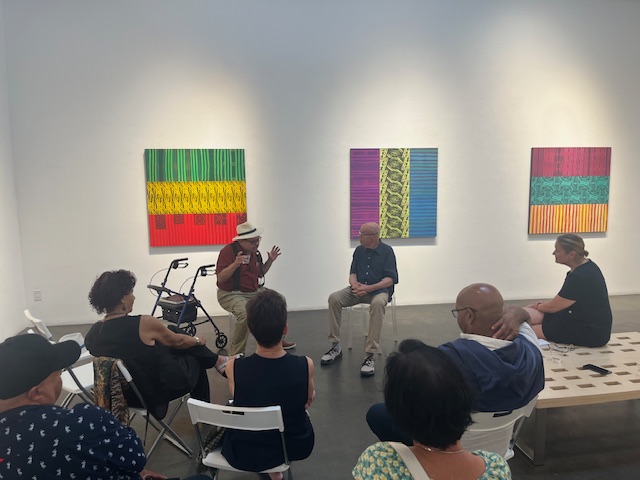
[NoHo Arts District, CA] – This month’s LA Art blog features Richard Berman’s Interweavings exhibition at Nuart Gallery, a layered collage series exploring cultural history, symbolism, and modern identity.
Interweavings at Nuart Gallery
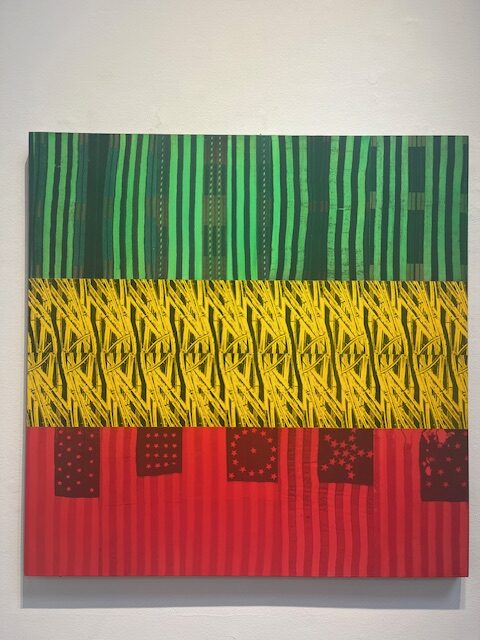
Richard Berman’s Interweavings exhibition at Nuart Gallery delves into a rich exploration of visual history, cultural symbolism, and the intersection of modernity through a set of painted collage panels. These deeply layered works juxtapose imagery from diverse historical sources, weaving together Navajo chief blankets, 19th-century American flags, and aerial freeway views. Through this combination of references, Berman creates a conversation that spans centuries, offering a striking commentary on how the past and present coexist within our visual and visceral consciousness.
Visual Language and Cultural Layers
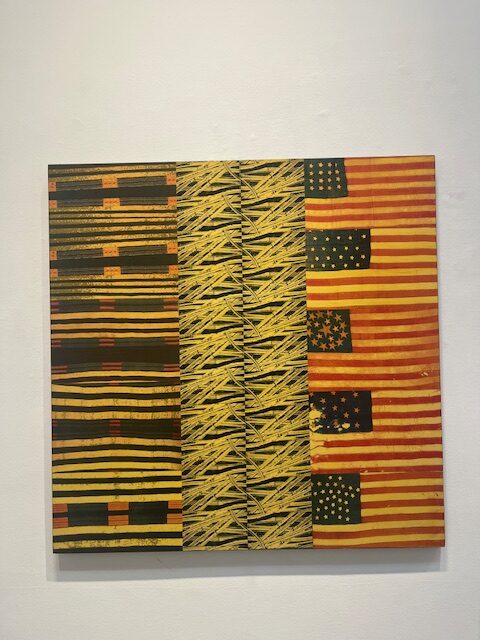
Berman’s painted collages are a masterful fusion of contrasting yet related imagery. On one hand, the panels feature the bold, intricate patterns of Navajo blankets, symbols of Native American heritage and craftsmanship. On the other, they incorporate the stark geometry of 19th-century American flags, invoking the iconography of the United States’ early history (which was the catalyst for dethroning Native American culture and craft. By pairing these symbols with the more modern, industrial imagery of aerial views of freeways – representing the rapid growth and technological advancement of contemporary society -Berman constructs a visual language that speaks to the complexities of cultural identity, progress, the legacy of the past, and contemporary inclusion.
Tension Between Past and Present
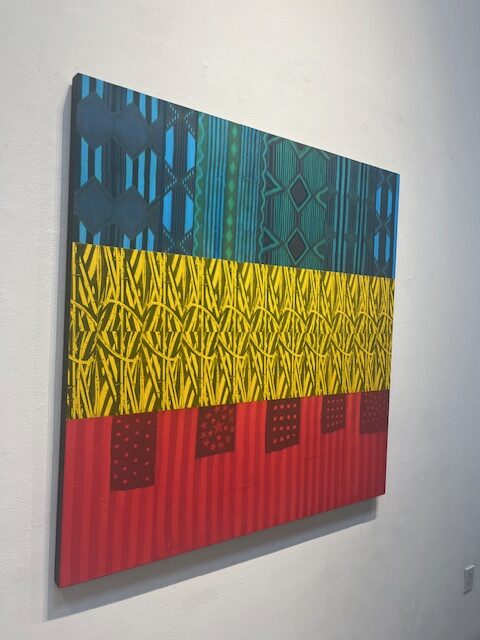
The juxtaposition of the native and the industrial forms creates a tension between tradition and modernity, while also emphasizing the deep-seated connections between culture, history, and technology. For Berman, these images aren’t just relics of the past or symbols of a bygone era. Instead, they are living, breathing entities, woven into the fabric of today’s landscape, offering viewers a glimpse into the continuous dialogue between what has come before and what is being built in the present moment.
Layered Meaning Through Texture and Form
One of the most compelling aspects of Berman’s painted collages is the way he layers meaning through texture, color, and form. The artist doesn’t simply place these historical references side by side; he integrates them in ways that allow each layer to speak to the others. The fluid, almost organic patterns of the Navajo blankets contrast sharply with the rigid, linear structure of the American flags, while the sweeping, curving lines of freeway imagery cut through the composition, offering a modern, almost mechanized counterpoint to the natural world represented by the blankets.
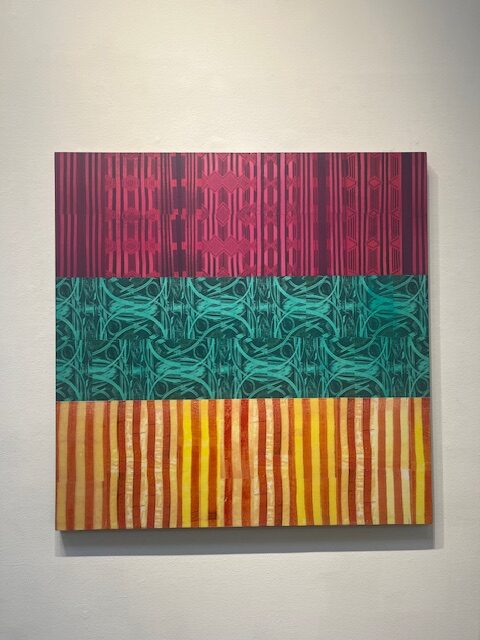
This layering of elements invites viewers to interpret the works on multiple levels. On one level, there is a formal engagement with the way visual patterns and symbols can be combined to create new meanings. On another, the cultural references in the artwork provide an opportunity for reflection on the evolution of American identity and the ongoing impact of both indigenous traditions and industrial progress. Berman’s use of collage also hints at the fragmentation of contemporary society, where multiple, often conflicting narratives coexist and shape our collective understanding of the world.
A Dialogue Across Centuries
Berman’s Interweavings is not just a retrospective of past visual traditions; it’s a dynamic conversation between centuries of visual history. The artist’s decision to pair the historical with the modern reveals his belief in the cyclical nature of time, where the past continuously reverberates through the present. The Navajo blankets, which hold centuries of cultural significance, are positioned against the backdrop of American flags – a symbol of the nation’s founding and growth. Which we frequently forget is as faltering as it has been burgeoning in such a short span of time. The addition of aerial views of freeways brings this dialogue firmly into the 21st century, suggesting that the landscapes we now inhabit are the product of both historical heritage and contemporary engineering.
The freeway imagery in particular is a telling inclusion in Berman’s work. Aerial views of highways, which represent the spread of urban sprawl and the mechanization of our daily lives, evoke feelings of detachment and distance from nature. This stark contrast to the intricate and organic designs of the Navajo blankets suggests that modernity, for all its technological advancements, has created a divide from the rich cultural roots that once connected people to the land.
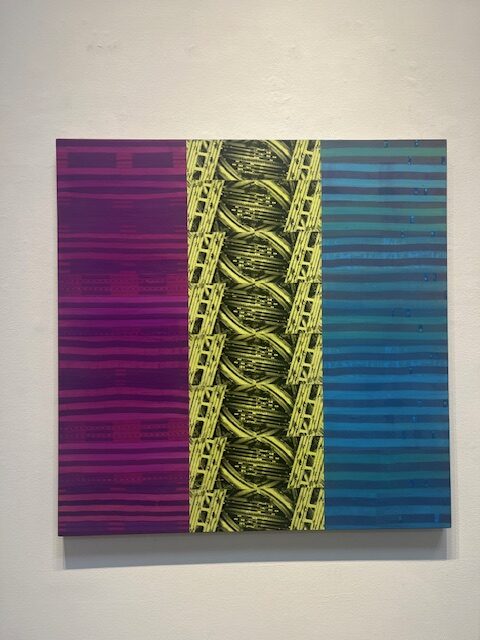
Yet, Berman’s skillful use of collage and layering allows these contrasting elements to coexist in harmony. The apposition of seemingly disparate imagery not only tells the story of how American culture has evolved but also how these historical moments and symbols continue to influence modern identity and consciousness.
Final Thoughts on Interweavings
Richard Berman’s Interweavings exhibition uses painted collage panels to create a profound and visually arresting dialogue between cultures, histories, and landscapes. The work serves as both a reflection on America’s cultural heritage and a meditation on the ways modern technology and infrastructure shape our world today.
Berman’s ability to layer these symbols and images so intricately allows for a nuanced understanding of history’s influence on contemporary society, suggesting that we cannot understand the present without acknowledging the legacies of the past. The artist’s work challenges us to reconsider how we engage with our cultural and technological landscapes, asking whether we have truly reconciled the past with the rapidly evolving world we inhabit. Through Interweavings, Berman invites us to look deeper into the fabric of our society and recognize the connections that bind us to both history and the future.
Find Out More About Richard Berman’s Interweavings
https://www.nuartgallery.com/exhibitions/206/works
https://www.artsy.net/artist/richard-berman