
Coast-side Southern Californians can expect the return of perigean spring tides — more commonly known as king tides — on Thursday. These exceptionally high tides occur when the sun, moon and Earth align, increasing the gravitational tug on the ocean tides.
The full moon exerting its pull is the last supermoon of 2025, the third after supermoons in October and November. December’s event is called the Cold Moon because it rises amid longer, chillier nights approaching the winter solstice, according to the Old Farmer’s Almanac.
The king tides will continue into Friday and occur again on Jan. 2 and 3.
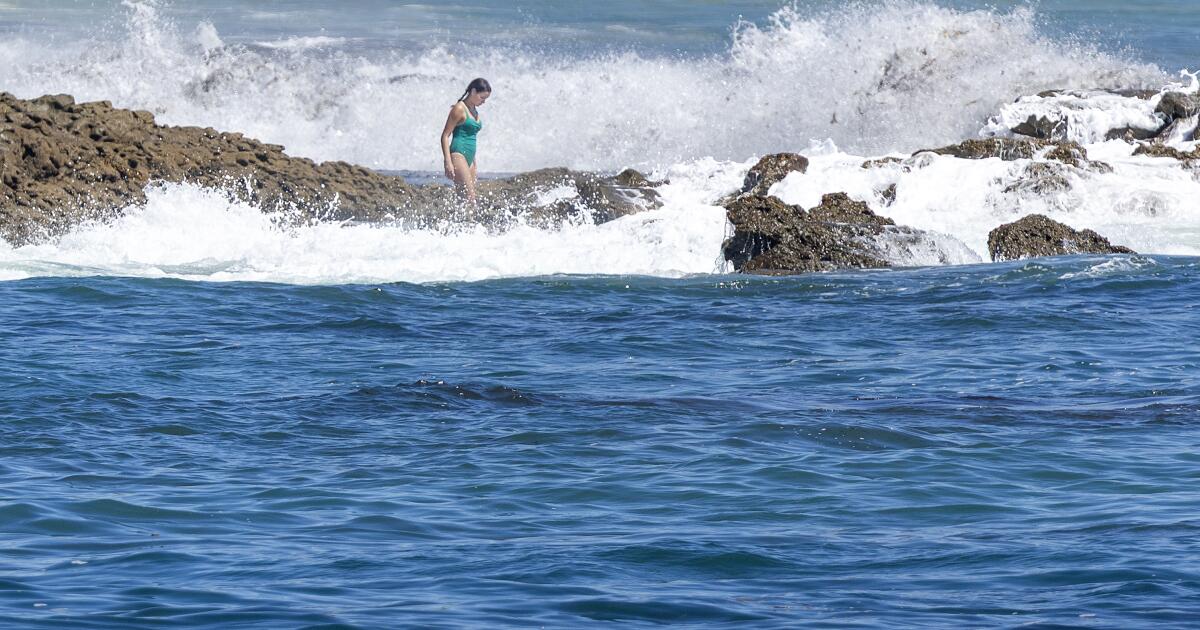
The National Weather Service warned California beachgoers on Wednesday to stay out of the water due to hazardous swimming conditions as rip currents can pull swimmers and surfers out to sea. The agency also advised staying off rocks: “Rock jetties can be deadly in such conditions.”
Though the massive waves can present dangers for seaside visitors, king tides provide insightful data into what the regular high tide will look like in years to come as sea levels continue to rise.
By 2050, the median sea level on the California coast is expected to rise as much as 1.2 feet and, by 2100, as much as 6.6 feet. Climate change is playing a big role in this shift as a high concentration of carbon dioxide (caused by the burning of fossil fuels) traps heat, melting land-based glaciers and ice sheets into the ocean.
Understanding rising sea levels and identifying flood-prone locations will inform decisions on the best infrastructure for safer coastal communities.
Here is more information on king tides and how you can safely watch the crashing waves — and even partake in some fun data collection.
What causes a king tide?
King tides occur when the ocean is “pulled” back and forth by the gravitational tug of the moon and the sun. These tides typically occur during a new or full moon, causing the oceans to bulge a bit more than usual. They are called “perigean” spring tides when they coincide with the moon being at “perigee,” or its closest approach to Earth.
King tides are natural and predictable and not related to climate change.
What does a king tide look like?
In simple terms, the high tides are higher and the low tides are lower than average.
But because these high tides can reach 1 to 2 feet higher than average high tides, they provide a glimpse into the future of sea level rise over the next few decades.
What are the dangers associated with king tides?
A high tide can wash people offshore and capsize small boats near shore. High tides can also cause flooding and beach erosion and, in some cases, cliff and bluff collapses.
The National Weather Service beach hazards statement cautioning visitors to stay out of the water due to hazardous swimming conditions is in effect through Saturday.
The warning includes the Santa Barbara County coastline, the Malibu coast and Los Angeles County beaches. Those areas are expected to see high tides of 7.2 to 7.8 feet.
In the San Diego County and Orange County coastal areas, elevated surf of up to 5 to 6 feet is predicted, and the San Francisco Bay Area has been warned of breaking waves up to 14 feet high.
For more information on tides and currents, visit the National Oceanic and Atmospheric Administration website.
How can I safely watch king tides?
Despite the dangers associated with king tides, people can view this phenomenon safely — if they take a few precautions — from various locations throughout the coast as part of the California King Tides Project.
The initiative is led by the California Coastal Commission to help visualize future sea levels and flood risk in coastal areas. Participants can snap a picture around high tide and upload it onto a tide map, which can later be used by government agencies for research and planning. Scientists can also use these images to better predict future sea levels.
Participants should take extra precautions when walking on slippery areas and keep their distance from the waves. Keep an eye on local beach conditions.
Some frequently repeated and wise words of advice: Never turn your back on the ocean.
Catching a glimpse of the Cold Moon is best done at moonrise on Thursday, around 4:20 p.m. in Southern California, when the moon illusion means that our satellite appears larger as it rises above the horizon.