
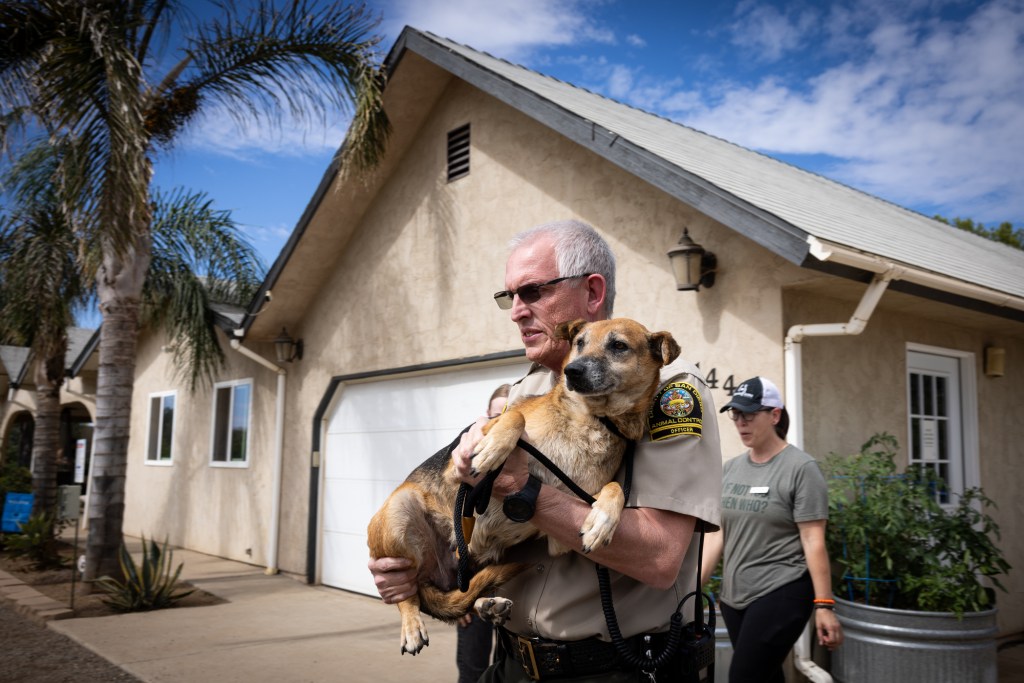
A law enforcement call in the animal kingdom can take many forms.
San Diego County animal services officers can investigate a person for hoarding dogs, or owning a ferret as a pet — a crime in California.
They respond to coyote pups separated from their mothers and to birds with broken wings. Cockfighting draws scrutiny, too, with homes searched for steroids or gaffs — the sharp blades that get strapped to a fighting rooster’s feet.
Lt. Lewis Petersen has seen this and much more in his 35 years with the county’s Department of Animal Services, which handles animal control for all of the county’s far-flung unincorporated areas.
That means officers spend a lot of each 10-hour shift on the road, bouncing between county shelters, mountain ranges and the dirt roads of rural communities. “The job can get very monotonous,” Petersen told The San Diego Union-Tribune recently, en route to an injured bird on a Mount Laguna roadside.
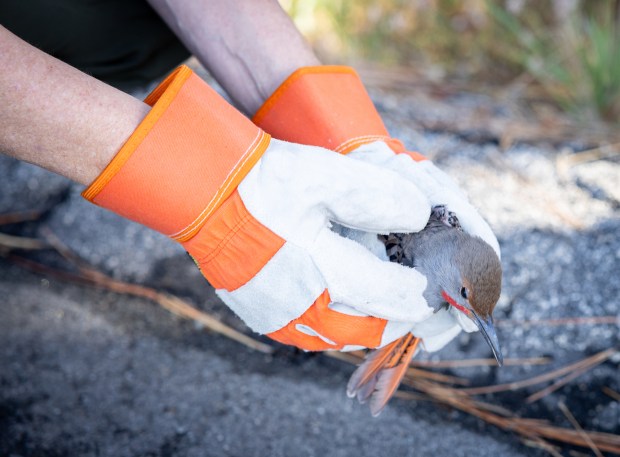 Animal Control Lt. Lewis Petersen picks up a northern flicker that was likely hit by a car on Friday, Oct. 10, 2025, in Mount Laguna. The bird was taken to Project Wildlife, where staff would assess whether it could be released back into the wild or needed to be euthanized. (Ana Ramirez / The San Diego Union-Tribune)
A decade ago, the county agency was a major player in animal welfare across the region, its officers across three shelters serving six cities, including San Diego, along with unincorporated communities.
Then in 2017, an effort led by a Republican-controlled Board of Supervisors saw the department hand over its contracts with cities to the San Diego Humane Society, which led the county to lay off dozens of staffers.
In the years since, the department has seen turnover soar.
Forty of its 59 employees left last year — a turnover rate of 68%.
In its budget, the agency has the money for 12 officers. But until November, for months only five had been in the field, tending to injured wildlife, wrangling stray dogs and urging animal owners to comply with county rules.
Petersen said turnover has hurt the department for a long time, but it’s recently claimed many experienced officers — meaning many of the personnel getting sent out on calls are brand new to the job. It’s also affected the agency’s shelter and other administrative staff.
“It’s been just difficult for us,” he said.
Amid the wave of turnover last year, a new director arrived to the department with an eye on rebuilding it.
 Animal Services Director Vaughn Maurice has a meeting with staff on Wednesday, Nov. 5, 2025, in Bonita. (Ana Ramirez / The San Diego Union-Tribune)
Vaughn Maurice, a Louisiana native, formerly worked as the animal services director for Stanislaus County and the executive director of the Humane Society of Utah.
His office sits in the corner of a wood-paneled trailer strung with an American flag and animal-print blankets at the department’s Bonita shelter.
“COVID didn’t help any animal organization,” Maurice said, blaming his department’s past turnover on the strains of the pandemic, long shifts and nationwide trend in shelter overcrowding that hit the department’s two shelters hard.
“A lot of organizations nationally saw an increase in turnover,” he said. “We saw more than our fair share of it, but certainly it was not isolated to us.”
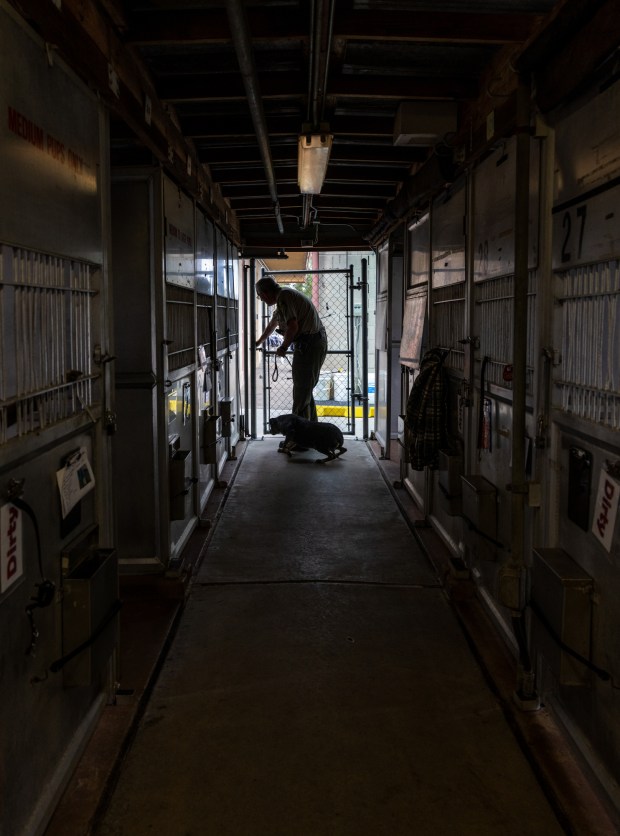 Animal Control Lt. Lewis Petersen takes a dog to a kennel at the Bonita shelter. (Ana Ramirez / The San Diego Union-Tribune)
To fight turnover, Maurice has shortened officers’ shifts from 13 hours to 10. Dispatch now triages calls, at times asking residents to bring animals to shelters themselves in a bid to cut down on work for officers.
This year, the department is on track to have lost only 36% of its staff, nearly halving last year’s turnover rate, he said.
Petersen said new officers take to the law enforcement part of the job very quickly. But he said the breadth of calls officers have to handle in the field proves more difficult.
During a ride-along with the Union-Tribune, Petersen recovered an injured northern flicker woodpecker and a bloodied raccoon from roadsides in Mount Laguna. He drove them to Project Wildlife, the San Diego Humane Society’s wildlife rehabilitation program, near the University of San Diego.
“You can teach someone to handle animals,” Petersen said. “But to go into an experience with every type of animal there is, it’s not the same. It’s really hard to pick up.”
Later in the day, he picked up two stray dogs from properties in Ramona, hoisting them into stalls on his truck before driving them back to the county’s shelter in Bonita.
At the shelter, Petersen weighed, photographed and gave tick medicine to one of the two strays, before leading it down a corridor of cages with barking dogs — many of them up for adoption and tended to by staff and volunteers.
The county has made considerable investment to replace the 70-year-old Bonita shelter, where the repairs it needs are now far more expensive than replacing the facility.
Last year, the county broke ground on a $37 million shelter in Santee, which will give staff and officers a new, modernized outpost to house animals and get dispatched to calls throughout the county.
The new shelter is set to open in the summer. No plans have been made for the future of the Bonita shelter, which sits near the Sweetwater Reservoir. Another shelter in Carlsbad will continue to operate.
‘An amazing agency’ under strain
For years, when San Diego County faced a wildfire or other emergency, Denise Gove was in charge of saving the animals. She led the department’s community animal response team, or CART; its volunteers would work behind roadblocks to evacuate animals and get them to safety.
“It was an amazing agency,” said Gove, who retired this year after 13 years with the department.
Ten years ago, Gove recalls, the department took a lot of pride in its emergency response efforts and training academy, and its staff were well-trained and could rely on their superiors.
At the time, the department’s staff serviced San Diego and the smaller communities of Carlsbad, Del Mar, Encinitas, Solana Beach and Santee. But county supervisors had other plans for the agency.
Looking to cut costs, supervisors ended the contracts with the cities. The Humane Society, already the animal services provider for a handful of cities, won those contracts; it still serves 13 of the county’s 18 cities.
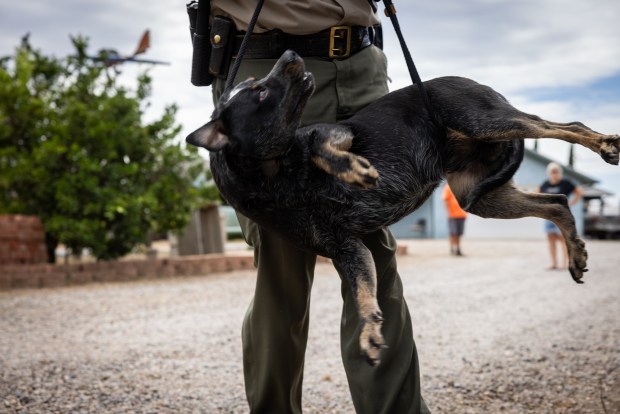 Animal Control Lt. Lewis Petersen lassos a Queensland heeler that was found by a couple on Friday, Oct. 10, 2025, in Ramona. (Ana Ramirez / The San Diego Union-Tribune)
Supervisors then launched a separate effort they called managed competition. Animal services had to submit a bid alongside the Humane Society to show it could keep serving unincorporated communities at the lowest possible cost.
“This is healthy,” then-Supervisor Dianne Jacob said at the time. “It gives (employees) the opportunity to get together, huddle down and say, ‘How can we become more efficient? How can we become better at what we do?’”
The department beat out the Humane Society for the unincorporated area. But as a result of losing the contracts with the cities, its staff was slashed from 124 to 60, its budget from $19 million to $8 million.
Weeks before supervisors ended the contracts with cities in 2017, longtime director Dawn Danielson retired. Another longtime official, Dan DeSousa, succeeded her but retired in 2020.
To replace DeSousa, the county tapped Kelly Campbell, a former executive with the American Society for the Prevention of Cruelty to Animals; she started the job in March 2020, just as the COVID-19 pandemic began.
During her tenure, turnover in the department jumped. That year, the department lost more than a quarter of its employees, and a similar share the following year. In 2022, turnover rose to 45%; it hit 52% the following year.
Meanwhile, Gove said, the agency became increasingly chaotic.
“I cannot even comprehend the cost of this staff turnover,” she said. “It costs a lot of money to hire a person, obviously to pay for it and the training — and then all of that walks away.”
Campbell left last year. She did not respond to requests for comment.
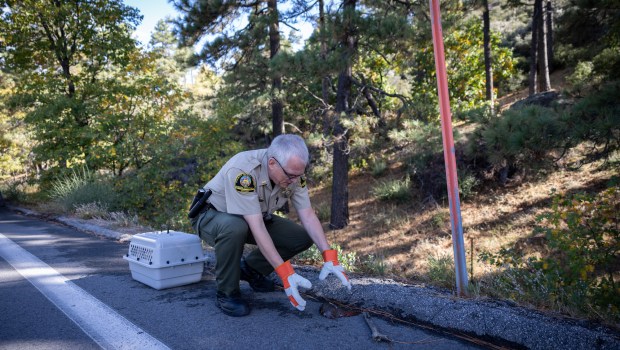 Animal Control Lt. Lewis Petersen prepares to pick up a northern flicker from the side of the road on Friday, Oct. 10, 2025, in Mount Laguna. (Ana Ramirez / The San Diego Union-Tribune)
Two interim directors — Steve Lujan and Carl Smith — followed. But both men’s brief tenures were punctuated by accusations of retaliatory firings from former staff, county records show.
Officer Melissa Prettyman said Smith accused her of defamation, demanded $13,000 and eventually forced her to resign, after she complained about him at a county supervisors meeting and reported his relationship with a subordinate to human resources. The county denied a claim she filed last year, said spokesperson Chuck Westerheide.
In an interview last week, Prettyman said she recently filed a lawsuit. The former animal services officer of 13 years said the turnover she witnessed meant the public had not gotten “the quality service they deserve” from the agency.
When Lujan was interim director, shelter processing technician Susannah Clayton says she complained to him that the agency was illegally spaying cats in the shelter before officially classifying them as strays, and that he responded by telling her to resign or be fired. The county settled a lawsuit she filed this year for $65,000, Westerheide said.
Neither Smith, who no longer works for the county, nor Lujan, now the county’s assistant director of child support services, returned a request for comment.
Clayton declined a request for comment, and the county declined to comment on her lawsuit.
‘Let’s look to the future’
Maurice said he’s not aware of any issues with retaliation under past leadership. But he’s focused on righting the department, and stanching the flow of experienced staff.
“You have to take the attitude of: Let’s start from where we are,” he said. “We’re not here to worry about the past. Let’s look to the future. Let’s do what we can to make things right within the shelter, and look at how can we make some changes to help employees so that they want to stay and can do their job better.”
Other metrics show the department trending in the right direction, Maurice added. It’s now fully staffed with 12 officers — it added five new ones just last month, all of them with past experience in animal services.
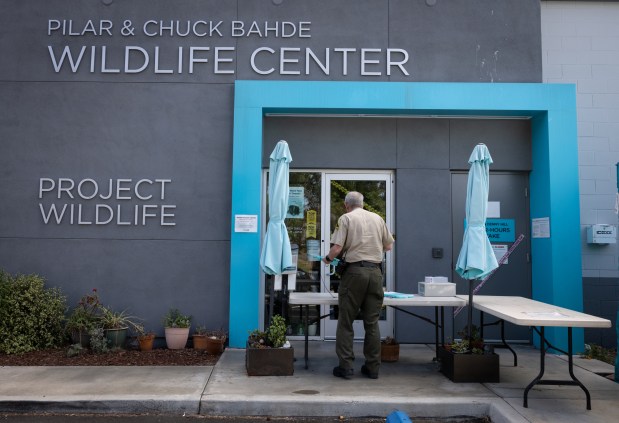 Animal Control Lt. Lewis Petersen drops off a bird and a raccoon at Project Wildlife on Friday, Oct. 10, 2025, in San Diego. (Ana Ramirez / The San Diego Union-Tribune)
Petersen welcomes the needed help from the new hires, adding he thinks “new leadership is taking the department in the right direction.”
Reforms have also reduced the number of open cases officers have to work, with average monthly open cases dropping from 157 last year to 30 this year. That’s been achieved through multiple policy changes, Maurice said, like relying on other staff to transport animals and setting standards to close out unsubstantiated complaints.
And the average amount of time animals spend at the shelter — a key metric — dropped from 33 days when Maurice joined the department to 21 days. Maurice cited the department’s expanding social media presence and community events for the drop.
The share of animals that are euthanized also fell over the same period, from 10% to 7%.
With the department set to move into its new shelter in May, Maurice said it’s “in a great place moving forward.”
“We can always get better,” he said. “Certainly there’s more room for improvement, and we’re working on that.”