
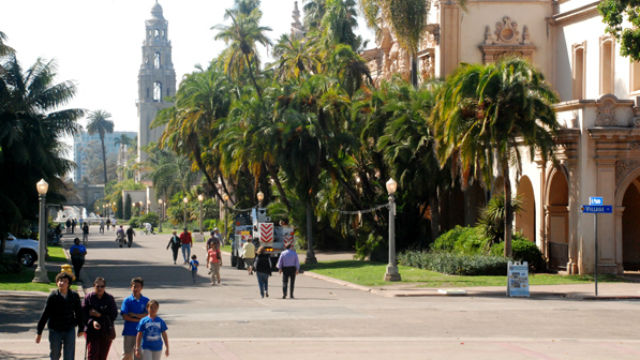
 Pedestrians cross the Plaza de Panama in Balboa Park. (File photo by Chris Stone/Times of San Diego)
City of San Diego officials implemented a complicated fee structure for parking in Balboa Park, set to begin Jan. 5, without fully vetting its unintended consequences.

The City Council approved the proposal despite the concerns and testimony of park users, park institutions and park organizations big and small. Together, they expressed an emerging general consensus: It is not right to use San Diego’s Crown Jewel to fill a tiny piece of the city’s budget gap.
This rushed decision risks what the World Cities Culture Forum called “the heart of thriving cities” — culture.
“It is a crucial part of a city’s fabric, a golden thread that runs through all aspects of urban policy,” the UK-based nonprofit wrote.
Culture is an expression of community, shared values and creativity. Balboa Park is San Diego’s soul.
The paid parking implementation did not take into consideration any understanding of what Balboa Park is, or what the park provides to a rich tapestry of our citizenry.
Balboa Park is one of the world’s great city parks. It attracts visitors from all over the planet. It is the largest assemblage of museums and cultural institutions in our country outside of Washington D.C. It serves organizations from a broad cross-section of our community, serving youth to seniors.
It’s also a place to stroll, picnic, commune with nature and sit and watch the parade of visitors go by. It is first and foremost something that belongs to the people of San Diego.
Balboa Park is one of San Diego’s global calling cards, but it is also a regional park and the neighborhood park for Uptown, North Park, South Park, Hillcrest, Barrio Logan, Sherman Heights, Stockton, Grant Hill, University Heights, Golden Hill and downtown. In addition, the Park Boulevard academic corridor, beginning in the park, is one of the region’s largest educational clusters, with thousands of students coming into the area each day.
The plan for paid parking appears to have been based on only one question: How much revenue can it generate? And yet, that money will not represent any new dollars for park improvements. City officials’ expedited planning process did not allow for any consideration of what Balboa Park provides to the community.
Global placemaking guru Fred Kent and his team assessed Balboa Park in 2022 for the Social Life Project. “The depth of what Balboa Park offers to visitors is immense,” they wrote. “One gets a taste of so many cultures and forms of artistic expression, and gets the feeling of the enormous creativity coming from across the globe — far more than anyone would otherwise be able to experience in their lifetime”.
But the city did not weigh how paid parking plan impacts all of this in their planning process. Or, maybe we can say they simply ignored it. In either case, it was not a good move for building public trust.
City officials should have conducted an analysis of the park’s benefits, and the impacts of paid parking, as part of planning their proposal. Moving forward, we need to gather data to make decisions on whether to modify the fees or to even continue charging at all. But numerical metrics alone rarely are useful in making decisions on well-being. As Albert Einstein reminds us, “not all things that can be counted count, and not all things that count can be counted”.
The analysis must go beyond the usual revenue and attendance generation from the institutions. It must engage park users and stakeholders in a dialog. And the dialog must be more than an online survey or a one-off workshop. True engagement is labor intensive, but is the only way to reach the best answer to the question. The evaluators should go to the park and observe and interview as part of the process. Parking revenues themselves should cover the cost of this analysis, and a trusted park leader like Forever Balboa Park should manage the process.
Alas, the parking plan for Balboa Park is really a short-term, desperate solution. What is needed is a big, audacious vision and plan for what our beloved Balboa Park can become in the 21st century.
Perhaps a private, citizen-led bond measure could pay to build that vision, or it could come from some other combination of public, community or philanthropic resources. This source could fund all the infrastructure-deficit improvements, ongoing maintenance, parking needs and maybe even a new, architecturally significant world class building or icon that represents the soul of San Diego.
Michael J. Stepner, FAIA, FAICP, is former City of San Diego Architect and Professor Emeritus of the New School of Architecture and Design. He is the recipient of the 2024 AIA San Diego Lifetime Achievement Award.
Mary Lydon, the principal of Lydon Associates, has held leadership roles within the Urban Land Institute, the Downtown San Diego Partnership, and Housing You Matters. She also served on the City of San Diego Planning Commission. She currently serves on the boards of the National Center for Creative Land Recycling, UCSD Housing Policy and Design Center and Humble Design San Diego.
Want to submit a letter to the editor, guest column or opinion piece? Find our guidelines and submission form here.
READ NEXT