

At a standing-room-only Sacramento city council meeting in November, District 4 City Councilmember Phil Pluckebaum sat at the dais, multitasking.
He was listening to the over 50 public commenters who came to speak for and against a project that would build warehouses on environmentally protected land in Natomas.
At the same time, he was also monitoring a meeting at the County Board of Supervisors on a clean energy project that would need to cut down trees in order to build solar panels on his computer.
“ Typically what I’m doing is monitoring what’s happening on the metro cable stream at the same time that we’re having our meetings,” Pluckebaum said. “In part because there’s closed captions.”
On the monitor, he noticed an orange creature with an obtrusive yellow mustache—resembling a famous Dr. Seuss character—walk up to the podium to speak before the supervisors.
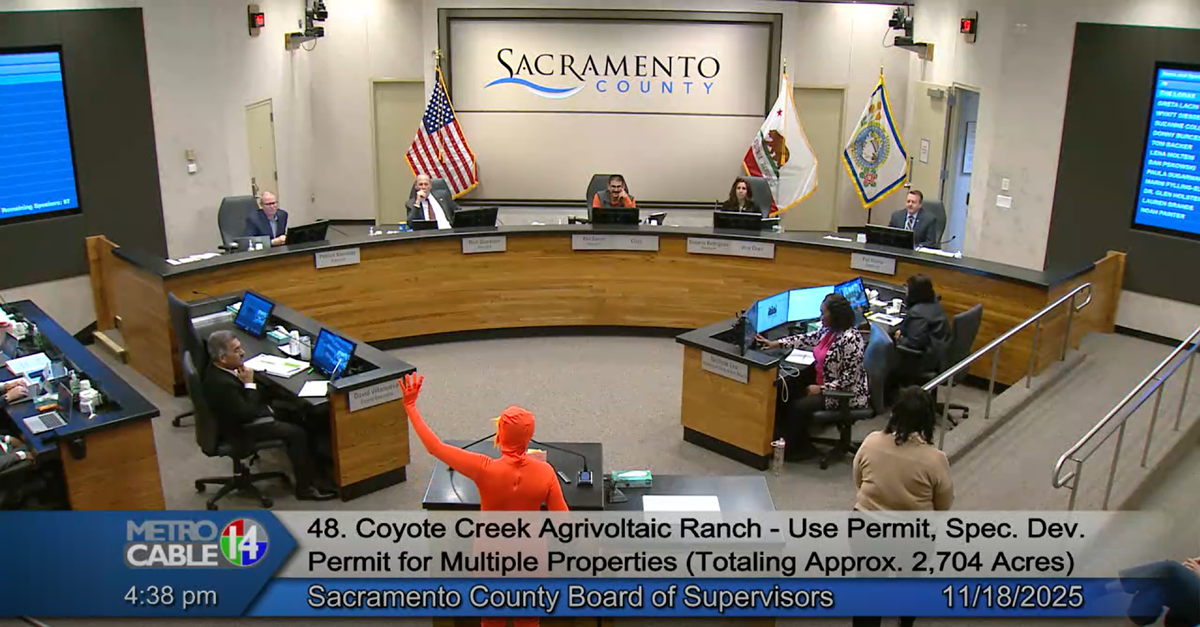 Megan Elsea, Sacramento’s Lorax, speaks before the Sacramento Board of Supervisors Nov. 18 against the Coyote Creek solar project, which will require cutting down mature Blue Oak trees.Sacramento County Board of Supervisors
Then, just a few hours later, he saw the same creature walk up to the podium in front of him at city hall.
“She signed in on her speaker slip ‘The Lorax’,” he said. “I have been using that as proof that the Lorax resides in District 4.”
Sacramento’s Lorax and 350 Sacramento Board Chair member Megan Elsea pulled a double shift that day. After speaking for the trees – in this case Blue Oaks as opposed to Truffula– at the county, Elsea hopped on her bike, made a pit stop at 7-11 for a Clif protein bar and orange juice, and got to city hall by 6 p.m.
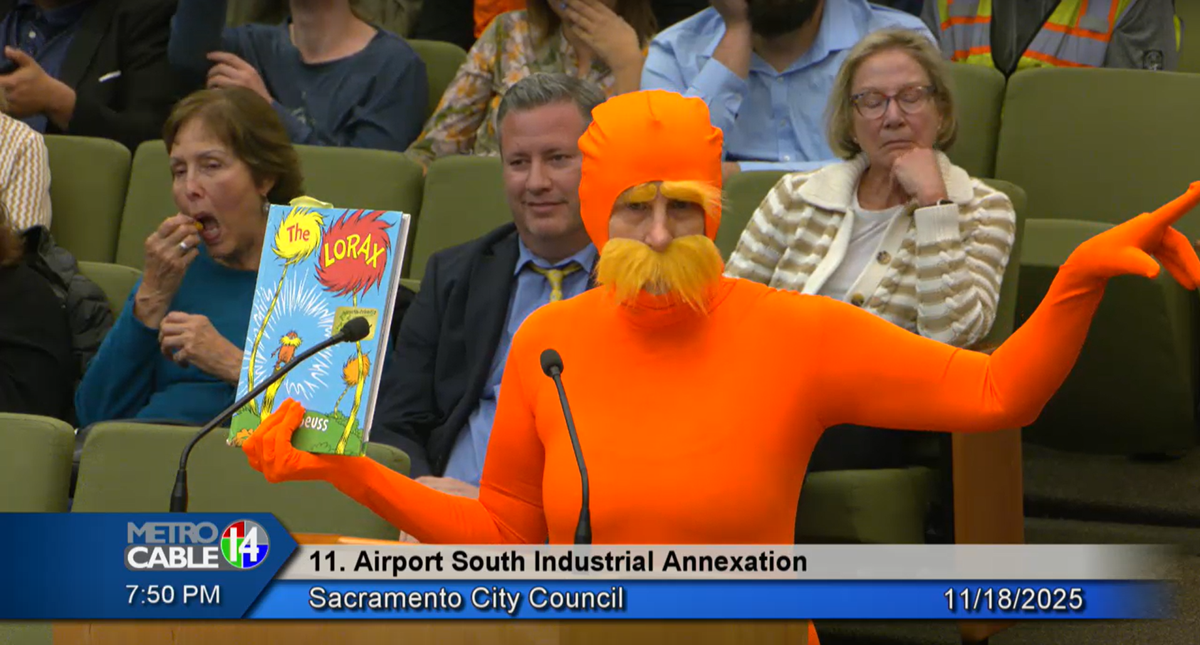 Megan Elsea, dressed as famous Dr. Seuss character the Lorax, speaks before Sacramento City Council Nov. 18 against the Airport South Industrial project, which would build warehouses on protected land in the Natomas Basin.Sacramento City Council
She was exhausted, but felt it important to show up.
“ I thought, you know, so many people are dying or have serious health problems or are displaced because of climate change. I can do something a little embarrassing,” she said.
The Dr. Seuss character the Lorax originates from a book of the same name published in 1971. In the book, the small orange creature takes on the role of “speaking for the trees”—confronting business tycoon the “Once-ler” who seeks to chop them down for industry.
Elsea got the idea from an email newsletter subject line from climate action group Third Act, that read “Speak for the trees.”
“That’s what gave me the idea. Speak for the trees, like the Lorax. I wonder if I could get a Lorax costume,” Elsea recalled. “Then I had an ethical dilemma because I could get one from Amazon, same day delivery, and that’s really bad for the environment.”
Elsea felt an exception could be made. For the environmental advocate, public demonstration is a way to bring attention to issues that plague the community not just for the sake of supervisors or councilmembers, but also other residents in attendance.
“There’s more dramatic stuff happening right now, like ICE kidnapping people and our democracy melting away,” she said. “But I think climate change, we can’t forget it. And I think the climate change crisis and the democracy crisis are entwined.”
Her goal is to get more people to pay attention and speak out against projects involving urban sprawl, or ones that negatively impact the environment and surrounding neighborhoods.
“ Projects that are outside the urban boundaries that are gonna increase vehicle miles traveled and gonna pave over green space,” Elsea said. “[We need to] put the brakes as much as we can on as many of those as we can.”
At city hall, Elsea held her copy of the Lorax high.
“I am here to speak for the environment in general,” Elsea said, waving an orange finger in the air. “We can have jobs and a safe environment. We can have jobs by building in-fill housing.”
As a board member for 350 Sacramento, a climate justice nonprofit, Elsea told CapRadio she does online training sessions to get people prepared for commenting at public meetings.
“ Be prepared. Don’t go over two minutes,” she tells people. “Try and make it interesting. If you have a personal story, that’s usually helpful. Some facts are helpful, but don’t put in too many facts. ”
Public comment during public meetings is a way for members of the community to provide input on issues related to items on an agenda or in their community to a governing board and is protected by California’s open meeting law known as the Brown Act.
Members of a governing board are not allowed to directly respond to comments they receive during public comment.
Elsea’s demonstration got Councilmember Pluckebaum’s attention, but whether or not these kinds of actions are effective is debatable for him. He said oftentimes contentious projects are years in the making before getting to council.
”From my point of view, it’s not a good process or a meaningful process for engaging the public,” he said. “Which is why a lot of us do neighborhood meetings, town halls, community gatherings and stuff as often as we can, to have more unconstrained conversations where we can actually have a back and forth dialogue.”
While frustrating for councilmembers at times, ACLU Director of Democracy and Technology Angélica Salceda told CapRadio that public comment is essential to a healthy democracy.
“ Depending on the topic, [you] may see a lot of people providing public comment. It’s quite common to see the opposite,” Salceda said. “That is, no public participation at some of these meetings where our elected or appointed officials are making really important decisions about our communities.”
Salceda said that however people choose to express themselves, whether it be suited up in orange or wearing shirts to show solidarity with a specific cause, gives electeds a clue that people are paying attention.
”We talk about public comment as being something that can be annoying,” she said. “But for many people in the community, it can be really hard to go in front of elected officials who have decisionmaking power, especially if someone is a non-English speaker.”
For both Elsea and her Lorax persona, it’s the small victories– like getting people talking, that are enough sometimes.
“ Until someone like you cares a whole awful lot, nothing is going to change. It’s not. But the thing is, lots of people care a whole awful lot,” she said to CapRadio. “I’m optimistic because people are caring and showing their care more and more.”
Follow us for more stories like this
CapRadio provides a trusted source of news because of you. As a nonprofit organization, donations from people like you sustain the journalism that allows us to discover stories that are important to our audience. If you believe in what we do and support our mission, please donate today.