
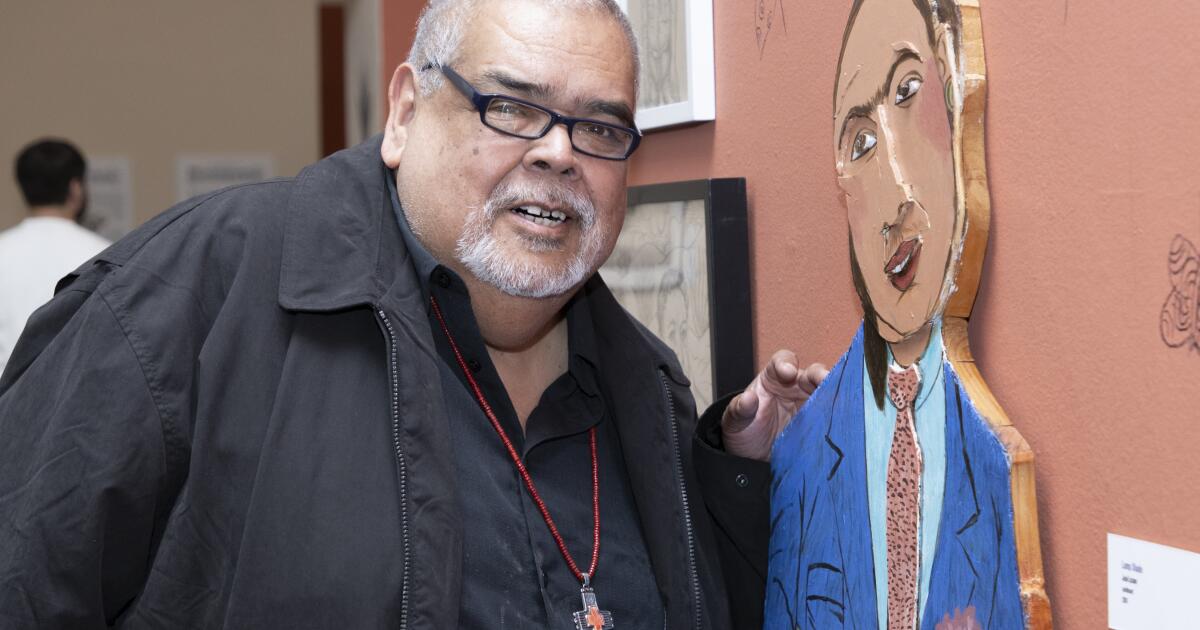
Before art collectors, such as Cheech Marin, and galleries across Southern California began coveting his work, Jose Lozano had questioned his talents as a graduate student at Cal State Fullerton.
During the 1980s, he had demontrated his creativity through the abstract expressionism of Jackson Pollack and Willem de Kooning, much to the chagrin of his professors.
Growing up in Fullerton and becoming frustrated, Lozano drew a portrait of “Queenie,” a Black neighbor. In doing so, he stumbled upon his knack for transforming everyday people into muses. The drawing caught the attention of Pierre Picot, a visiting professor, who affirmed his new artistic direction.
“I know composition [and] how to tell a story,” Lozano said, reflecting on the moment in an archived CSUF oral history interview last year. “It’s what a drawing demands and it’s going to be fun.”
Before passing away from cancer last month at 67, Lozano’s artwork came to animate spaces in Latino communities, including “Aliso Dreams,” a mural painted on the side of the LA Plaza Village apartment complex near Olvera Street in Los Angeles, and the “Lotería Card #1” mural that stands at the Bristol Swap Mall food court in Santa Ana.
His portraits of Metro riders, families, Mexican wrestlers and clowns challenged conventional notions of depicting Chicanos in art.
“He comes from the second wave of Chicano artists,” said Albert Lopez Jr., a Santa Ana artist. “He captured the gestures and identity of his culture and the people he wanted to talk about. When you see his work, you can identify it because of its unique style.”
Born in Los Angeles in 1957, Lozano spent his early childhood primarily at his grandmother’s house in Juarez, Mexico. When his mother was hired at the Hunts Wesson Foods Co., he moved to Fullerton and lived in the Tokers Town barrio.
A schoolteacher took notice of his early artistic talents and offered to pay for him to take art classes at the local YMCA.
Alicia Lozano-Garcia, his sister, recalled how her brother used the packing slips of nylon stockings for his art during his younger days.
“Our mom would actually save those,” she said. “He would ask for them at times and use them as the canvasses for his drawings.”
After graduating from Fullerton High School, Lozano enrolled at the ArtCenter College of Design in Pasadena. He also studied art history at Cal State Fullerton before working on his master’s degree in painting.
Lozano said his artwork was inspired by family, friends and the Latino community as “sociological portraits” in a 1995 Los Angeles Times article.
His art sometimes faced criticism for supposedly depicting Chicanos in unflattering fashion. Others saw his artwork as political resistance.
“He spotlights and pays homage to everyday people, our abuelitos, tias and cousins,” said Sarah Rafael Garcia, founder of LibroMobile and Crear Studio in Santa Ana. “He made our reality beautiful in his own way,”
Garcia, who first learned of Lozano through SolArt Gallery and Café in Santa Ana, features his artwork at LibroMobile, her independent bookstore, and helped set up his lotería-inspired mural at the adjacent Bristol Swap Mall, which was painted in collaboration with artist Roger Reyes.
In the latter part of his career, Lozano’s artwork continued to gain recognition from his own community in Orange County, including in Fullerton. The Muckenthaler Cultural Center exhibited his solo “El que pinta” exhibit in 2010. Two years later, he curated “Open Your Eyes/Abre Los Ojos,” a Chicano and Mexican art show at the mansion turned art center.
“If the art is good is good enough or it’s powerful, I think it transcends the label and it just stops becoming Chicano art, and it’s just art, where it’s embraced by everybody,” Lozano said in the CSUF interview. “I don’t like the notion that Chicano art is made just for Chicanos.”
A heart-shaped sculpture art piece Lozano did remains a permanent fixture outside of the Fullerton Museum Center, where his work was exhibited in three shows in the past four years.
The museum is planning to host a public celebration of Lozano’s life on Dec. 22, from noon to 3 p.m.
“Even though he’s no longer here, I want to make sure that future generations in Fullerton will know who Jose Lozano was,” said Elvia Rubalcava, the museum’s executive director and an avid Lozano art collector. “He felt like Fullerton did not really see him, at least not as much as Los Angeles revered him.”
In addition to painting ceramic mural tiles for a Metro station in Los Angeles and other notable art projects, Lozano also authored two children’s books. “Little Chanclas,” published by Cinco Puntos Press, was named Best Bilingual Picture Book by the Latino Book Awards Assn. and was reviewed in the New York Times.
At the time of his death, Lozano had two unpublished children’s book manuscripts.
“He wanted to make sure that these stories were published,” said Lozano-Garcia. “Hopefully, we’ll be able to approach other publishers and have the books out there for the community, to share stories that he wrote and also his illustrations.”
Lozano-Garcia is also looking to have her brother’s art exhibited posthumously with proceeds from shows going toward scholarships.
“There’s more to come,” she promised.
In the meantime, the family is asking for donations to Plaza de la Raza in East L.A. and the Fullerton Museum Center in lieu of flowers.
When asked about her favorite piece from her late brother, she looked at “Girl Goes Walking,” a gripping serigraph her brother did in 2008 that hangs in her home. The work is a commentary on the femicide that gripped Juarez, their other hometown across the border.
When considering his own legacy, Lozano wanted to be remembered for conveying the nuances of life through art.
“Humans are complex and flawed, in that they recognize that in them and themselves,” Lozano told CSUF interviewers last year. “People love. People laugh. People forget to laugh.”