
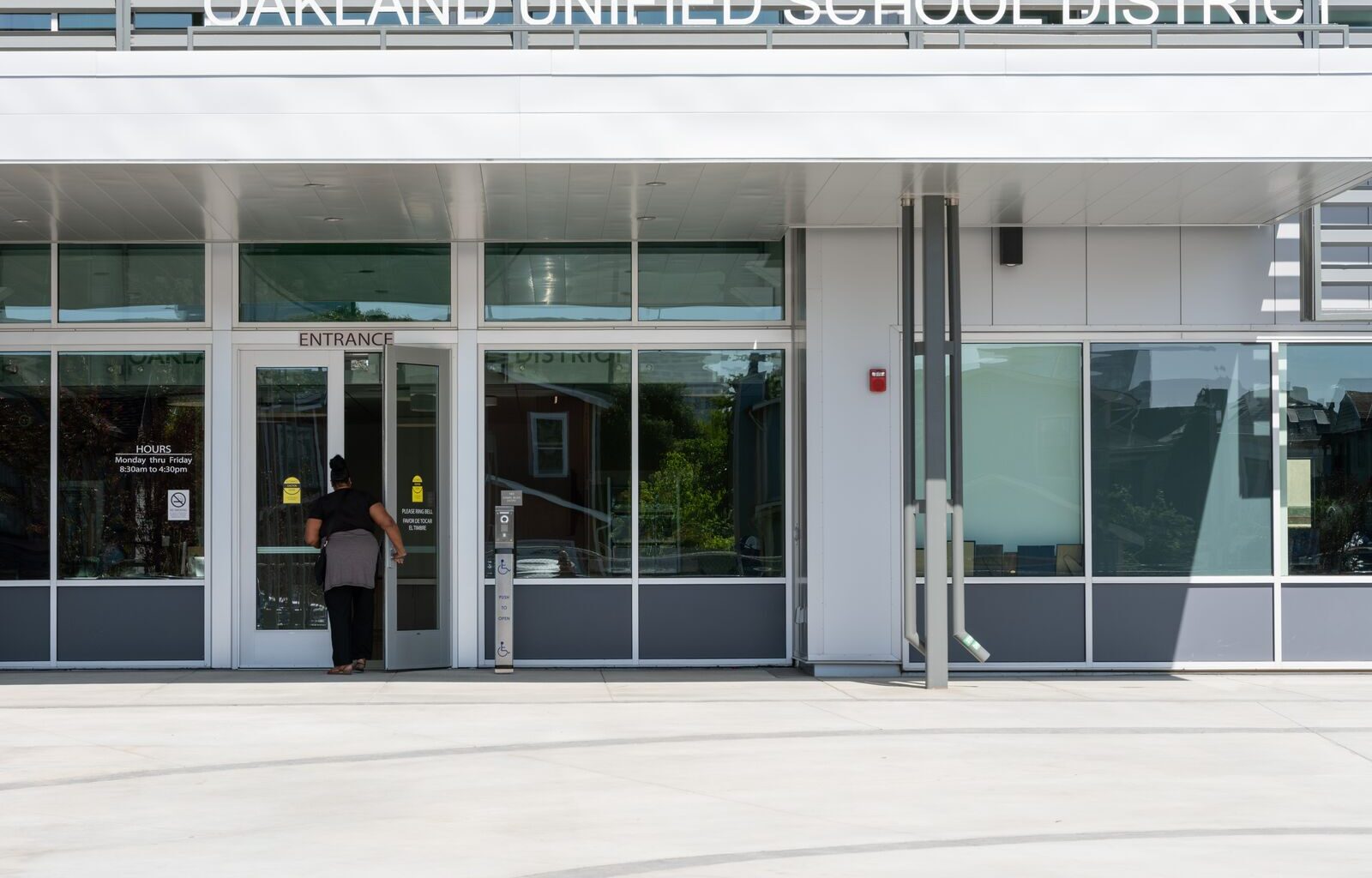
On Dec. 10, the Oakland Unified School District board must vote on a plan to reduce its budget by $100 million or risk another county or state takeover.
This fall, the school board directed district staff to come up with a plan that would largely rely on shrinking the district’s central office, improving student enrollment and attendance, and freezing contracts. The board’s goal was to keep cuts away from school sites. Under these proposals, which they say would reduce the office to its bare bones, the savings added up to $21.8 million at the most, far from the $100 million needed.
At this Wednesday’s board meeting, interim superintendent Denise Saddler will introduce two new scenarios. These proposals, shared publicly on Sunday evening, will result in $103 million in savings and include the deep cuts to the central office plus tens of millions of dollars in cuts at school sites.
“This analysis continues to affirm that single or combinations of cutting ‘around’ school spending will not yield the outcomes the District has struggled to achieve,” Saddler wrote in the proposal.
Today, The Oaklandside takes a close look at the proposed central office reductions. We’ll have another story on the proposed school site cuts tomorrow.
For many OUSD families, who only interact with school staff, it may seem obvious to focus cuts on the central office. OUSD headquarters can feel like a spending black box compared with salaries for the teachers and counselors they see every day. But the central office provides essential support to school leaders and is crucial to school operations — and its budget has shrunk dramatically as a portion of overall spending over the past decade. As enrollment at OUSD has dropped by 3,400 students during that time, staffing costs at school sites more than doubled while central office spending has remained roughly the same.
The district’s central office, or headquarters, houses six big divisions that include everything from academics and communications to business, finance, and legal. At a November school board meeting, OUSD department heads each presented proposals for downsizing their offices, much of which comes down to laying off staff and giving more work to those who remain.
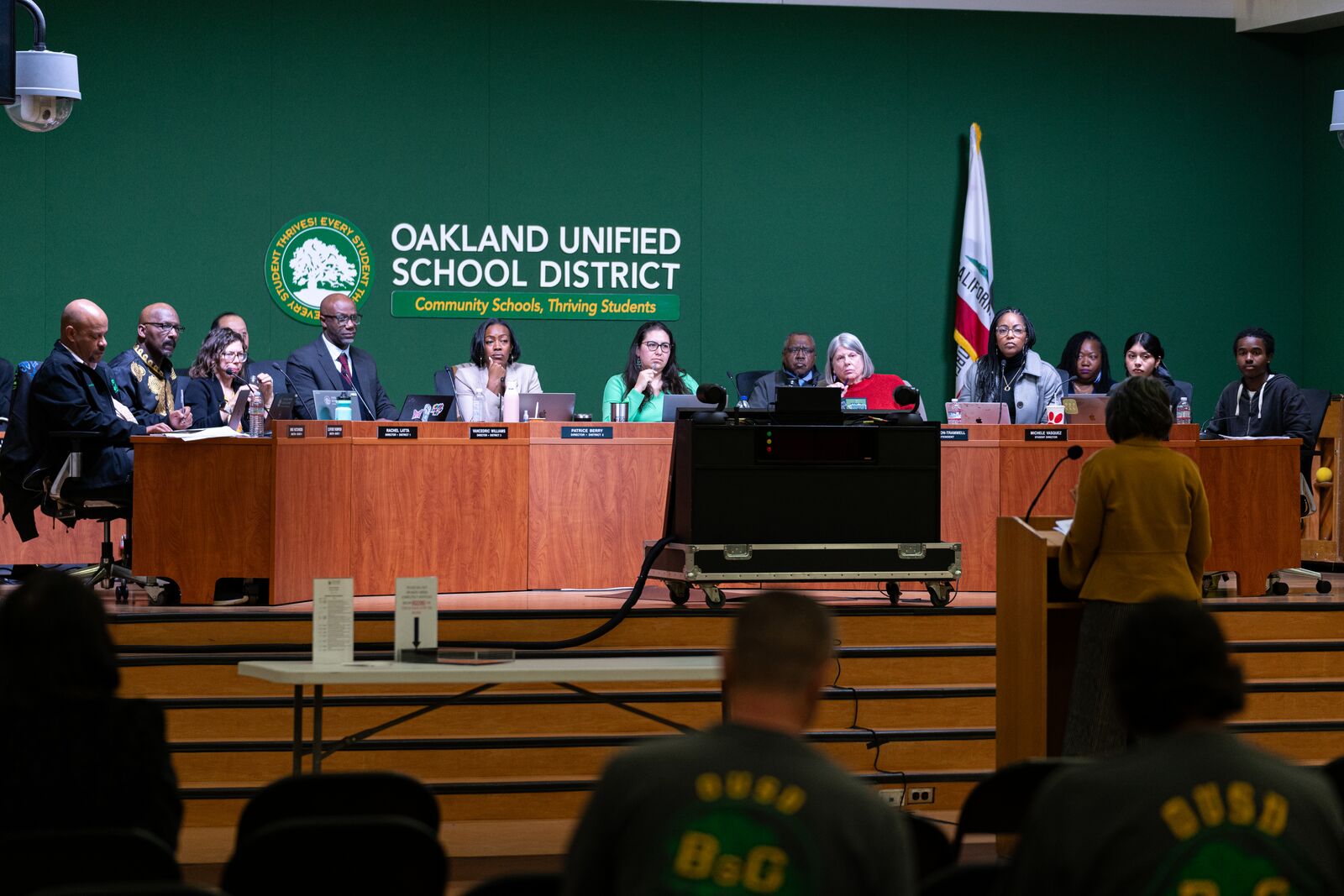 During a February board meeting, Alameda County Superintendent Alysse Castro told district leadership it was facing a fork in the road regarding its budget. Credit: Florence Middleton for The Oaklandside
Dan Bellino, district chief of staff, explained that these cuts would shrink OUSD operations.
“We are absolutely in a place where we have to do less with less,” Bellino said. “We can’t continue to keep doing the same work with less.”
In June, the board adopted its 2025-2026 budget, projecting about $806 million in revenues and $916 million in expenses in its general fund. (District budget projections are constantly fluctuating, so those numbers shift over the course of the year.)
The district has other earmarked funds, such as adult education, capital funds, and insurance, which bring total OUSD revenues to about $1.1 billion and expenses to $1.3 billion. All of the cuts must come from the smaller general fund — mainly, the unrestricted general fund.
Like all school districts, OUSD’s biggest expense is salaries. For 2025-2026, that amount is $412 million — $652 million including benefits. The remainder covers things like books and supplies, contracts, and insurance. For years, critics have called for cuts to be made to the central office, including reducing the ranks of administrators who earn the highest salaries.
The Oaklandside obtained all of the district’s salary data and found that OUSD has 32 staff who earn more than $200,000 per year — 23 of them at the central office. Those positions include:
the superintendent and interim superintendent, the chief executives of the district. The district doesn’t usually have both of these positions, but former superintendent Kyla Johnson-Trammell remains on payroll until January
the chief business officer, who supervises finance, transportation, and risk management
the chief academic officer, who oversees curriculum and instruction
the chief talent officer, who leads recruitment, hiring, and retention
the chief systems and services officer, who supervises district operations from facilities to technology and custodial services
the general counsel, who handles labor contracts and legal compliance
the chief financial officer, who oversees district finances
four network superintendents, who oversee clusters of schools
and nine high school school principals.
In total, the top salaries at the central office amount to about $5.7 million.
Cuts to the superintendent’s office, which has staff who work on philanthropy, could mean fewer donations flowing into OUSD. Shrinking the talent department, which oversees hiring and professional development, could threaten staff retention and training and make it harder to find qualified educators to fill roles.
The network system, which is not unique to OUSD, is how the district oversees its schools, by splitting them into groups, each managed by a network superintendent who oversees school principals and ensures their school sites are running smoothly. For example, during the district’s lead contamination crisis, network superintendents were often the ones contacting the district’s plumbing department on behalf of their schools. Having that support at the central office has been crucial to principal retention, and OUSD this year saw its lowest principal turnover rate in years.
Sondra Aguilera, OUSD’s chief academic officer, emphasized that although cuts to the central office may not directly touch students, they could impact how well teachers, principals, and others at a school site are able to do their jobs.
“There are very few positions that do direct service to students within the central office,” Aguilera said. “The role of the central office is to develop the capacity of the adults that work with our students, and that’s what the emphasis is in a lot of the services that we provide.”
Superintendent’s office: $2.4 million in cuts, 51%
The superintendent’s office is home to the superintendent, chief of staff, safety, and communications departments. Staff in these offices also do legislative and lobbying work, partner with other governmental agencies, and steer the district’s philanthropic partnerships, which bring in additional funding to OUSD. Under one scenario, the chief of staff, chief partnerships officer, and senior executive officer would be eliminated, saving about $2.3 million.
With those reductions, “there would be reduced support for the leadership transitions over the next couple of years,” Bellino said. “Even though the executive director of safety would remain, there would be impacts to the overall support for that position and overall safety work.”
Without staff dedicated to philanthropy, OUSD might bring in less money from donors, Bellino said.
The district’s communications efforts would be reduced, leaving only capacity for school-to-family communications, enrollment, safety, and crisis communications. There’d be less ability to communicate with the general public or offer website support to schools.
Governance: $1 million in cuts, or 11%
OUSD’s governance department, led by the district’s general counsel, handles legal compliance and labor relations. This includes bargaining with labor unions, resolving grievances from members, and addressing lawsuits and complaints against the district. The office also manages charter school oversight and ensures school board adherence to the Brown Act, the state’s open meetings law. In the proposed scenario, two positions would be eliminated and the office would reduce its reliance on outside contractors who handle special education claims and would hire a dedicated attorney instead, general counsel Jenine Lindsey said. Her office is also reviewing all its contracts for other ways to save money.
Talent: $3.4 million in cuts, or 22%
This is OUSD’s human resources department. It oversees hiring, training, employee support, credentialing, leadership development, and organizational wellness. The department manages the district’s pathway and apprenticeship programs that enable staff to advance in their careers or earn teaching and administrative credentials. Staff recognition, like employees of the year, are also managed by the department.
“It will be an impact on our pipeline programs, residency work, some of our hiring, and also our recognition,” said Tara Gard, OUSD’s chief of talent. “We’re not going to be able to have the same amount of events that we have — we shouldn’t be. If it comes down to feeding somebody at an event or keeping a person, then we need to keep a person.”
The department identified outside contracts and costs for cuts, including $60,000 for job posts on external sites, $150,000 for new employee orientation and professional development for substitute teachers, and $75,000 for professional development for classified staff.
Systems and services: up to $9.2 million in cuts, or 22%
This department handles technology, custodial services, facilities, food, and buildings and grounds for the district. The department also oversees the district’s enrollment office.
Reductions in this department could have broad impacts on daily life in the district’s schools. For example, the technology department maintains OUSD’s Chromebooks and other tech infrastructure. The facilities and buildings and grounds teams service school buildings, make repairs, and handle renovations and upgrades, including administering OUSD’s $735 million bond program. Food service handles purchasing and administration of the breakfasts, lunches, and snacks that every school serves.
According to a 2020 assessment, OUSD’s technology department is one of the smallest departments for similarly sized districts in the state, Preston Thomas, OUSD’s chief systems and services officer, said during the Nov. 19 meeting.
“So there isn’t a lot of things that you can cut there without deeply impacting the infrastructure in the system,” he said.
Since 2020, OUSD has committed to a 1:1 student-to-device ratio, which costs $3.4 to $3.5 million a year to maintain, Thomas said. Reverting back to a 4:1 ratio, which was the district’s baseline before the pandemic, could free up some of those funds — but could impact how classrooms operate.
In the custodial services department, the proposal is to recoup costs by increasing the square footage that custodians have to clean, which would require fewer workers. That would mean that classrooms, which generally are cleaned on a daily basis, might be cleaned only every other day, Thomas said.
Over the last several years, OUSD has neglected to fully invest in its deferred maintenance budget, which means the district’s aging school buildings need hundreds of millions of dollars in maintenance.
“We are lucky that we do have Measure Y as a bond that does support some of this work, but the dollar amount is so significant that you do need resources available to address that,” Thomas said. “And if we come to emergency situations, the board is going to have to find the funding to be able to pay for that regardless.”
The district’s enrollment department was funded with one-time funds for five years as part of an enrollment stabilization plan passed in 2021. Those efforts appear to be paying off and OUSD is seeing increased enrollment this year, but without additional investments, those gains risk being reversed.
Fiscal: $2.2 million in cuts, or 33%
Reductions in the fiscal services department, which includes finance, payroll, risk management, transportation and logistics, could amount to $2.2 million with the most severe cuts or $1.8 million with a pared-back plan. Lisa Grant-Dawson, the district’s chief business officer, said over the last several years her department has been working to strengthen the district’s financial controls and reduce its audit findings.
“We’re the only district in the state of California that does semi-monthly payroll,” Grant-Dawson said. “So therefore we have more payrolls that we run for some employee groups.”
With reductions in this department, the budget development process may have less flexibility in the future. Staff capacity for managing grants would also be reduced, with potential revenue implications.
Academics: $3.5 million in cuts, or 15%
This department, also called Continuous School Improvement, houses a variety of academic operations, such as the office of equity and the district’s English language learners and special education programs, as well as the “network” structure that oversees schools — and which the school board has asked to be consolidated. There are currently three elementary networks, each with 16 to 18 schools, one middle school network with 17 schools, and one high school network with 17 schools.
In the first budget scenario, elementary schools would go from three networks to two, and eliminate the role of network partner — staff who liaise between the networks and offices like the office of special education.
“The network partner is responsible for ensuring that the school can function, and they also ensure that a lot of the operational activities of the schools are taken care of,” said Aguilera, the chief academic officer.
If a principal is seeking out training for a teacher on a new curriculum, or if a school site needs a repair done, the network partner is typically their first phone call.
Under the scenario with the deepest cuts, there’d be only two elementary networks, with each network superintendent overseeing 24 to 25 schools — a 50% increase from their current load.
Aguilera said that she polled elementary school leaders and learned that principals want to maintain the current network structure.
At the secondary level, the middle and high school networks would remain separate, but their support staff would be consolidated. So an employee who might currently coordinate between all middle schools and the central office’s science department would add high school coordination to their plate as well.
“*” indicates required fields