
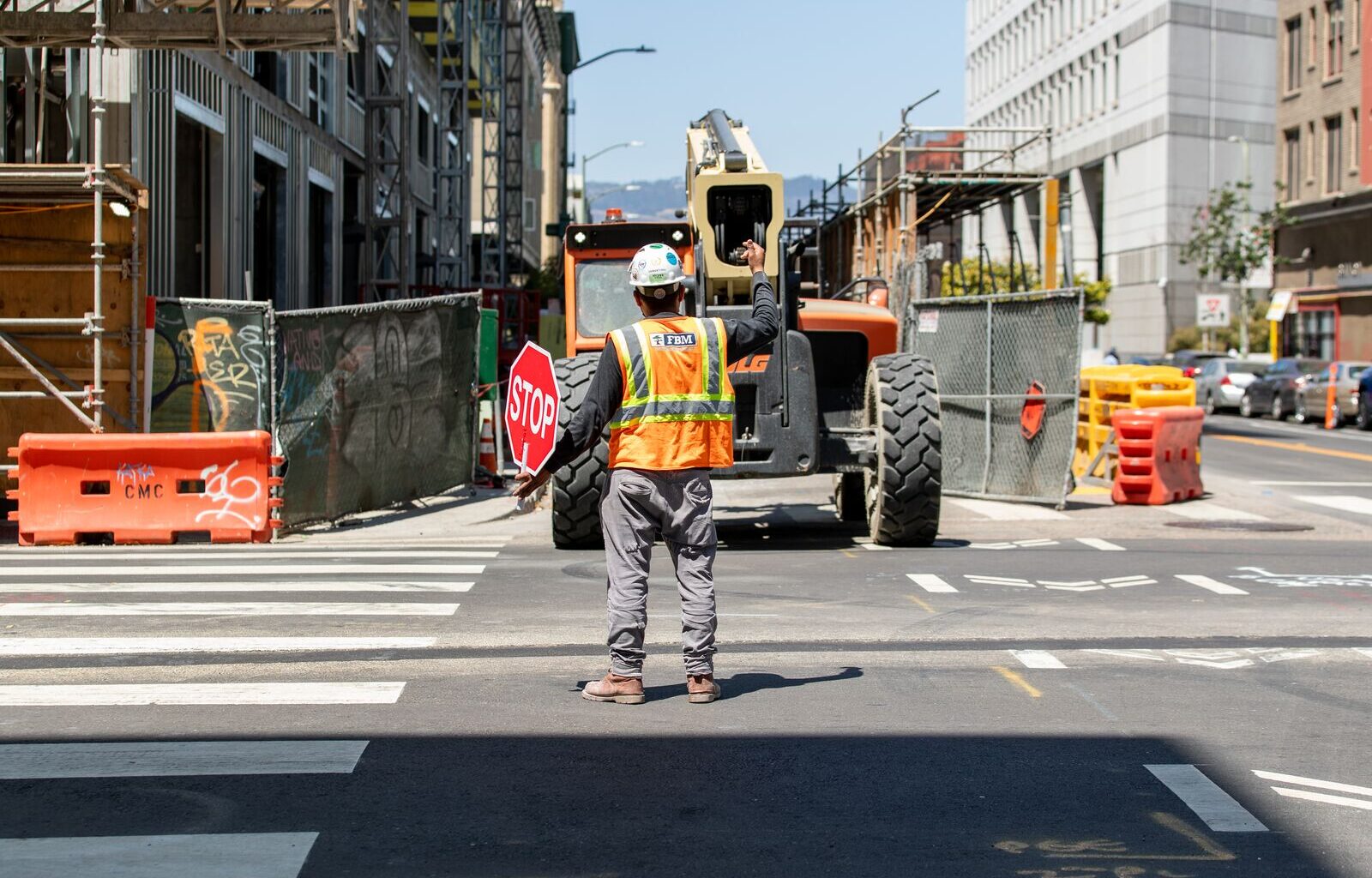
Say there’s a leak in your roof and you need to replace it. Or maybe you’ve hired a contractor to renovate your restaurant. Or Grandma’s moving in, and you want to install a cottage in the backyard.
Virtually anything built or altered in Oakland first needs permission from the city. A series of planning approvals, building permits, and inspections ensure that a project’s materials are fire-safe, the structure is sound, the height doesn’t surpass zoning limits, the contractors are licensed, and the design isn’t out of keeping with city standards.
But the process of getting these permits is rarely easy.
The Oaklandside has heard over the years from countless homeowners, architects, contractors, and developers who were irate over the hair-tearing task of seeking a permit for residential or commercial work.
Themes emerged in these complaints: professionals and regular folks alike waiting weeks to reach a city planner, getting bounced around from one department to another, receiving conflicting instructions on requirements and fees, and confronting tech glitches and delays. Several people in the building business told us the conditions have turned them off from starting projects in Oakland — and have led to an increase in unpermitted, often dangerous, work.
Some city leaders have candidly acknowledged the problem.
Speaking to a conference of local developers in 2024, then-Mayor Sheng Thao conceded: “Oakland has a shit permitting system.”
Oakland’s permitting woes cause headaches for customers and can cost Oakland desperately needed revenue in the form of permit and developer fees, as well as the lost property taxes and other dollars that would have flowed into city coffers if more buildings had gone up. At their worst, these problems can lead to systemic challenges for the city and the region. Oakland has a state-set target of building thousands of new homes in the next couple of years, and macroeconomic factors like interest rates have nearly ground that process to a halt. The bureaucratic rigamarole only makes it worse.
“Just the idea of doing another project right now in Oakland, it’s just not worth it,” veteran architect and former Pinole mayor Tim Banuelos said in an interview in 2024. His firm handles everything from ADUs to apartment building design and remodeling. “Once you get to the actual planners, those guys are all really good. It’s getting to them that’s the problem.”
Fewer people pursuing permits hurts Oakland’s finances. The city’s Planning and Building Department is unique in that, since 2006, it’s been funded by fees from the services it provides, rather than the city’s general budget. In 2024, permit fees paid for 209 staff in the department who work on various aspects of development services, from permit approvals to building code enforcement and engineering. Without those fees, the department couldn’t oversee development in Oakland and would have to dip into the city’s burdened general fund.
Back in 2020, the city assured the fed-up builders and homeowners that it would finally do something about the permitting mess. In 2023, Oakland hired Robin Abad, the city’s first “permit ombuds.” He and staff from several departments have been working since then to eliminate the stumbling blocks and streamline the permitting process. The project not only addresses permits for housing and other buildings, but also for new businesses, special events, entertainment venues, dispensaries, and more.
 Mayor Barbara Lee has put an emphasis on improving Oakland’s permitting system during her first year in office. Credit: Estefany Gonzalez for The Oaklandside
Mayor Barbara Lee has also made permit reform a cornerstone of her first year in office. Early on, she announced an expansion of the types of businesses that can open in commercial areas without extensive review, and she secured $3 million to upgrade permitting software in the budget passed by the City Council in the spring.
“I know firsthand how frustrating it can be to navigate city processes,” Lee said in a press release. “The city should be a partner, not a roadblock, in getting your business or home renovation or development off the ground.”
Altogether, Oakland has instated a sweeping array of reforms to the permitting process, some newly launched this fall and others dating back a year or two. Many of the battle-scarred builders we talked to said they rejoiced when they heard about the changes.
Others said it’ll take more than tweaks for the permit system to function well.
“Sisyphean” sagas trying to build in Oakland
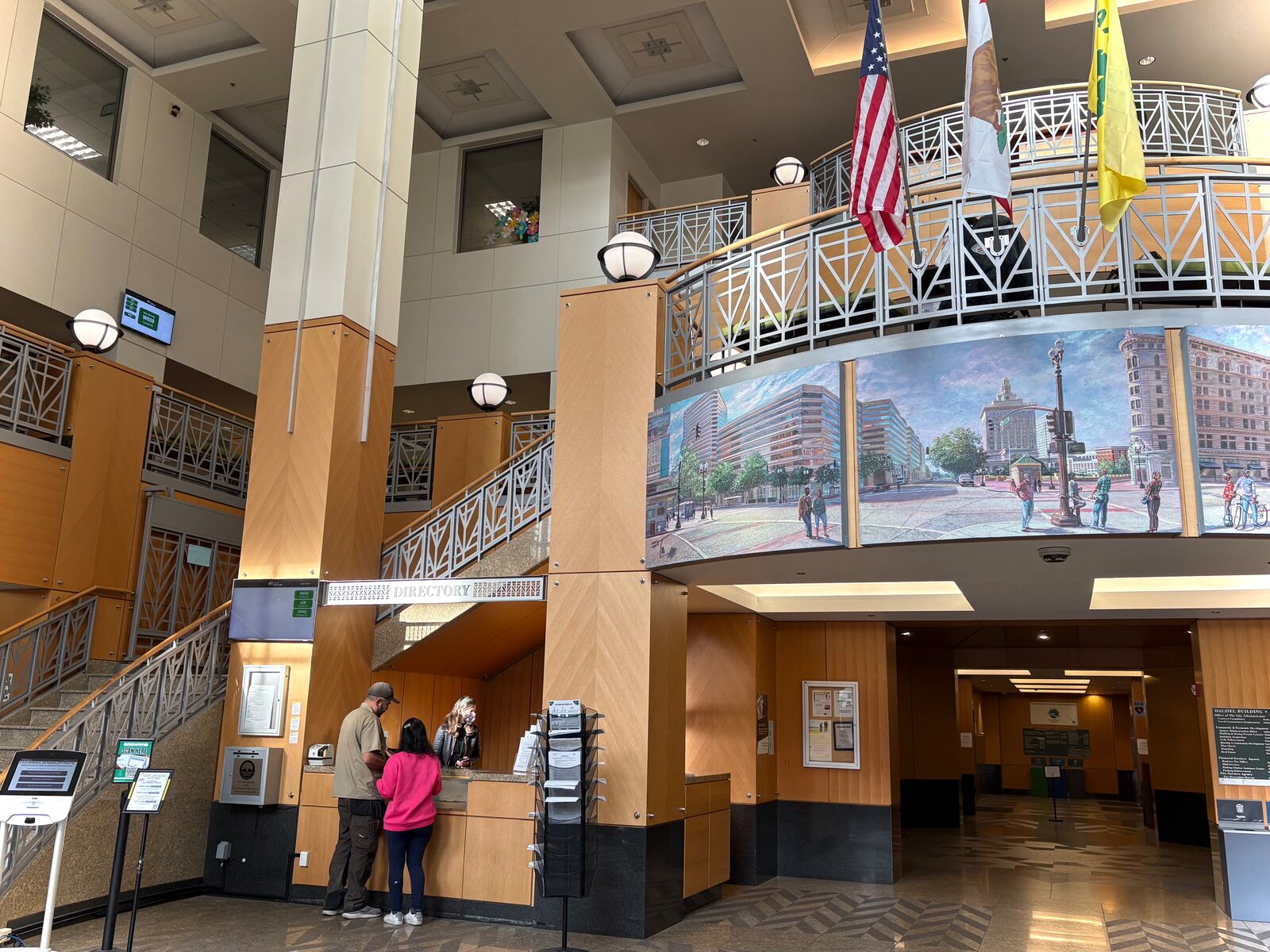 Customers sign in and get a number on the ground floor of Oakland’s permit center at 250 Frank Ogawa Plaza. Credit: Natalie Orenstein/The Oaklandside
To understand the significance of the new changes, it helps to understand what seeking a permit has been like in Oakland in recent years.
One North Oakland homeowner’s kitchen renovation project a few years ago was typical of the stories we’ve heard. What seemed like a straightforward job turned into a saga marked by lengthy delays and poor communication.
“It took months for the permit,” the homeowner, who asked not to be named over fear that her project could face further delays, told us in an interview at the time. “No one ever answered voicemails or emails for the simplest questions.”
This was not too long into the pandemic, and the planning and building departments, she said, were “walled off like a fortress.”
Around the corner from City Hall, Oakland’s permit center is located right inside the doors of 250 Frank Ogawa Plaza, a gray-and-brick government building. You take a number and are prompted to wait on the ground floor before getting called upstairs, where city staffers from different departments sit behind a counter, assisting customers.
Many of Oakland’s problems, veterans of the permitting process told us, date back to the start of the pandemic, when the counter closed to comply with public health orders.
“Before the pandemic, the system was basically working, in the sense that anyone could go” to the permit center downtown, developer and property owner Athan Magganas told The Oaklandside earlier this year. He’s built a number of small and large residential and mixed-use properties in the East Bay.
A few years ago, “They said, ‘Ooh, we reopened,’” Magganas recalled. But the days and hours were limited. “Then they’d say they could only take the first 22 people,” he said. “At 12 p.m., they’d take lunch for an hour. You’d never be able to get a permit off the bat,” he said.
The North Oakland homeowner recalled visiting the center once it partially reopened in 2022. There, she encountered dozens of frustrated people waiting in line, looking like the makings of a mob.
YOUR PERSPECTIVE
From 2023 to 2025, we asked people what single thing they’d change about Oakland’s permit system if they had a magic wand. Some of their responses:
“Have people who can respond in a remotely timely fashion.”
“Hire a bunch more planners.”
“Have staff return calls and emails within 24 hours.”
“They need to just issue the permit.”
“We need an audit of impact fees and permit fees.”
“Have a fast-track line for professionals.”
“More walk-in hours.”
“I thought, ‘This is torch-and-pitchfork territory,’” she said.
she also said something that would be repeated, almost word for word, throughout our reporting for this story: “There are some really good people there. But it took months and months and months to find out the rules.”
Many people brought up the dreaded voicemail message.
“It’ll ring and ring, and then you’ll get the voicemail,” said Banuelos, the architect. “Then you go to leave a message, and they haven’t set up their voicemail. If I was working at a job and I didn’t answer my voicemail, I would be fired. And to be a public entity and not have any way to talk to the public, or have the public talk to you, is criminal.”
Those tedious exchanges, we heard, impacted clients and threatened the sustainability of projects.
“How do you justify to someone, ‘Hey, the city’s process is going to cost you another $3,000 to $4,000 in my time?’” Banuelos said.
People in and outside of the city both told us that several permit counter staff quit during the first years of the pandemic. The vacancies left in their wake weren’t filled for ages. Morale plummeted for staff and customers alike.
“Some people, of course, are jerks,” said a former counter staffer who spoke to us on the condition of anonymity. “But a lot have the right to be angry.”
During the first years of the pandemic, city leadership flaunted the increased ability to pursue permits digitally and work with staff online; while the center was closed, email never sleeps. But when the center reopened, the still-short staff had to juggle both the in-person visits and the 24/7 electronic inquiries.
One employee could get 300 emails a day.
“It’s wild, the volume they are expected to deal with,” said the former staffer around that time. “It’s impossible for staff to keep that spigot from overwhelming them.”
Some projects hit a tangle of snags.
For two years, a homeowner named Max has attempted to get a pre-fabricated ADU installed and fully permitted on his Longfellow property — which was already zoned for two structures. At first, he was told to expect completion in April 2024. But then a permit expired while Max’s contractor and the city were at an impasse over a decision; the online payment system went down at a critical moment; and changes to the law meant the contractor’s license was no longer valid for the work.
When we spoke in November, Max was still awaiting final inspection.
“Why would anyone try to build in Oakland if it’s this much of a Sisyphean debacle?” he asked.
A raft of reforms
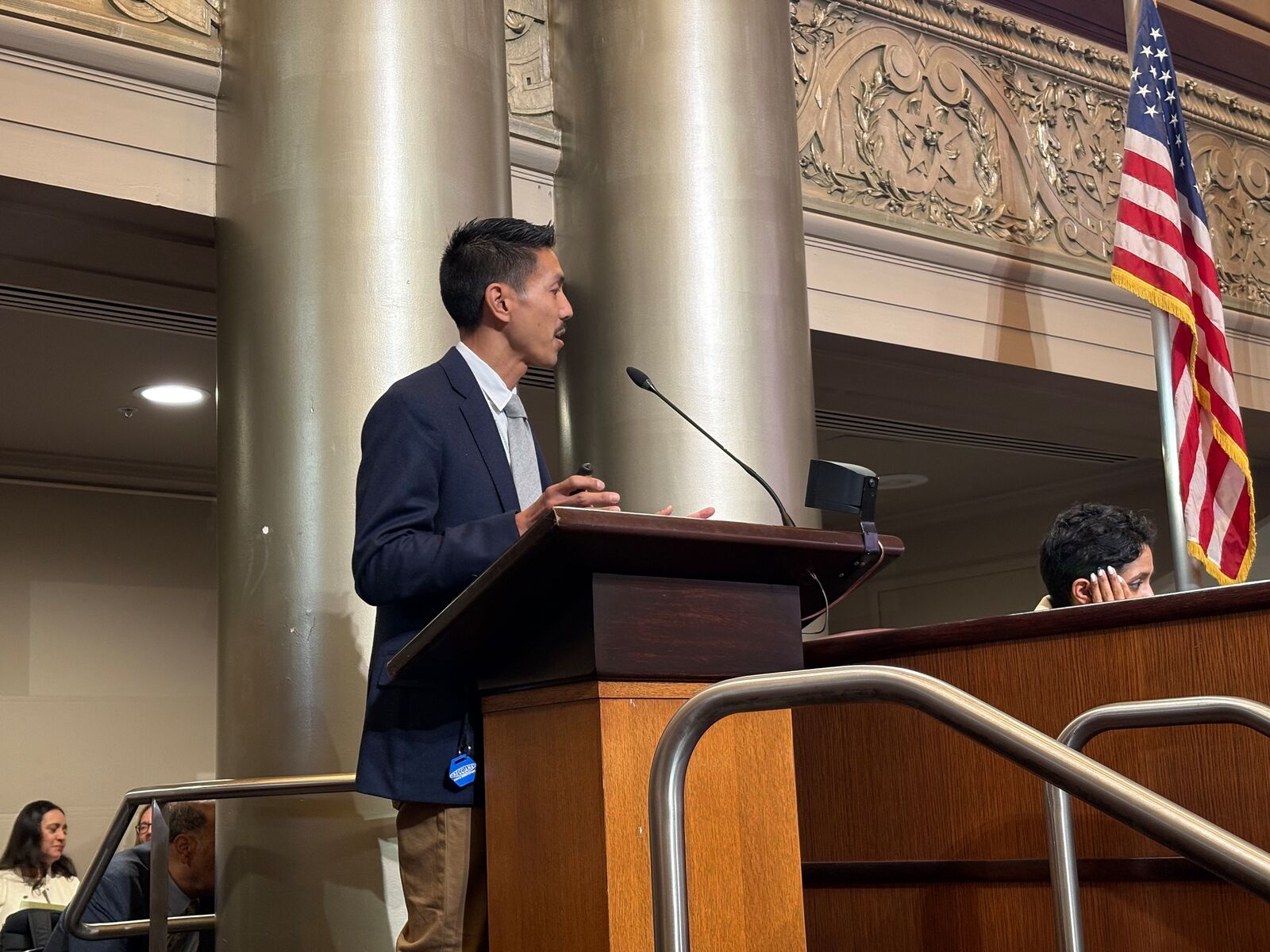 Robin Abad, Oakland’s first permit obuds, tells the City Council about new reforms in November 2025. Credit: Natalie Orenstein/The Oaklandside
If you apply for a permit tomorrow, next week, or in 2026, there’s hope you’ll have a smoother experience than the people we’ve spoken to over the past few years.
First off, there are simply more people available to help you.
The city’s permit center now has 26 employees assisting customers in a variety of departments, including planning and building, transportation, fire, and more. That’s nine more people than in the early days of the pandemic, and two more than before COVID-19. The planning and building permit counter alone is at six people now, after hitting a low of two, Abad said.
And the place is open way more often.
As of this month, developers like Magganas, architects like Banuelos, engineers, contractors, new homeowners, and all can drop in from 8:30 a.m. to 12 p.m. Monday through Thursday, or schedule appointments for any weekday afternoon. And they can now make those appointments in one place online, regardless of the department.
In many cases, the permitting process itself has been slashed significantly. Until recently, constructing a house or a medium-sized building required extensive — and often expensive — review by the city for environmental and design compliance. There was a built-in period for public input, and the findings from the review could also be appealed, further delaying or sometimes even killing a project.
In July, the City Council adopted planning code amendments allowing most residential projects with up to 30 units — everything from a duplex to a three-story apartment building — to earn that initial approval “over the counter,” so long as they meet new design standards. That near-automatic approval reduces the review time for most buildings from 10 months to two, according to the city.
The new rules, adopted in part to comply with a range of new state laws encouraging housing production, apply to both market-rate development and affordable development.
“This was some super heavy lifting on the part of the planning bureau here,” Abad said.
And the city plans to eliminate its zoning and building worksheets, which have long been required as the first steps before even starting an application. That’s expected to cut 52 days of staff review time for each permit.
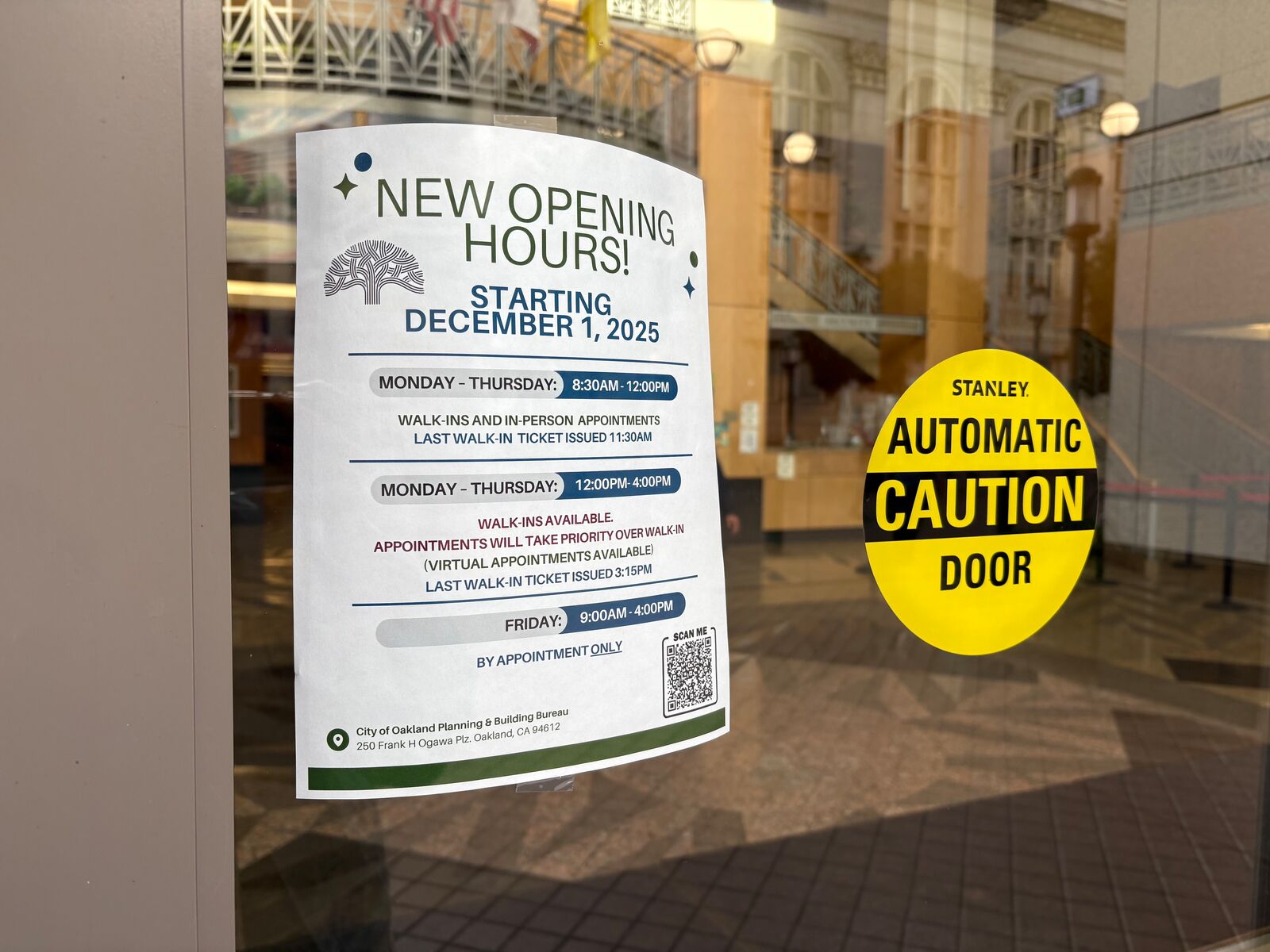 Oakland’s permit center advertises its expanded hours. Credit: Natalie Orenstein/The Oaklandside
Building permits for a number of smaller projects also don’t require in-person meetings anymore. Instead of a week of back-and-forth and a visit to the permit center cashier (who takes permit fees) for things like roofing, plumbing, and insulation, applicants can now get and pay for a permit online in a matter of minutes.
Over 8,000 of these same-day permits were pulled last year, according to Oakland — as opposed to zero in 2022. Next year, the city plans to offer the same access for bathroom renovation, window replacement, and more.
“The improvements are gradual and overlapping,” Abad told us in October, but they’re concrete. “We’re not alone amongst cities in trying to recover from the pandemic.” He’s excited for visitors to start noticing a change.
When we caught up with Banuelos this month, he said he’d turned down projects in Oakland since we first spoke last year, after confronting a series of delays and glitches on an addition to a house in Montclair. But hearing about some of the reforms, the architect said he’d consider working here again.
“It sounds like they’ve gotten a little bit more real about what needs to be done,” he said.
Some more reforms on the horizon are designed to cut out the need for applicants to contact staff with minor questions or to communicate with multiple representatives.
A “digital scoping tool” slated for next year will help applicants figure out which permits they need for their project, how to apply, and the estimated costs, according to the city. Right now, applicants often need to scour the web and city code and engage in lengthy back-and-forths with staff to figure out those answers.
Once a project is in the works, the city intends to offer a single online process for plan review, instead of a dizzying system in which different departments send disparate feedback in separate places.
Will the changes work?
A new homeowner named Matt spoke to us as he was waiting for an appointment at the permit center last year.
He didn’t want his last name printed because he was ditching work to catch the brief opening.
Matt said he was caught in a “finger-pointing” fight between the city and the East Bay Municipal Utility District over a sewer lateral. When buying or selling a house in the East Bay, you need to make sure you have a lateral that’s working and compliant. If you can’t get a certificate declaring that in time for the transfer, you can obtain a 180-day extension from EBMUD by putting down a $4,500 deposit.
Matt had paid that money and ensured his sewer lateral was fixed and functional. But he couldn’t get the chunky deposit back from the utility until city inspectors declared it compliant. And that was taking some time. Meanwhile, EBMUD was “sending increasingly threatening notices,” Matt said.
He was able to check the status of the project on the city portal, but not all of the notations were clear to him. Without an easily accessible human to help him sort things out, he said, “I tried to use ChatGPT to navigate it.”
Like many of the issues we encountered in our reporting, Matt’s wouldn’t be completely eliminated by Oakland’s new reforms. But his pain would likely be eased.
Sewer lateral repairs have just been added to the list of projects eligible for same-day digital permits, Abad said. While this wouldn’t address Matt’s inspection delay, it would speed up the work to get to that point, and will come in handy for other property owners dealing with, say, an emergency rupture.
And someone in Matt’s position will now have more options for coming into the center to get help from a staffer.
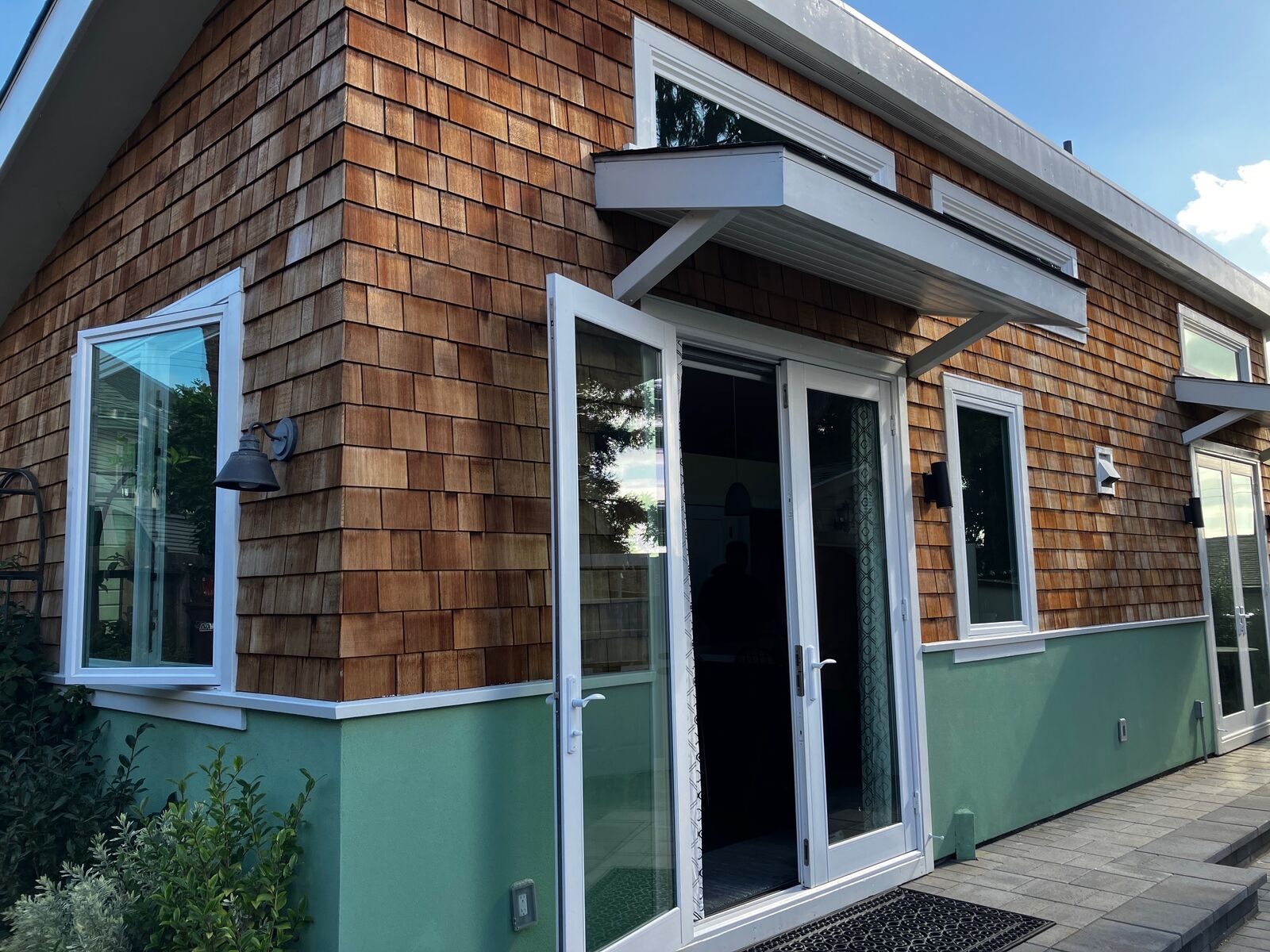 The city and state have tried to make it easy to build ADUs, but some developers and homeowners say they still encounter delays getting permits (file photo). Credit: Natalie Orenstein
We also spoke with Laura Blair, the COO of Buildzig, an Oakland developer that does all sorts of properties but has a special focus on ADUs — backyard cottages, in-law units, and the like.
“Building an ADU takes four to six months,” Blair told us last year. “It’s a quick process. The problem is getting the ADU permitted.”
The state and city have passed a slew of laws in recent years aiming to make it easier to build ADUs, because they’re quicker, cheaper, and less offensive to neighbors than bigger, imposing buildings, but still add housing stock.
About a year ago, Blair helped a client obtain a state grant and low-interest loan from the city for low-income homeowners building an ADU. Despite the incentives from the government, it still took ages to get permits in hand, said Blair, who once worked for the city herself.
“It takes multiple emails to find out the project status,” she said at the time. And once you got done with the planning stage, she said, it was “not super intuitive” to figure out how to then submit to the building division. Already, the city had made improvements to the process, she acknowledged, “but it’s not something that someone without specialized knowledge” could easily navigate.
Blair said it’s been tough not to be able to give clients a clear timeline, especially since ADUs are often built to meet urgent personal needs.
“They want to know, how long is Mom going to live in a precarious situation?” she said.
When we caught up with Blair this fall, she said the process does go faster now: “I think they worked through their backlog.”
And one new change in particular will make a tangible difference for applicants like her. Starting in October, the city began accepting “one-stop digital applications” for ADUs attached to single-family homes. A number of other common permits come with this option now, too.
“This replaces a paradigm of multiple in-person submittals to various different departments,” Abad said. “It’s moving towards a sort of universal project application.”
Blair said she’s heartened by some of the bureaucratic progress, but noted that the new reforms don’t address another key area for builders: cost. The permit fee for a small ADU has risen, and is compounded by other fees developers have to pay, she said.
The expenses and delays burden the regular homeowners and independent professionals the most, said Oakland-based architect Stephen Verner.
“In a large development, you’re prepared for battle. The developer will have a team in place, and you know you’ll have to do some amount of due diligence to get a permit,” he said. “With a house, people don’t have that money and time set aside.”
Budget-strapped Oakland also may lack the funds to fix problems as swiftly as other places. Wealthier cities have more resources to make permit-seekers’ lives easier and the built environment stronger.
Verner has worked in Atherton — one the “richest cities in California,” per Forbes — where he said the city has a “little white car patrolling around” to try and spot unpermitted work.
Because Oakland’s Planning and Building Department is self-funded, the plummet in construction — due in large part to macroeconomic factors outside of the city’s control — means less money coming in to make things better.
While he said Oakland “stands out for its dysfunction,” Verner is “encouraged” by the changes coming down the line and Lee’s focus on the issue.
Speaking at a City Council committee meeting in November, Laura Geist, general manager of the Oakland Ballers, said the process of turning Raimondi Park into a stadium and hosting two seasons of games there over the past couple of years has been surprisingly smooth, despite needing to pull everything from building permits to special events approvals.
“You hear that it’s such an arduous, horrible thing, and that has just absolutely not been our experience,” Geist said. “Every department we’ve worked with has been super helpful in walking us through the process, and then once we’ve done it once, we’ve been able to go in and self-service.”
Confronting Oakland’s tough housing history today
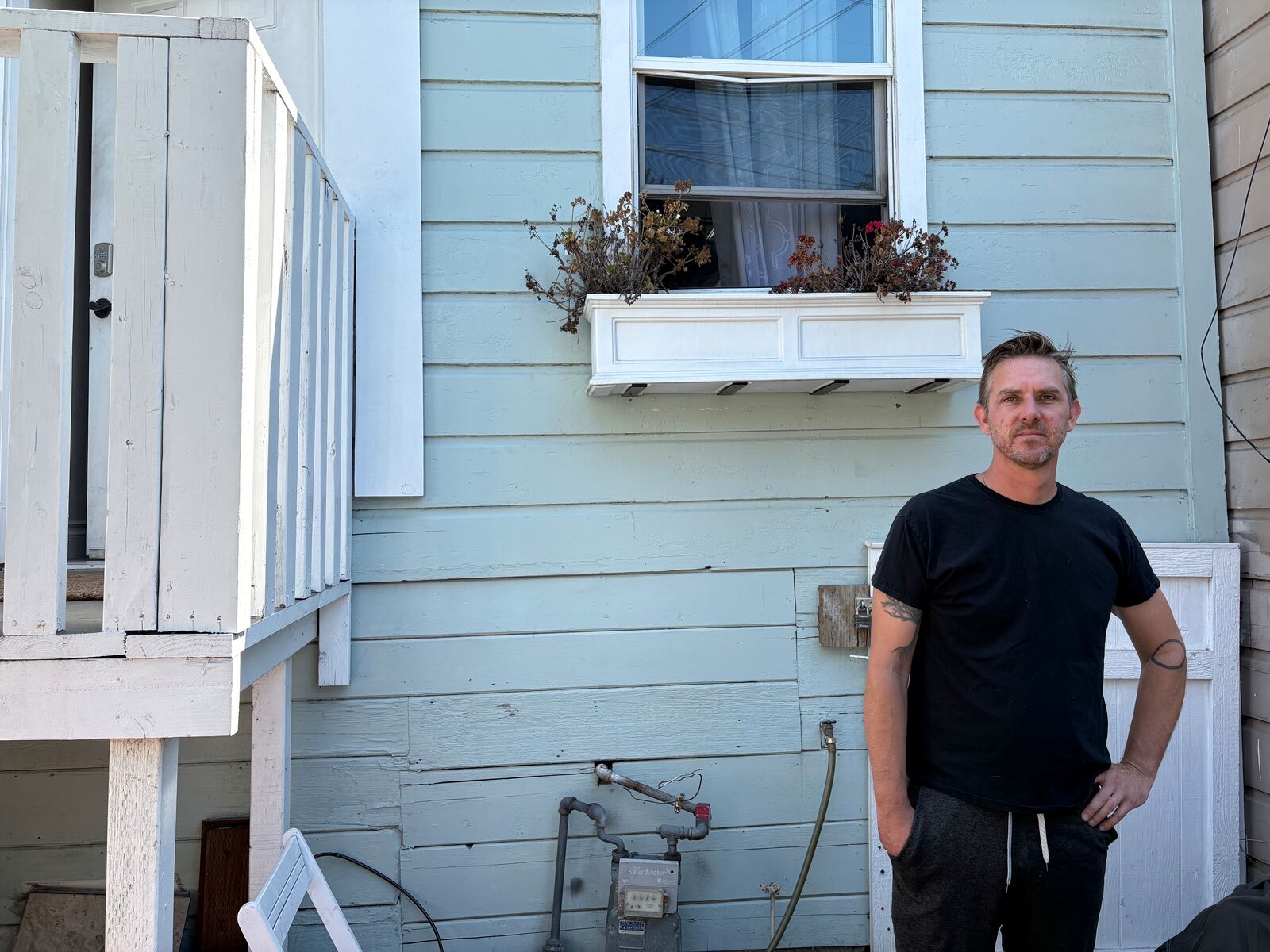 Jeffrey Tollefson didn’t know what he was getting into when he bought his house in Prescott. Credit: Natalie Orenstein/The Oaklandside
One new homeowner’s experience in West Oakland shows that permitting problems cut deeper than the number of staff at a counter or the forms required to apply.
When Jeffrey Tollefson bought an 1870s house in the Prescott neighborhood a little more than a year ago — his first purchase after renting in the city for a decade — his elation didn’t last long.
A day before closing, he found out the seller, a flipper who’d illegally Airbnb’d the place, hadn’t disclosed a lien the city had placed on the property due to blight and an illegal addition. But it would have been too costly to back out then. Instead, Tollefson, who works in construction, figured “however naively” that he could take on the project, signing a $3,000 agreement with the city that he’d get it permitted within a year.
The first challenge was figuring out exactly how much of the house was illegal. The portion quoted to Tollefson didn’t seem to match the very incomplete maps and plans in the historical record. Tollefson knows this from hunting down documents and having a detailed exchange with a city staff historian, which we reviewed.
Starting in the 1960s, West Oakland, which had become a heavily Black neighborhood during World War II, was simultaneously neglected by the city and targeted for “urban renewal.” The city razed blocks of homes and businesses in the 1970s and 1980s. Over the decades and under those conditions, plenty of unpermitted work was done to houses, and poor records were kept.
“I just need people [with the city] to say, ‘Yeah, that’s part of our history, we’re gonna be a little humble and work together,’” Tollefson said. The city has an amnesty program for illegal ADUs, making it easy to get them permitted, but no such concept exists for a case like Tollefson’s. Instead, he was given piecemeal information about requirements, fees, and deadlines from different divisions. He ultimately faced a difficult decision.
After long delays, Tollefson was assigned a planner, who told him that zoning approvals should be automatic. False. Turned out he needed design review, which found a $12,000 requirement for a “variance” — an exemption from the code — because the house was built over the property line. But that wasn’t the end of it.
When Tollefson later reached out to the building division, someone there alerted him to other issues with the house’s layout. In California, most bedrooms need an emergency exit, like a window, that lets a resident leave the property quickly. Bedrooms at Tollefson’s property have windows that exit onto a neighbor’s property, rather than public space. He was told this would also require a variance — that is, if he could also get his neighbor to grant an easement. The rest of the old addition would then need to be inspected, which could easily reveal other issues.
The alternative? Demolish the large chunk of the 1,050-square-foot house that the city had identified as an illegal addition, and rebuild from scratch. That, or foreclose. Tollefson spent a series of sleepless nights agonizing over “what to do and how to do it.” He didn’t want to give up, though; he’s “still super stoked to be a homeowner” and loves the neighborhood.
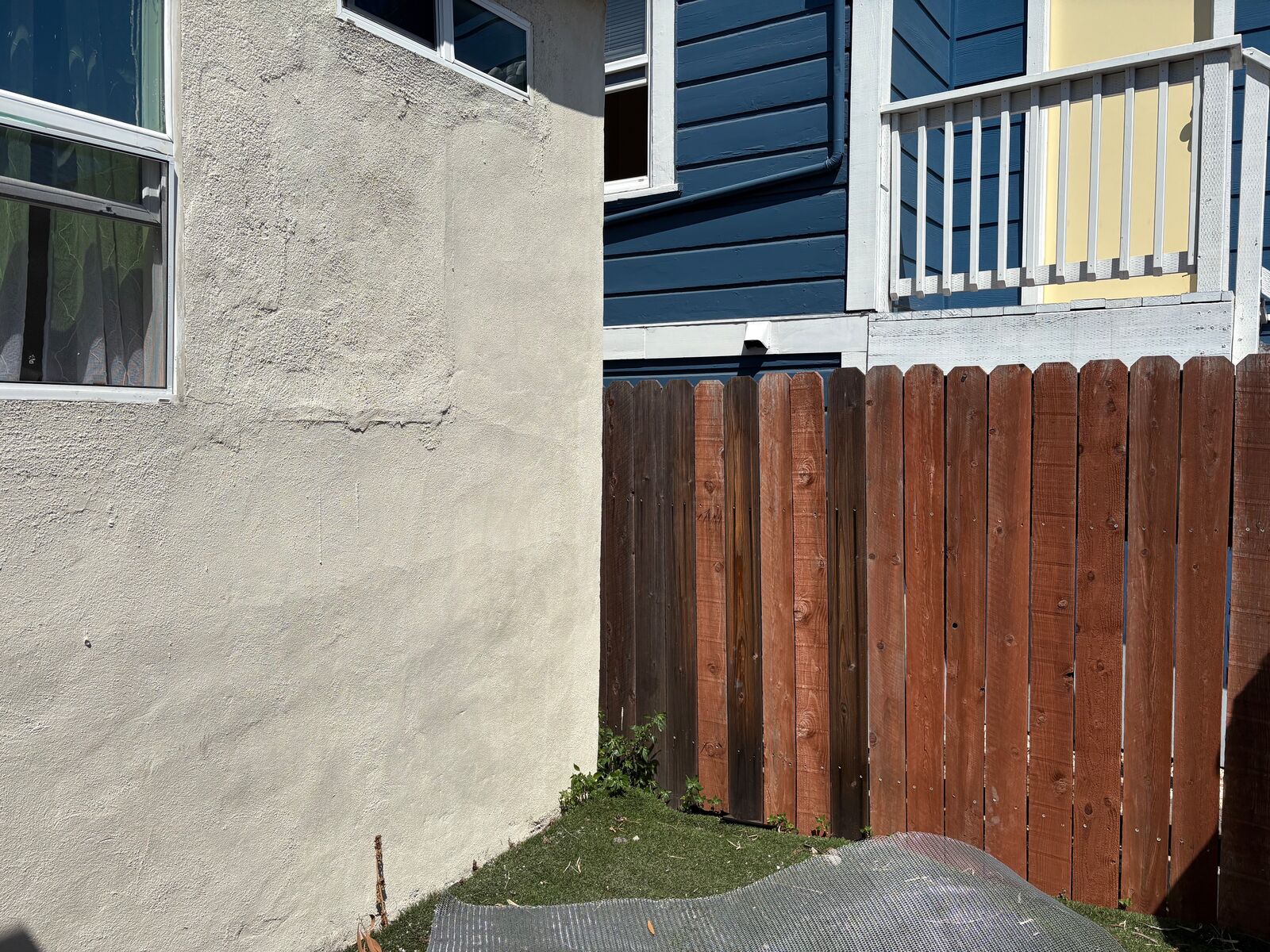 According to the city, parts of Tollefson’s house were built over his property line at some point in the past. Credit: Natalie Orenstein/The Oaklandside
Tollefson said his nightmare reveals why so much dangerous, unpermitted work falls under the radar.
“They do not incentivize coming forward,” he said. “Their fix is to penalize everyone. It really restricts development.”
Speaking with us several months ago, Tollefson said “a case manager who could follow me from start to finish” would have been an immense help for his confusing project.
Future builders in his position might get that. Among the changes planned for next year: a “single staff point of contact through the permit life cycle.”
Abad said the city is working to tackle the lack of interdepartmental communication by giving each department simultaneous “visibility” into the project status and coordinating better on solutions that meet fire safety requirements, urban design and aesthetic requirements, and building safety and structural requirements. Some siloes are the necessary result of the slew of different state codes and laws the city has to follow.
But Tollefson’s experience speaks to a deeper challenge for Oakland when it comes to providing opportunities for regular people to buy, live, build, and stay here. It’s a city that will always be grappling with a fraught past whose vestiges are visible in rundown, unrecorded, unpermitted, neglected housing stock — homes the city needs, and whose owners can rarely afford to bring them up to code.
At best, these conditions make homebuying that much more out of reach for most people. At worst, they risk turning neighborhoods in Oakland into foreclosure factories.
Converting that history into opportunities will require not only permitting reforms but a serious reckoning.
“*” indicates required fields