
A 2.9 magnitude earthquake just east of Piedmont jolted Oakland and other East Bay cities shortly before 3 p.m. on Monday – the latest of dozens of small quakes to rattle the East Bay in a span of 15 hours, according to the U.S. Geological Survey.
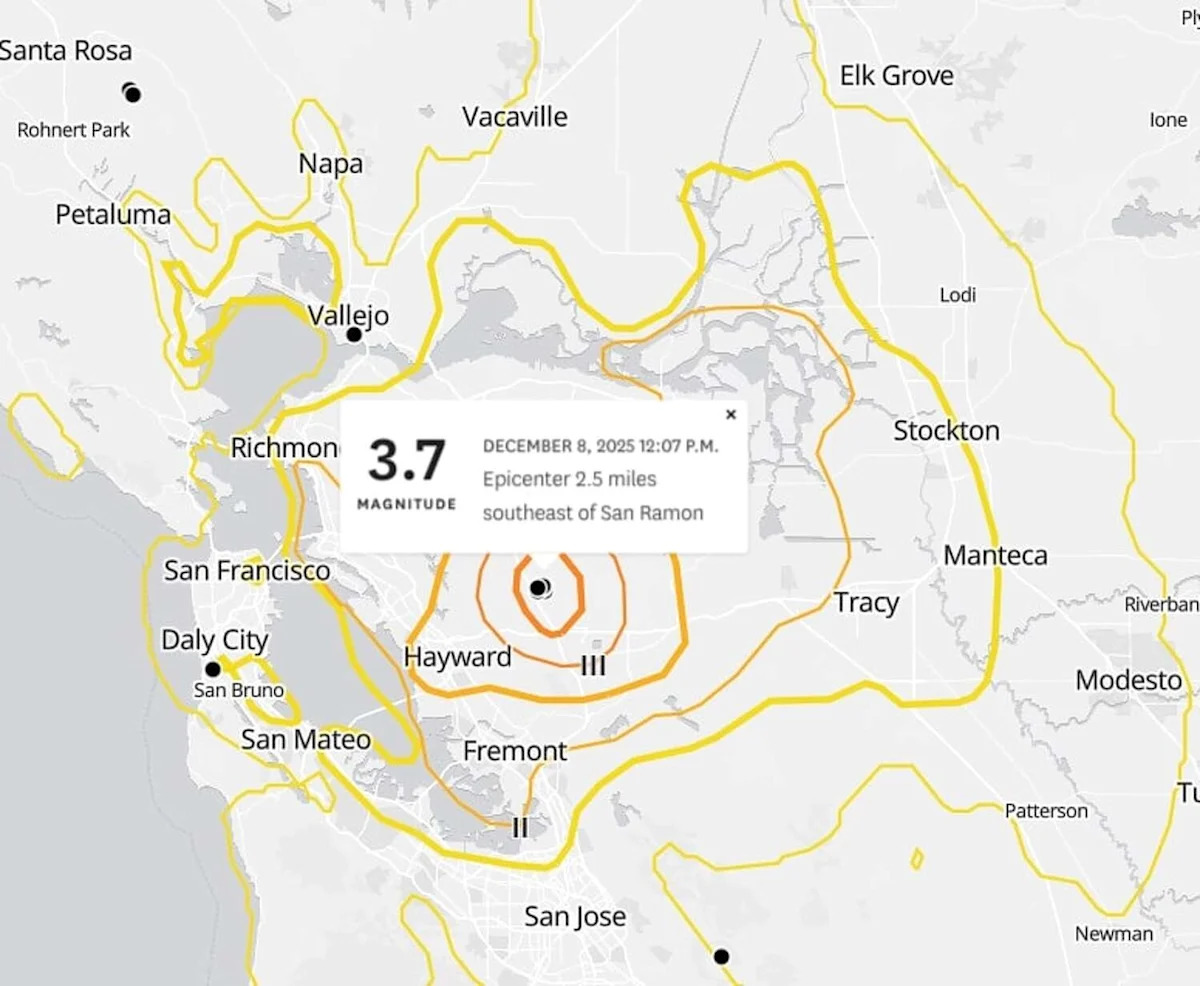
Earlier, a 3.6 magnitude earthquake struck the East Bay‘s Tri-Valley region. The 9:07 a.m. quake was the strongest of a cluster of jolts that popped in the San Ramon area throughout the morning. No damage was immediately reported, but the 3.6 quake, which was initially measured as a 3.7 and later revised downward, was felt as far as San Jose to the south and Hercules to the north.
USGS officials did not know whether the 3.6 quake would be the largest of the swarm, but they said such strings of seismic activity aren’t uncommon in the region and generally don’t get much stronger. Last month, a swarm in the same area lasted a couple of days, peaking with a 3.8 magnitude quake on Nov. 9.
“What we do know is this is very typical,” said Annemarie Baltay, a research geophysicist with the USGS, of the Tri-Valley quakes. “It’s just the earth saying, ‘I’m doing my stuff.'”
The Piedmont quake originated in a different area than the San Ramon quakes. What fault caused it is not immediately known, but the Hayward Fault runs just east of Piedmont.
The San Ramon activity is occurring along a segment of the Calaveras Fault, which runs from the Salinas area in Monterey County to north of Danville in the East Bay, Baltay said. Although scientists don’t know the exact source of the movement, they say it’s likely the fault releasing stress or fluids migrating beneath the surface.
“It’s part of the long-term, large-scale plate tectonics of the area,” Baltay said.
The swarms along this part of the Calaveras Fault have been recorded since at least the 1970s, with appearances in 2002, 2003 and 2015, according to the USGS.
The fault is able to produce quakes as large as 6.7 magnitude, scientists say. It caused a magnitude 6.2 earthquake in Morgan Hill in 1984, and another of the same size in 1911.
The activity on Monday included two 2.9 quakes and a 3.0 quake.
This article originally published at East Bay earthquakes: the science behind the cluster.