
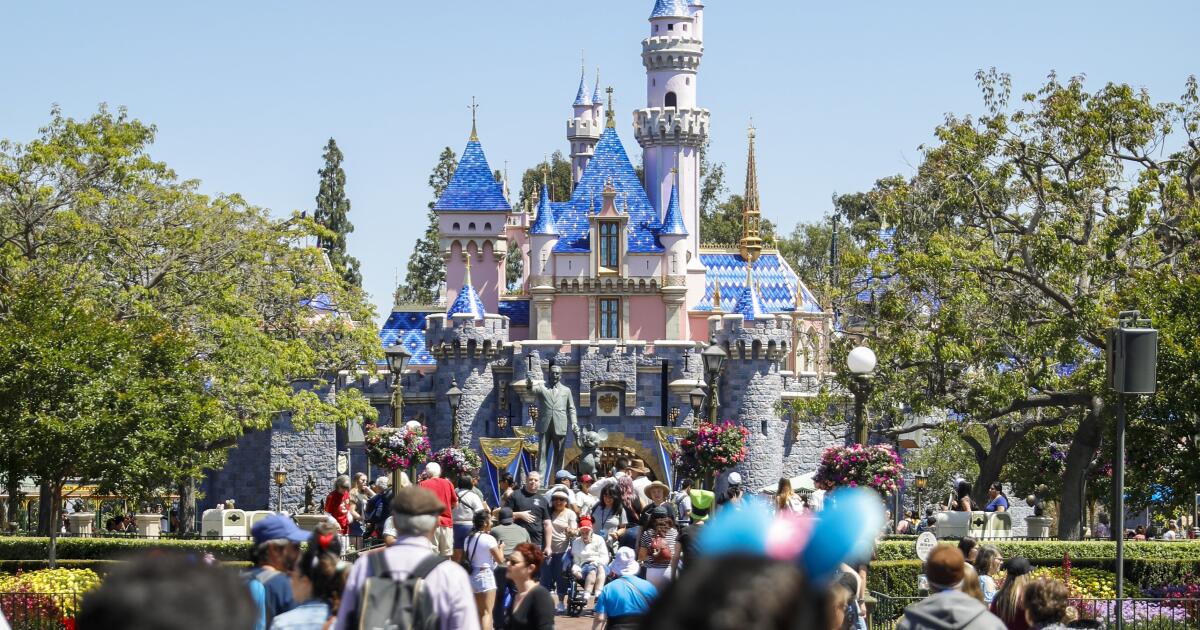
For the past 70 years, Disneyland has anchored Anaheim as a tourist destination, one that now attracts more than 25 million visitors annually.
Over the decades, Anaheim leaders have described the theme park as a “golden goose.” The prevailing wisdom held by many local politicians is that whatever is good for Disneyland is good for Anaheim, with taxes from resort-area hotels pouring into the city’s general fund for services.
The mantra surfaced again last April, when former Anaheim Councilmember Stephen Faessel declared that “every time that there’s been Disney investment, the city benefits” before he voted in support of DisneylandForward, a nearly $2-billion expansion plan.
But Anaheim residents and elected officials haven’t always seen eye-to-eye with the company.
Political battles over corporate subsidies, campaign spending and minimum wage laws in recent years have cast Disneyland’s influence over Anaheim’s governance in a more critical light.
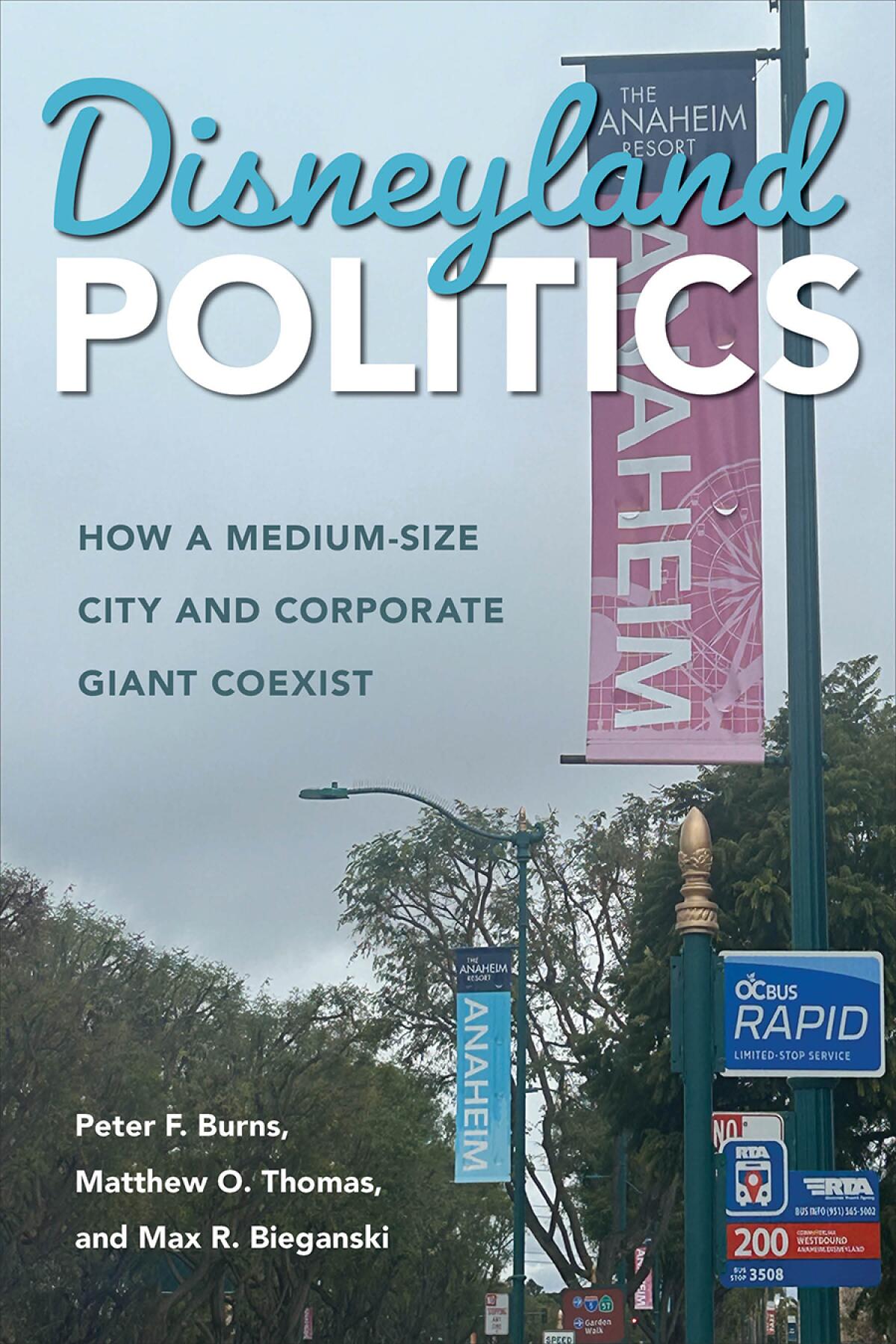
The mouse-eared milieu serves as a case study for co-authors of a new book, “Disneyland Politics: How a Medium-Sized City and Corporate Giant Coexist.”
Peter Burns, a political science professor at Soka University in Aliso Viejo, teamed with Max Bieganski, his former research assistant, and Matthew Thomas, a political science professor at Cal State Chico, in examining the political relationship.
The book weighs how Anaheim has balanced Disneyland’s interests with that of residents — especially when they conflict.
TimesOC spoke with Prof. Burns about “Disneyland Politics” and its conclusions about The Mouse’s political muscle.
What prompted you and your co-authors to take a deep dive into Disney’s political relationship in Anaheim through this book?
Burns: I tend to study places that are near where I work and that I’m familiar with. I started to look around Orange County. I liked Disneyland and just thought, “What are the politics of this place?” What does Disneyland want from the city? What does the city want from Disneyland? How do they react? What is their relationship? Those are kinds of questions that I have studied in urban politics, and so I asked them about Disneyland.
Fissures in the relationship have framed the politics of the last decade or so. But looking back at Anaheim’s history, what are some examples of past dust-ups?
Burns: I can see the start of some public pushback around the time … that Westcot was proposed, which was going to be the West Coast Epcot. This is around the early 1990s. The city and residents asked Disney to make changes to their plan for Westcot — it was more than 60 conditions— and Disney did that.
When the Anaheim Resort district was created in the mid-’90s, there was a clear difference between it and the rest of the city. One of the things that we talk about in the book is the idea of two Anaheims. When people look at Disneyland and their neighborhood, they see two Anaheims, one that’s valued and one that’s not as valued.
One of the provocative terms in the book is the “Disneyland Imperative.” What has that politically translated to in Anaheim?
Burns: It’s the sense that you don’t kill the goose that lays the golden egg. As Disneyland goes, so goes the rest of the city. The Disneyland Imperative is that in order for Anaheim to succeed, local government has to put money and concentrate its resources and attention into Disneyland.
People bought that for a while, but I think they started to look and see that the advantages that Disney got didn’t make their neighborhoods better.
N/A
(Courtesy of Temple University Press)
Between 2016-2018, a council majority emerged as “the People’s Council” under former Mayor Tom Tait. It wasn’t aligned with the Disneyland Imperative. What is the legacy of that council as you see it?
Burns: Two things happened. First, people saw that Disney could be defeated. I think it also changed the terms of the relationship between Disneyland and the city — where Disneyland is less likely to ask for tax rebates. Any Disney deal now also has to benefit the city.
Recently, an effort to put a Disney gate tax on the ballot failed. Tax breaks may be off the table, but what does it say about Disney’s political power that a gate tax still can’t move forward?
Burns: Disney is very convincing when it wants something — and when it doesn’t want something. The company does a very good job of making its claims heard. Disney is a political giant. Even when the company doesn’t support candidates financially, everybody still needs to account for it. They have a lot of political power.
The gate tax is almost a third rail of Anaheim politics.
The book concludes by stating that Disneyland politics tells us a story about democracy. What is that story?
Burns: Cities operate in the context of scare resources. Many cities have had informal partnerships with business in order to make sure they have city services. A very clear example of this is in Anaheim where Disney and related industries drive revenue. The need for private capital in a city will sometimes butt heads with what residents want. What role does money play in politics and does it take precedence over people? Disney plays an essential role in the city. We really tried to provide both sides of the story in the book. Pro-Disney people in the city make a convincing argument. They will say that the narrative pitting Disney versus Anaheim neighborhoods is false.
But where’s the balance?
“Disneyland Politics: How a Medium-Size City and Corporate Giant Coexist” is published by Temple University Press and is available for purchase online.