
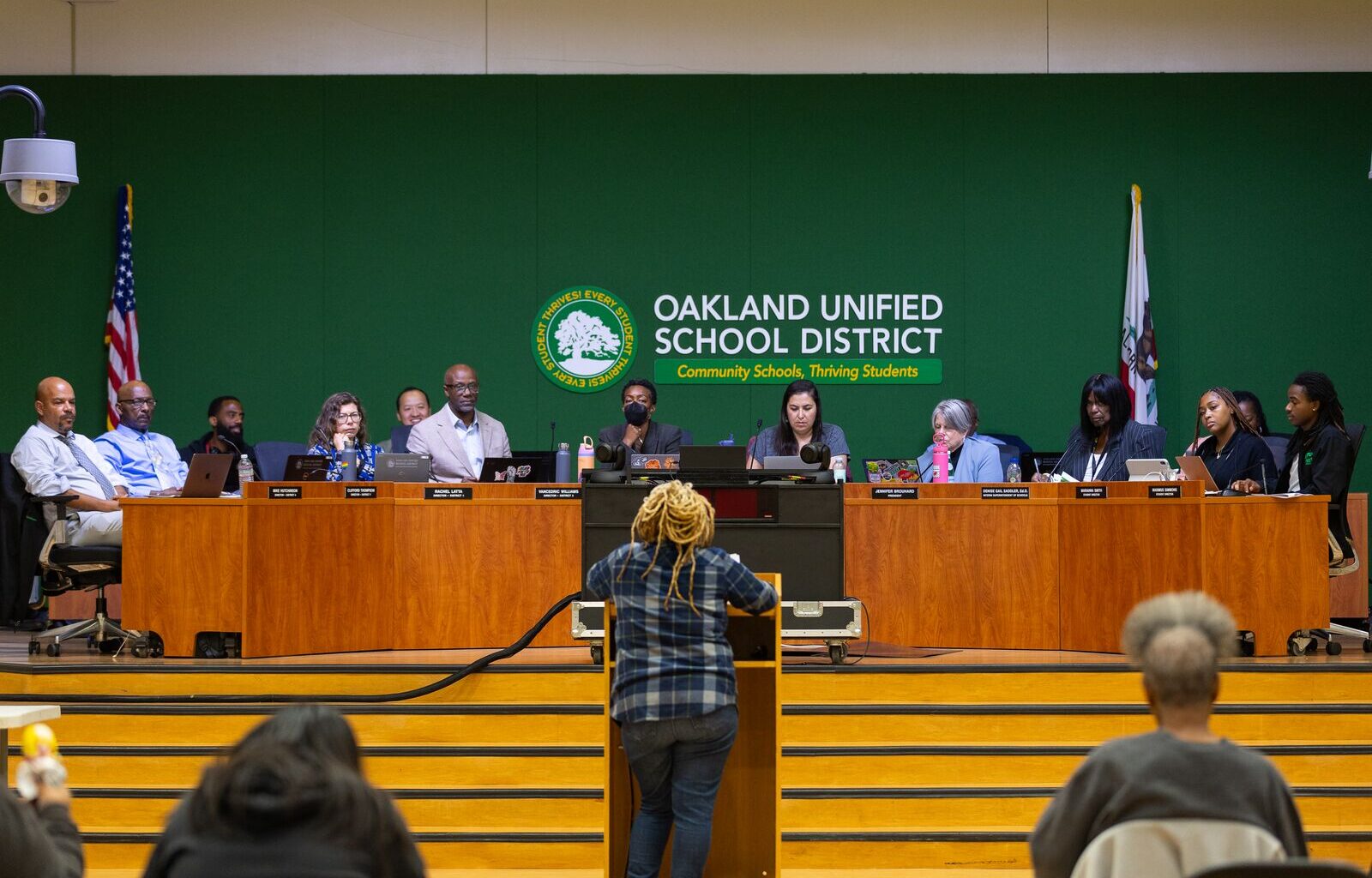
At a packed school board meeting, the last regular meeting of the year, the Oakland Unified School District board committed to slashing $102 million from next year’s budget, a move that will leave no part of the district untouched.
The plan includes deep cuts to both the central office and school sites, hiring and contract freezes, and shifting costs from the district’s general fund to restricted funding sources. The proposal, brought forward by interim superintendent Denise Saddler, also relies on anticipated increases in per-student revenue through investments in raising attendance rates and establishing transitional kindergarten hub sites.
OUSD will also make midyear cuts to the current school year’s budget in order to shore up the district’s reserves.
Students, parents, and community members stood up during the public comment period to advocate for protecting schools, preserving special education funding, and maintaining investments in safety — including in violence prevention programs that are set to lose city funding at the end of this school year. Families from Skyline High School in particular, urged the board to continue investments in safety precautions following an on-campus shooting last month that injured a student.
This fall marked the first opportunity the elected board has had to make independent decisions about its finances in 22 years, after the district left state receivership in July. Beyond the budget cuts, Saddler asked the board to commit to a district restructuring process, which could include school closures or mergers, in the spring to bring spending in line with revenues for the long term.
The vote broke down along somewhat familiar lines, with directors Rachel Latta, Jennifer Brouhard, VanCedric Williams, and Valarie Bachelor voting to approve the proposal. Directors Mike Hutchinson and Patrice Berry voted against it, while Clifford Thompson, who usually votes with them, joined the majority in voting yes.
Hutchinson, who represents District 4, and Berry, who represents District 5, raised concerns that the plan lacked details, naming areas to be cut but not specific programs or positions. Saddler’s proposal also does not include a deadline for her to come back to the board with those details.
“It’s more vague than I feel comfortable with saying ‘This is the plan,’ because I still don’t know what positions and what the implications of some of those recommendations are,” Berry said. “What I don’t want to happen … is that we spend time doing the math and doing the homework and proceeding through the implementation of these recommendations only to find that there’s not $100 million there because some of it’s not feasible.”
Earlier this year, the board had to reverse a budget decision after learning it would upend popular school programs. The board approved a budget plan in March that capped the district’s contracts at $125 million. When implemented, the cap primarily defunded after school programs and field trips, prompting outcry from students, families, and community organizations. The board then rescinded that plan.
Counting on attendance and TK gains
For this school year, the district expects to save $10 million through a hiring freeze and $7 million through cutting central office and school site budgets. The district also anticipates increasing revenues by $10 million this year through raising the attendance rate by 2%. Attendance is up 1.8% so far this year, according to OUSD.
For the 2026-2027 school year, OUSD will shrink the central office by $21 million as outlined in scenarios district staff presented last month. That will include reductions in the superintendent’s office, communications, governance, talent, systems and services, fiscal, and academics divisions.
School site budgets will be reduced by 7.5% to 10% across the board, saving $32 million. The details of those cuts won’t be known until the spring and could vary across schools, as principals work to develop their budgets with their school communities. The central office will absorb an additional 15% to 20% in cuts, resulting in another $11 million in savings. And OUSD plans to recoup about $12 million by shifting some attendance specialists and noon supervisor roles, along with the costs of some small schools, from the general fund to restricted funds.
Controversially, the proposal includes a 10% cut to special education spending, amount to $12 million.
Coriander Melious, a representative of the district’s Community Advisory Council for special education, raised concerns about the reduction in special education spending, pointing out that it could violate federal special education laws that require a maintenance of effort — meaning districts must spend the same amount year-over-year on special education services.
Brooke Lawson, representing the Parent Student Advisory Committee, which advises the district on its investments in vulnerable student groups, urged the district not to make deep cuts to safety and custodial services, arguing that reductions there could drive more families away from the district.
Keeping attendance 2% higher than it was last year is projected to bring another $10 million into the district for the next school year, and expanding transitional kindergarten offerings with two or three hub sites next year is expected to result in another $1.5 million in per-student funding.
Saddler acknowledged that her proposal lacked specifics about how the cuts would be implemented.
“All of these specific ideas in this scenario — this isn’t the plan, it is a scenario — are about really fleshing out how we can accomplish this goal; thinking about what we can do now and what kinds of things we can put in place,” she said.
Hutchinson brought forward an amendment, similar to one he introduced in October, outlining possible areas for reductions this year, including cutting substitutes and teacher coaches; a hiring and contract freeze; staff furloughs; reducing assistant principals; and cutting resources for small schools, newcomer students, English language learners, literacy, and special education. Hutchinson’s resolution also directed the superintendent to come back to the board in January with a specific plan to address what is currently projected to be a $104 million deficit for the 2026-2027 school year.
Hutchinson’s amendment was voted down along the same lines as it was in October. He, Berry, and Thompson supported it while Latta, Brouhard, Williams, and Bachelor voted against it.
“I personally think there is not enough information in these scenarios to even guide our work,” Hutchinson said. “Even if this board does not accept my amendment, I would expect the superintendent to come back with an implementable plan in January. We can’t wait any longer for a solution.”
JT Mates-Muchin, of the parent advisory committee, suggested that the district consider furloughs or salary reductions for the district’s highest paid staff. Saddler said they would be a consideration.
Many of the comments from students and parents who rose to speak were as much about the board’s conduct as they were about the substance of the budget scenarios, as board meetings have sometimes devolved into infighting, finger pointing, and arguments. The board has also clashed with district staff at times.
“I hear almost universally that this is a place for grandstanding, for politics, for bickering, and it is not a place for decorum at all,” said Matt Glaser, a parent at Peralta Elementary. “If you guys would like to see more of a turnout here, I really suggest you all shake hands, learn how to work together, and we will hold you accountable to that.”
“I’m here tonight because my family, like so many others, is exhausted in the annual ritual of budget crisis and the fear it creates in our schools,” said Kathryn Camp, a Glenview Elementary parent. “We also find the public displays of divisiveness between board members incredibly unproductive and immature.”
The board will now submit its proposal, and its first interim budget report for this year, to county superintendent Alysse Castro for review and feedback. Castro had given the board a Dec. 15 deadline.
“*” indicates required fields