
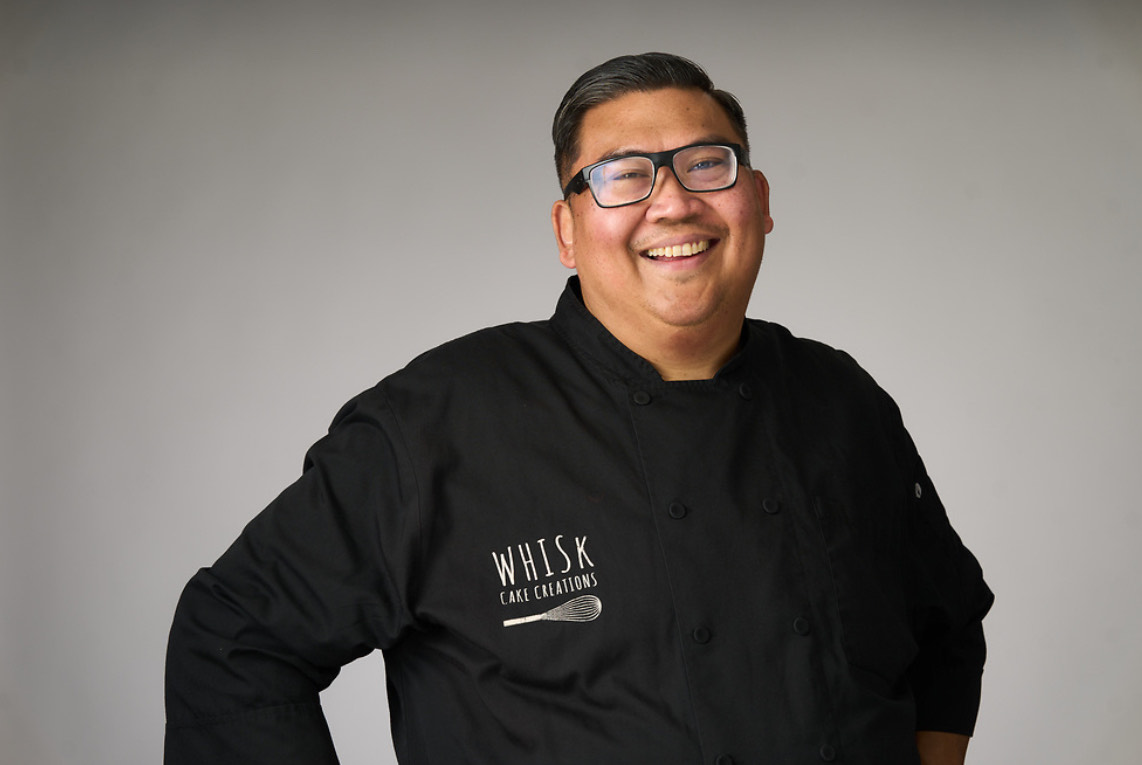
Last year, Henry Awayan was just Henry Awayan, owner of the Alameda-based specialty cake bakery Whisk Cake Creations. If you wanted a custom birthday or wedding cake made with lemon curd and raspberries, or mocha crunch, he was your guy. But as of Nov. 2, he’s now the “Ube King.”
It’s not a moniker he would have necessarily chosen. In fact, it was only when he showed up for a recent appearance, and someone said, “The Ube King is here,” that he decided to embrace it.
But given that his first cookbook just dropped with the Filipino purple tuber in every recipe, “The Ube Baking Book: Decadent and Delicious Recipes with Filipino Purple Yam” with Ulysses Press, he decided that if he didn’t claim the title, someone else might. He showed up to our recent interview donning a newly designed “Ube King” T-shirt and purple Nikes.
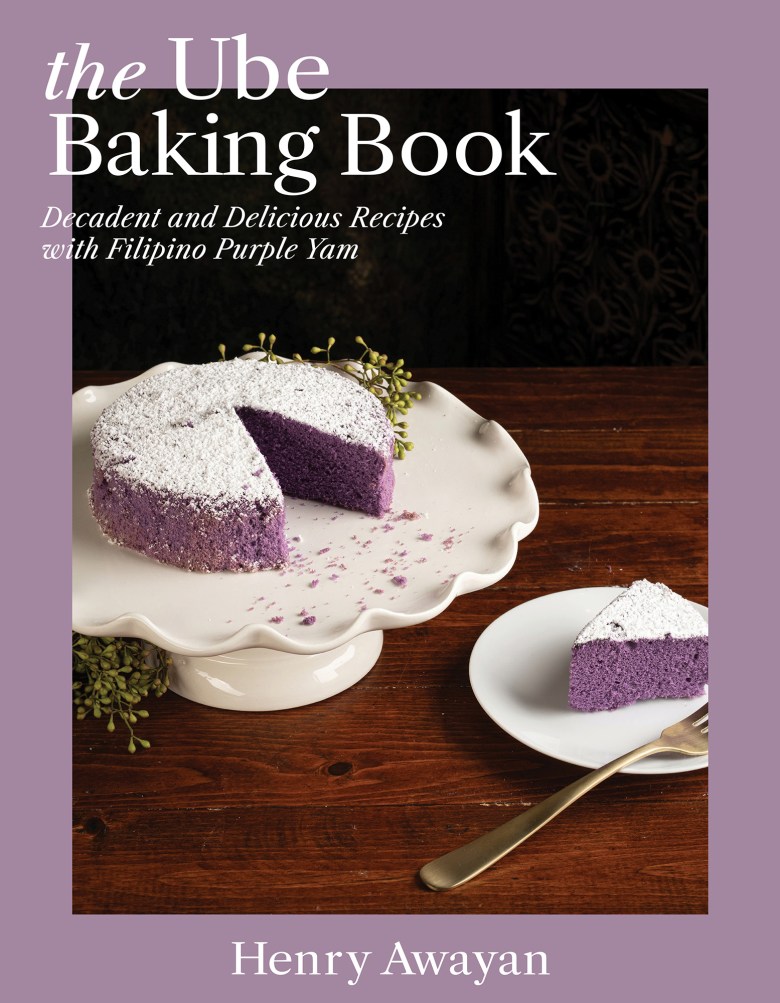
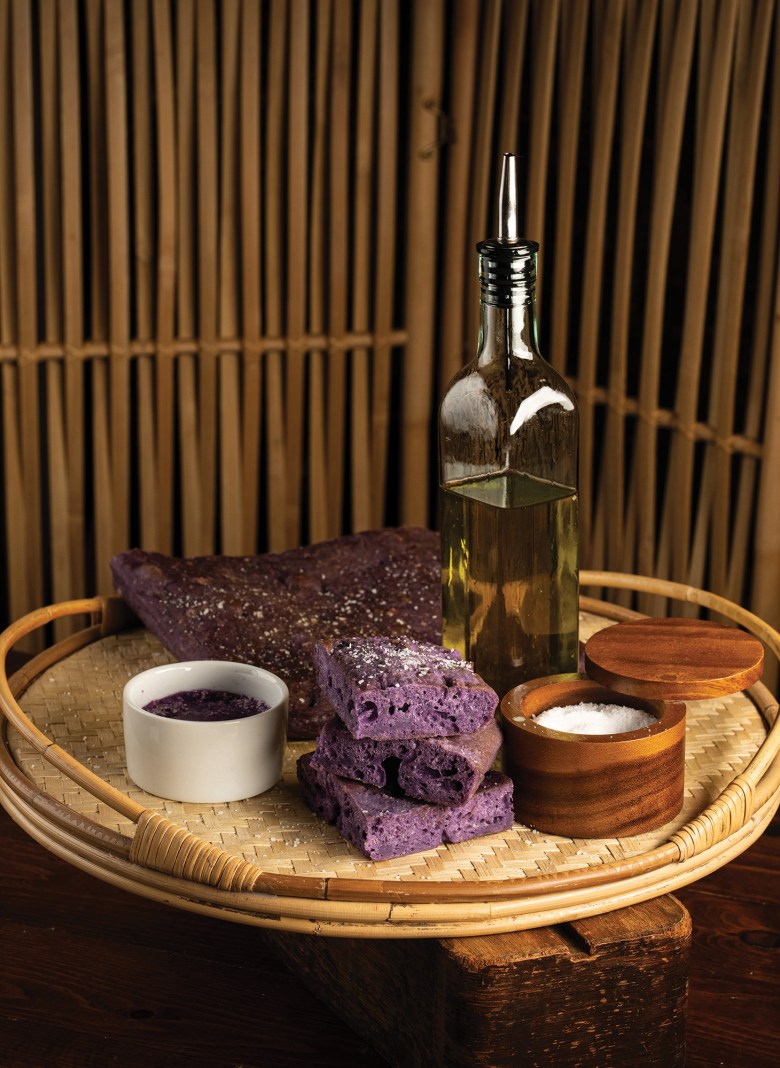
The Ube Baking Book came out in November and includes recipes like ube focaccia. Credit: Book cover image courtesy of Ulysses Press; photo by Maurice Ramirez
Ube is one of those ingredients that has been known in its own community, the Philippines, for millennia. But in the past few years, as with matcha before it, ube has been “discovered” by the rest of the world. (Awayan admitted he was supposed to have his cookbook turned in two years ago, but deadlines aren’t his strong suit).
Ube’s flavor is hard to pin down; it’s subtle, and it’s often described as combining elements of vanilla, pistachio and coconut with earthy undertones. What distinguishes it most of all, though, is its vibrant purple color; in this highly Instagrammable era, its popularity can be largely attributed to its purpleness.
Now, ube is everywhere; one need only look to mainstream markets like Trader Joe’s to count the variety of ube products on its shelves, from a spread to a waffle mix.
The book features more than 50 recipes for everything from halaya – one of the better known ube staples, also called ube jam – that’s made by adding ube powder to coconut milk, butter, sugar and both condensed and evaporated milks, to ube ice cream. Halaya can be eaten on its own, as a spread, or in Halo-Halo, with shaved ice, for a wonderful textural contrast.
The cake section features both traditional ube confections and Awayan’s own inventions: ube chiffon, ube cheesecake, ube tiramisu, ube purple velvet (as opposed to red), ube olive oil cake, ube coconut cake and more. The bread section features ube pan de sal and focaccia. The breakfast pastry section features mochi pancakes, muffins, doughnuts, waffles and crepes. There are chapters on custards and creams, cookies and bars, and drinks.
Recipes call for ube in its various forms: extract, powder, fresh or frozen.Many Asian markets in the East Bay carry ube in extract and powder form, but the fresh and frozen varieties are often harder to find.
The fact that ube is “trending” to such a degree is humorous to Awayan, as he’s known about it his entire life. The son of immigrants from the Philippines, he was raised in Alameda, and though there was a break in between, he and his wife are now raising their kids in the home he grew up in, about a block from the bakery, on Lincoln Avenue. For most of Whisk’s existence, he didn’t have a storefront; he ran his specialty cake business by the naval base for nine years, but he moved to his current location two years ago, and now sells cupcakes, cookies, rotating flavors of cake slices and coffee (he serves Mr. Espresso coffee, not only because it’s good coffee, he said, but because he’s known Luigi Di Ruocco, one of its owners, since elementary school), adding “Alameda is like that.”
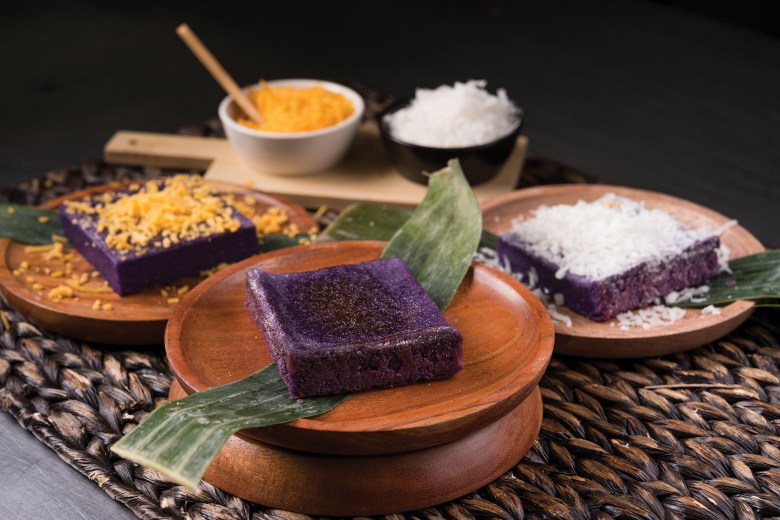 The cookbook includes a recipe for ube bibingka, a type of Filipino coconut rice cake. Credit: Maurice Ramirez
Awayan remembers baking his first cake when he was 10 years old, when his mother returned from a trip to the Philippines. She had been in a boating accident, and he thought a home-baked cake might cheer her up. Before that, he said he had often been in the kitchen cooking with his mother, grandmother or aunts.
“Filipinos, we like to cook. We like to eat. Our love language is food,” he said.
He wasn’t sure what he wanted to do professionally, and before he graduated from high school, a counselor asked what his hobbies were. When he said baking, the counselor asked if he had considered culinary school. He hadn’t, but he enrolled in Diablo Valley College’s culinary program and decided that was his path. He also took Penn State’s Ice Cream Short Course, then a two-week specialty class. (While there, he broke his leg ice skating for the first time.)
He had worked in cakes, including with well-known baker Katrina Rozelle, as well as ice cream before opening Whisk.
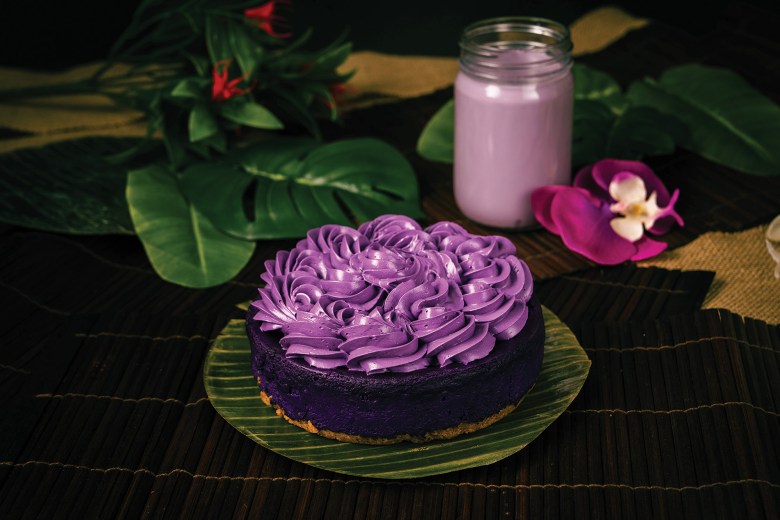 Ube cheesecake is one of many visually appealing recipes in “The Ube Baking Book.” Credit: Maurice Ramirez
Awayan had always wanted to open a bakery of his own, which he did nine years ago. He and his wife agreed they couldn’t tell their kids to “follow their dreams” if he didn’t follow his own. He steadily built up a client base, coming to him for custom wedding and birthday cakes.
During the early months of the pandemic, he took a job delivering mail, and when all Whisk’s orders were cancelled, Awayan came up with an idea that began as a joke to help keep a few people employed.
“Everyone was running out of toilet paper, so I thought, ‘let’s make a toilet paper cake,’ he said. “We made just a small, four-inch cake, decorated with fondant to look like toilet paper, and it just went crazy. In a way, it was almost like the toilet paper cakes saved the business.”
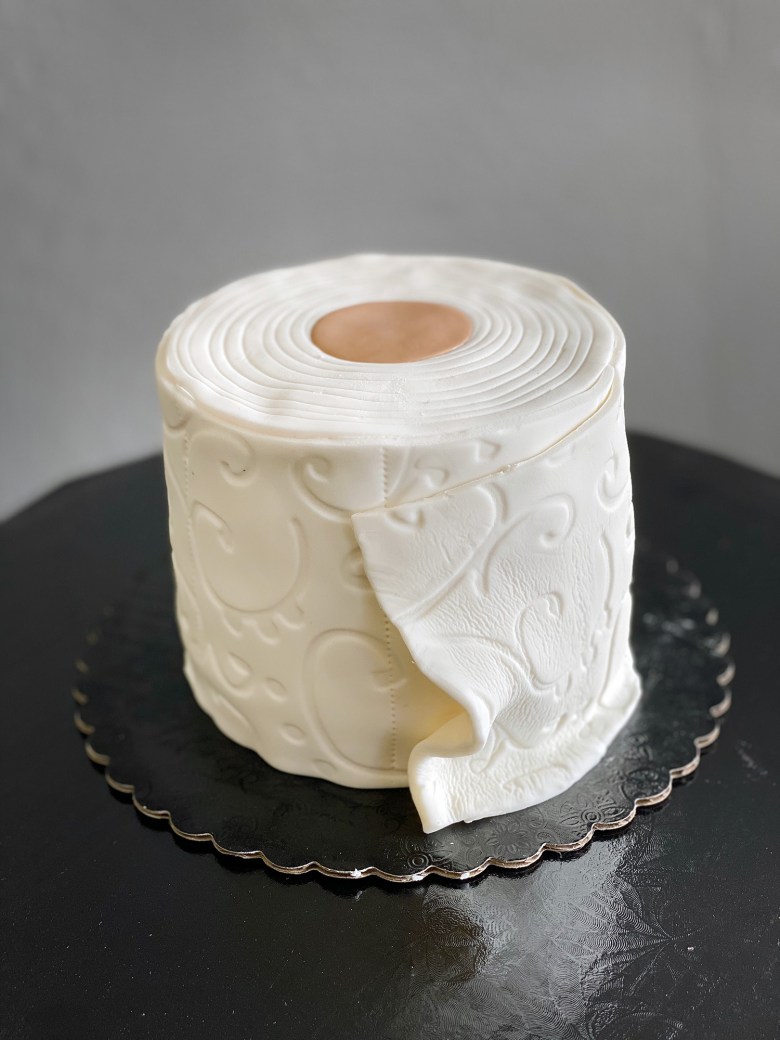 During the early stages of the COVID-19 pandemic Awayan came up with the idea to make a toilet paper cake, which became an instant hit. Credit: Courtesy of Henry Awayan
Awayan said he had been thinking about an eventual cookbook, featuring some of his more original cakes with the stories behind them, but hadn’t taken any steps yet to make it happen. Then, a high school friend already working with Ulysses Press approached him, and asked if he might like to submit a proposal for an ube cookbook.
At first, he hesitated.
“Filipinos can be very critical, especially the older titos and titas,” he said. “I thought they might criticize me because it’s not completely traditional.”
But then he thought better of it.
“I’m proud to be Filipino, and Filipino food is definitely having its moment now,” he said, noting how young Filipino chefs are making their mark in the Bay Area, and that this year, restaurants in the Philippines have been awarded Michelin stars for the first time.
The book was a lot of effort outside his regular bakery-owning duties. His recipes for cakes for 100 had to be scaled down to feed 10. He didn’t realize that each photo would take hours to shoot (photography was all done by Alameda-based photographer Maurice Ramirez, and the two did all the styling themselves).
While the book has Awayan making appearances all over the Bay now, he said in 2026, he plans to offer classes at his bakery, going through the book. Watch his website or Instagram account for more information.
In the meantime, though, Awayan is grateful to have this opportunity to serve as an ube ambassador, of sorts, and “spread the ube love.”
Recipe: Henry Awayan’s ube whipped cream
Makes approximately two cups (32 oz.) whipped cream
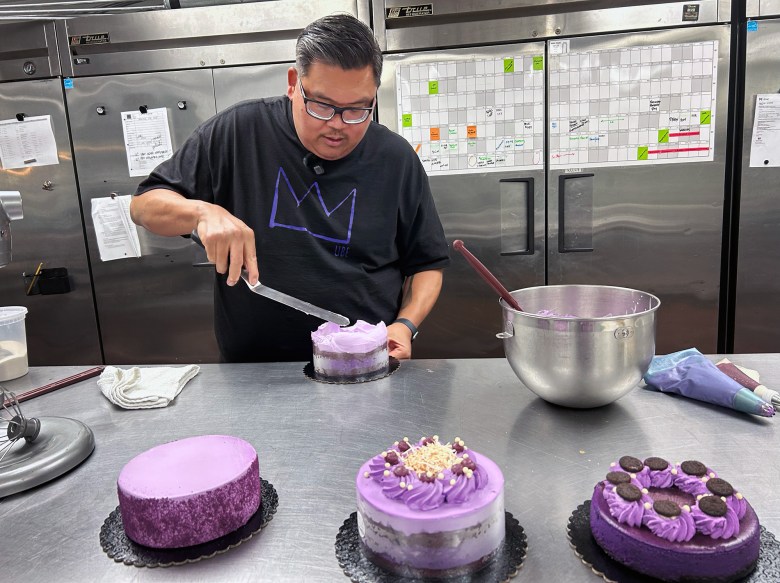 Henry Awayan applies ube whipped cream to a cake at his Whisk Cake Creations kitchen in Alameda. Credit: Alix Wall for East Bay Nosh
Ingredients:
2 cups heavy cream
4 tablespoons sugar
2 tablespoons ube extract
Instructions:
In a stand mixer with a whisk attachment, combine the cream, sugar and then ube extract and mix until medium peaks form.
Related stories
Video: The secret to making restaurant-quality, fluffy pancakes at home
November 22, 2024Nov. 22, 2024, 6:14 p.m.
Three years after sparking protests, Bar Panisse opens in Berkeley this week
December 10, 2025Dec. 10, 2025, 9:01 a.m.
The East Bay’s best new restaurant wins over diners with dedication to the details
December 10, 2025Dec. 10, 2025, 3:23 p.m.
“*” indicates required fields