
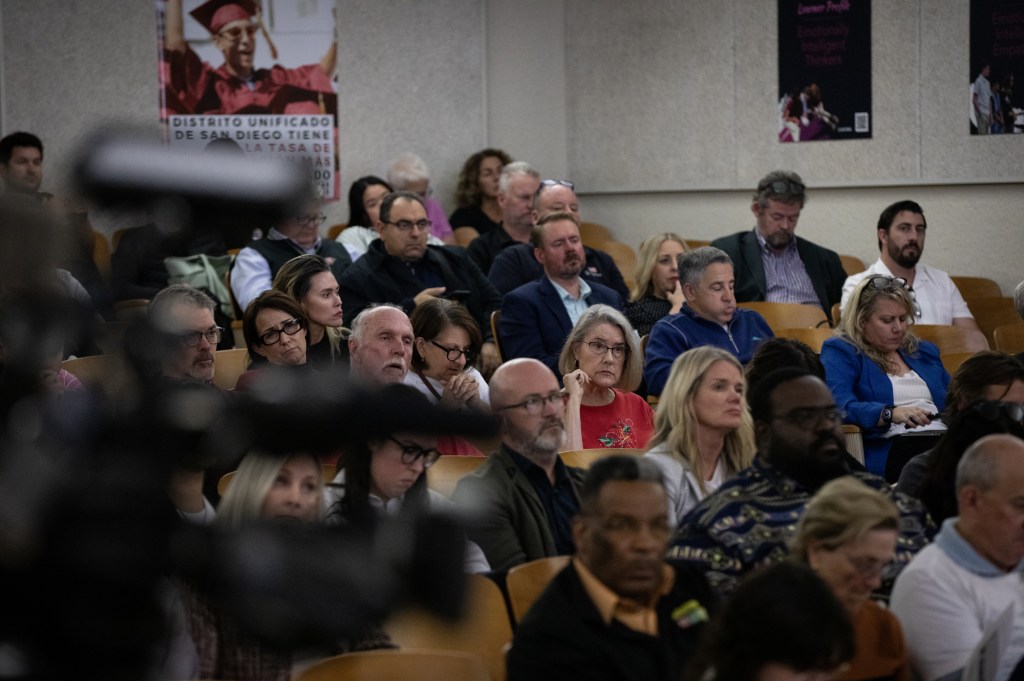
At a marathon Wednesday night meeting that at times turned chaotic, a divided San Diego Unified school board delayed a vote on most of its affordable housing plans until next month, rather than move ahead on proposals to build nearly 1,500 homes on district land.
Dozens of people crowded a room where the board had been set to consider development plans for five sites around the city, in what would have been a major step forward in the district’s strategy of investing in new housing to shore up its workforce and enrollment and bring in needed revenue to fund schools.
That planned vote would have let the district move to the next stage, including interviewing the development teams selected for each project.
Instead, trustee Richard Barrera moved to have most of the developers return next month for a special public workshop and deliver roughly 10-minute presentations to the board before it votes. The developers whose plans were deemed not viable would not return.
Later in the discussion, Barrera said the board wanted to be impressed by the proposals coming before them, prompting Petterson to ask if he were saying he wanted to start from scratch.
“Let me just clarify here,” said his colleague Cody Petterson. “Are you saying they should change their proposals?”
“I want proposals that meet our goals, period, so let’s see — let’s see what you come back with,” said Barrera.
“Wait, hold on — is this actually what we’re going to say?” said Petterson. “That we’re now going to completely resubmit new proposals, that these — this is so wild. I’m completely stunned. I’m sorry to say it. I don’t know where we are right now.”
On a split 3-2 vote, the board chose to go Barrera’s route.
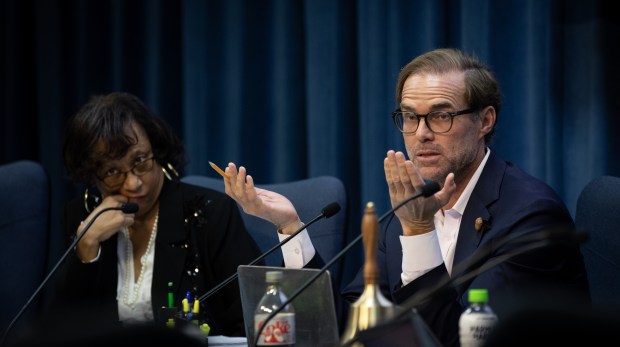 Member Sharon Whitehurst-Payne, left, and President Cody Petterson during a San Diego Unified School Board meeting on Wednesday, Dec. 10, 2025 in San Diego. (Ana Ramirez / The San Diego Union-Tribune)
Hazan had asked if they could share feedback to get to consensus around their priorities, so that January could see bidders give information or their best and final offer.
Petterson said they had all been under pressure to change the process at “the one-yard line” but have clear parameters around what they’re seeking to achieve.
The district did move forward with development plans for one site that had drawn only one developer application — the Instructional Media Center in Linda Vista.
The next steps for that project would include interviews and vetting to ensure it’s feasible and meets district guidelines, based on an outline of the process described by chief of staff Enrique Ruacho ahead of Wednesday’s vote.
Some public commenters had raised concerns about that project’s impact on the neighborhood, namely around traffic, parking and emergency evacuation routes.
“We are one way in and one way out,” said Callie Greer, a Birdland homeowner. “We are built in a canyon.”
But on Wednesday night, most of the community members who spoke about the proposals were there to comment on the site set to be developed in University Heights, in the building where the board meeting took place — the Eugene Brucker Education Center.
Some commenters pushed for more preservation and warned against overwhelming the surrounding area.
Marc Johnson, who served on the evaluation committee and co-chairs the Community Coalition of University Heights, said that the plan recommended for the site, from Affirmed Housing, wasn’t perfect.
“What is built here can’t overburden the University Heights community,” he said. “We have to address the existing infrastructure, and we have to find a solution that has the scale and size and mass that’s compatible with this site, and compatible with the neighborhood.”
Other community members made the opposite argument about scale, pushing for more homes than were outlined in the recommended proposal.
That proposal would build more than 900 rent-restricted units, most of them studios and one-bedrooms. District staff recommended it over three competing ones, including one that would have built substantially more units, but for tenants with higher incomes.
“Height is not a problem,” said Wesley Morgan, an uptown resident and the treasurer of YIMBY Democrats of San Diego. “Height is how you unlock parks, plazas, public space and green corridors.”
Much of the public comment across the projects came from members of the development teams, with some arguing that their proposal would be the best one for a given site.
In response, trustee Sabrina Bazzo asked for next month’s presentations to focus on what issues the evaluation committee might have been confused about or missed in its report.
In March, the board had approved guiding principles saying their goal was the highest number of affordable units, not necessarily the highest percentage of affordable units — but none of the staff-recommended proposals were those with the highest number.
Hazan said it was “confounding” that the highest-scoring proposal for the Revere Center site was not the one with the most units.
“The top priority that we identified for all of our projects is the maximum number of affordable units, and it looked like that may have been missed in this recommendation,” she said.
Near the end of the meeting, board members also elected new officers for next year. Barrera will serve as president; Bazzo will serve as vice president.
The five sites where the district wants to build housing are:
Eugene Brucker Education Center, 4100 Normal St., San Diego
Revere Center, 6735 Gifford Way, San Diego
Fremont/Ballard Center, 2375 Congress St., San Diego
Instructional Media Center, 2441 Cardinal Lane, San Diego
Commercial Street, 2101 Commercial St., San Diego