
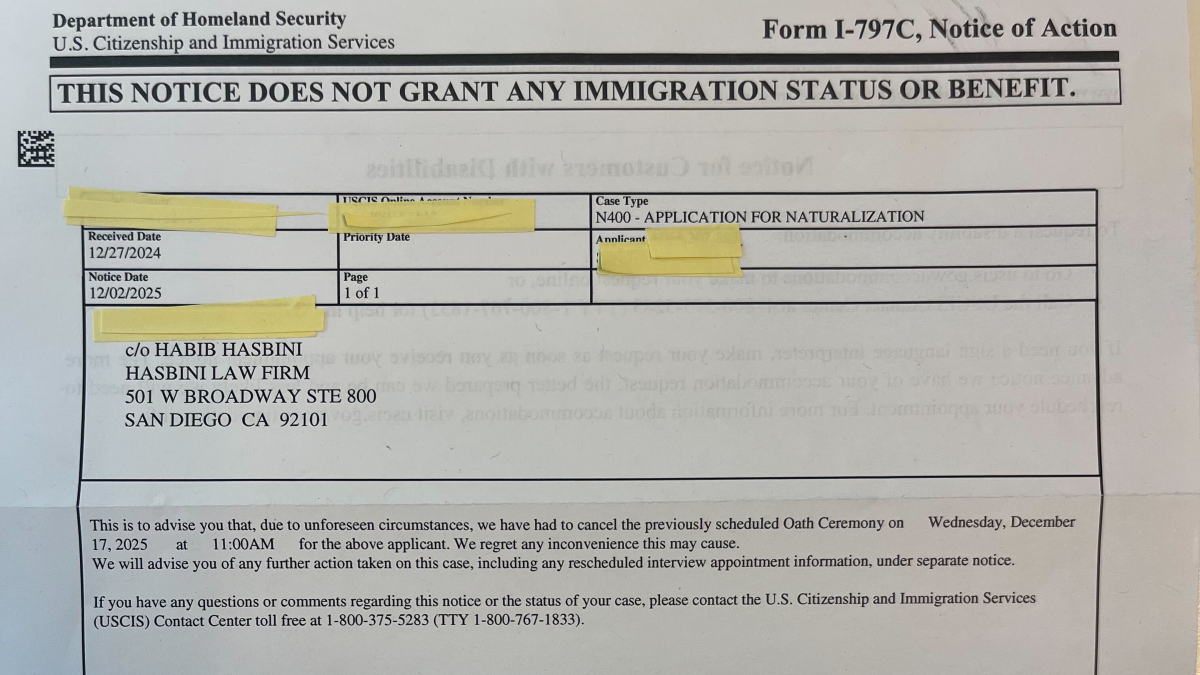
A woman from Afghanistan who worked for the U.S. military saw her citizenship oath ceremony canceled with little explanation after she was already approved, her attorney said, as the Trump administration indefinitely pauses all immigration applications for people from 19 countries.
“We knew it was coming, but we didn’t expect it to come for people who are only scheduled for like a celebratory ceremony, to celebrate becoming a citizen,” said immigration attorney Habib Hasbini.
Hasbini represents the woman, who NBC 7 is not naming for her safety. He said she was a cook and an interpreter for the American military and came to the U.S. in 2017 on a special immigrant visa (SIV), which is specifically for people who assisted the U.S. in Afghanistan. An SIV requires rigorous vetting, Hasbini said, and results in a green card. After five years with a green card, legal permanent residents become eligible to apply for naturalized citizenship.
“In order to work closely with the U.S. government, to be trusted with this role as a classified, you know, personnel, you need to go through certain vetting,” Hasbini said. “Anyone with criminal history will never be able to, you know, to get SIV, let alone work with the U.S. government.”
The woman settled in San Diego because she has family in the area, including two adult children who also entered the U.S. on SIVs and have since become naturalized citizens. She applied for citizenship this year, Hasbini said, and her application was approved in October. Her oath ceremony was scheduled for November but she has health challenges and was hospitalized right before, so they rescheduled for Dec. 17.
“This ceremony is not like a benefits request or application or adjudicating stage,” Hasbini said. “It’s simply a place where you go, you celebrate, you take pictures, the families, family members and friends, and they give you the certificate.”
“She feels it’s like a big honor for her to finally reach that stage,” Hasbini said.
But before her rescheduled ceremony, U.S. Citizenship and Immigration Services sent her a letter that said “due to unforeseen circumstances, we have had to cancel the previously scheduled Oath Ceremony.”
“We regret any inconvenience this may cause,” the letter continued.
“When she finally, you know, reached her big day, when she was like an inch away from the finish line, she was … told, you know, you cannot enter,” Hasbini said.
The letter arrived after the Trump administration announced in late November a pause on any immigration applications from 19 countries, including Afghanistan, Haiti and Somalia, among others, following the shooting of two National Guard members in Washington, D.C. An Afghan national admitted to the U.S. in 2021 and granted asylum earlier this year has been charged with the shooting, which left one National Guard member dead and another wounded.
“USCIS has paused all adjudications for aliens from high-risk countries while USCIS works to ensure that all aliens from these countries are vetted and screened to the maximum degree possible,” the agency said in a statement when asked about the letter Hasbini’s client received. “The pause will allow for a comprehensive examination of all pending benefit requests for aliens from the designated high-risk countries. The safety of the American people always comes first.”
There’s little indication when the pause will be lifted, if ever. At a rally in Pennsylvania on Tuesday, President Donald Trump touted the move.
“I’ve also announced a permanent pause on third-world migration including from hellholes like Afghanistan, Haiti, Somalia and many other countries,” he said to cheers from the crowd.
“Now, because of the actions of one person, collectively punishing all of us, this is crazy,” said Mohammad Rahimi, executive director of Afghan Family Services. “This is wrong, and this is un-American.”
Rahimi followed the same path to citizenship: working as an attorney with the American military in Afghanistan, entering the U.S. via SIV and becoming a citizen.
“We were ready to sacrifice and even sacrifice our life to support this mission,” Rahimi said. “This is a slap in the face of the immigrants and refugees who worked so hard, who supported the U.S government, came here, followed all the rules and laws, and made it all the way to this stage.”
“If she was a criminal, if she was a threat against this community, the government needed to find out in the last eight years. But they couldn’t find anything because she was doing everything that she needed to do,” he said of Hasbini’s client. “Prosecute this case, this Afghan guy and, you know, give him the punishment that he deserves. But stop generalizing our entire community.”
Hasbini said the path forward for his client was not clear and she was distraught upon learning of the cancellation.
“She’s traumatized now. She’s in denial. She’s still in disbelief,” he said. “But she still has some hope that hopefully one day she can be an American citizen.”