
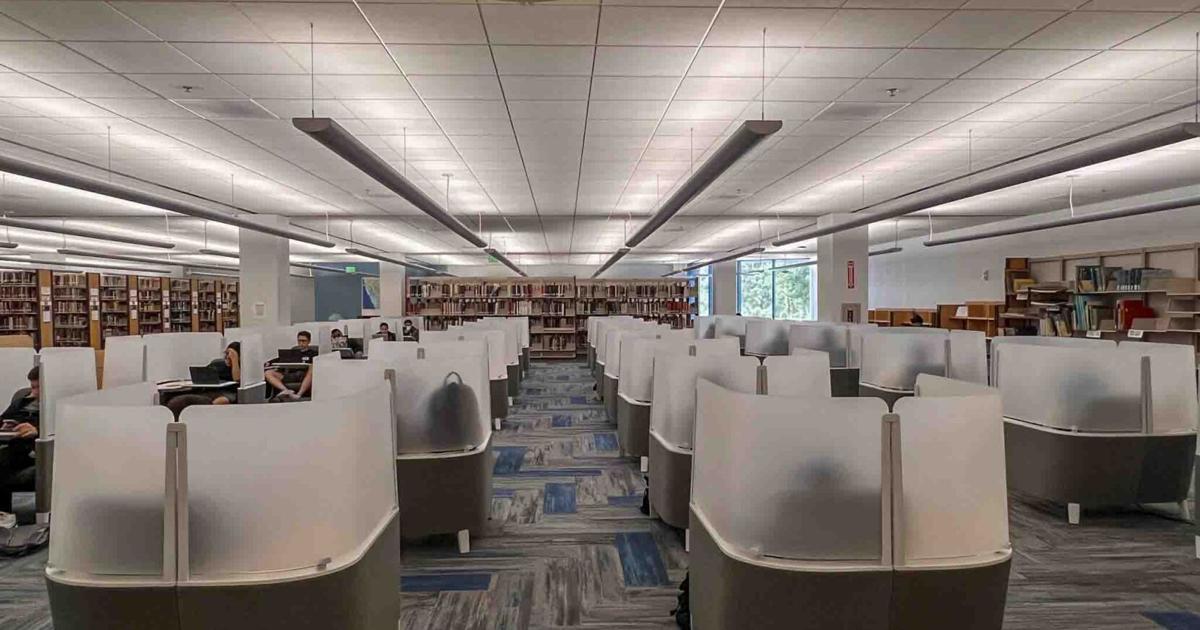
Members of the Academic Senate discussed the sustainability of class sizes on campus during the Dec. 11 Academic Senate meeting.
Christina Barbieri, a member of the statewide bargaining team, spoke at the meeting about faculty concerns regarding faculty workload and class structure when facing increases in the student body.
Cal State Fullerton has the largest student population in the CSU system, having welcomed over 44,000 students for the 2025-26 academic year.
Barbieri clarified that EP&R 76-36, a document outlining policies and procedures for faculty workloads, is not a part of the Collective Bargaining Agreement. She stated that the issue should be addressed instead at a campus-wide level.
“Every recent contract negotiation management has refused to acknowledge this document or place it back into the CBA. So the issue of class size will not be addressed through bargaining,” Barbieri said.
Barbieri then yielded to Anton Peshkov, an assistant professor in the department of physics, who spoke about his own experiences with inflated class sizes.
Specifically, Peshkov spoke about the class sizes for introductory courses he taught over the semester that are open to students across a number of majors.
“Typically, in past years, I’ve been here for three years, my typical introductory class was between 90 and 130 students, which is already very hard to do without having support. This year I was assigned 175 students,” Peshkov said.
Peshkov stated that the increased class size has impacted student performance. According to him, the fail rate for his classes in past semesters was between 15-20% of his students, but this semester he was expecting around a 50% fail rate.
According to Peshkov, this overextension of resources is exacerbated by the lack of support professors have when teaching classes, referencing the UC system’s use of teacher assistants. He urged that the university enact a cap on the number of students that are enrolled at CSUF to not impact graduation rates because of the decrease in the quality of classes.
Some also stated concerns that in cases where enrollment exceeds the cap, the university could adjust the type of lecturer needed to instruct the class full-time or hire new professors.
Members of the senate urged the university to reinstate a working group dedicated to targeting discussed issues and concerns.
Interim Provost Amir Dabirian responded saying that the university is working with the deans and department chairs to provide support for faculty.
Dabirian also announced during the meeting that 29 faculty members received tenure and 60 received promotions.
For part-time faculty, 77 part-time faculty members received elevations, an upgrade from the 37 part-time faculty members who were elevated last year.
“50% of our students are taught by our part-time faculty and lecturers, and they play a wider role in our success. So it is really critical for them to get the promotions they deserve,” Dabirian said.
The university also hired 42 new tenure-track hires, a point that caused some to voice concerns over faculty job security.
Specifically, some voiced concerns that hiring additional tenure-track faculty put the positions of senior lecturers who are not on the tenure track at risk.
Other concerns discussed at the meeting included allocating acquired funding for graduate students and reinforcing prerequisite requirements for incoming students.