
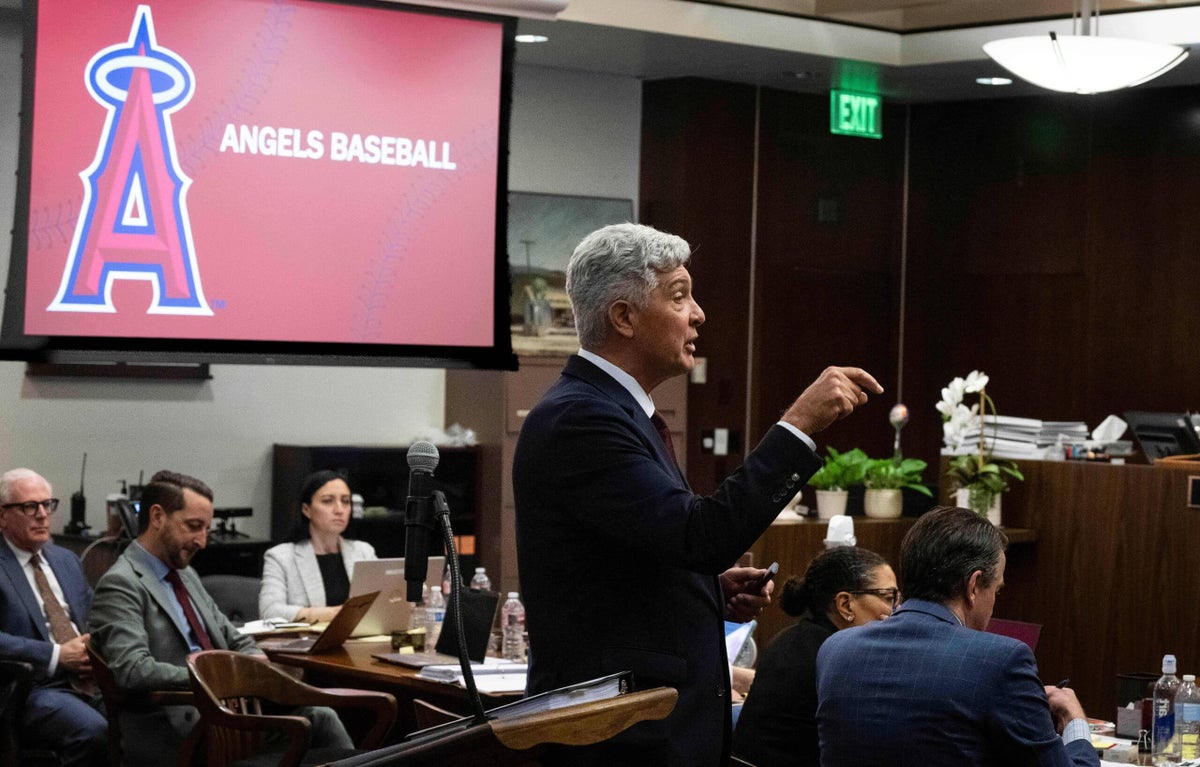
SANTA ANA, Calif. — After 30 days, 44 witnesses and 312 exhibits in a trial that’s been contentious at nearly every turn, a jury on Monday heard closing arguments in the wrongful death civil suit brought against the Los Angeles Angeles by the family of pitcher Tyler Skaggs.
Skaggs attorney Daniel Dutko made his case that the Angels were negligent in their handling and retention of ex-communications director Eric Kay. He argued that the Angels knew of Kay’s drug abuse, didn’t follow their own policies in addressing it, and were “gaslighting” jurors throughout the trial.
Angels attorney Todd Theodora argued that Skaggs was a drug user and drug dealer, and that Skaggs, not Kay, was the driving force behind other Angels’ players purchasing pills from Kay and abusing opiates. He said, “Angels baseball knows right from wrong” and handled Kay’s drug addiction properly.
Kay is serving 22 years in federal prison for providing the fentanyl-laced pill that Skaggs ingested, leading to his death on July 1, 2019. Jurors were provided jury instructions laying out facts about Kay’s criminal conviction, including that fentanyl was a “but-for” cause of Skaggs’ death, and that Kay provided the fatal pill.
Jurors will begin deliberating on Tuesday, after Dutko delivers his rebuttal to Theodora’s closing arguments. Both attorneys went over the allotted 75 minutes on Monday, with Dutko arguing for about one hour and 45 minutes, and Theodora taking up two hours.
The jury has numerous important questions to answer, with a significant range of potential outcomes. These are questions about whom they view as responsible, and how much money to ultimately award, if any. At stake could be hundreds of millions.
While criminal cases require a burden of proof beyond a reasonable doubt, civil cases only require a preponderance of the evidence — essentially asking the jury whose story was more likely to be accurate. This civil case only requires eight out of the 12 jurors to agree in order to determine responsibility.
There are three types of potential damages being argued. The first is economic damages, which relate to Skaggs’ potential future earnings. The Skaggs side has argued that number would be between $91 million and $101 million, while the Angels contend that it’s between $0 and $30 million. The second is non-economic damages, such as “loss of love,” which can have a less concrete range when determining a monetary judgment.
And the third is punitive damages, which are meant to punish the defendant and deter future similar conduct. In order to find for punitive damages, the Skaggs side needs to prove that the iPad from which Skaggs snorted the fentanyl was damaged before his death. That’s due to a complex California law that requires property damage to trigger punitive damages in a wrongful death case. The jury would then need to find that the Angels acted with “malice” and with “knowing disregard for the rights and safety” of Skaggs.
If the jury does find for the plaintiffs, they then have to determine comparative fault and assign a percentage of responsibility. Dutko suggested to jurors that the Angels were somewhere between 70 to 90 percent responsible, and suggested that Kay and Skaggs could each shoulder 10 percent of the blame. Theodora did not suggest a specific percentage, though his closing largely centered on Skaggs’ own responsibility for his death.
With the case set to head to the jury on Tuesday, here’s what jurors heard heading into deliberations.
The Skaggs family’s closing arguments
Skaggs attorney Daniel Dutko set the stage for his closing arguments by quoting his daughter. What the Angels have done throughout the case, Dutko told the jury, is “gaslighting.”
“It’s trying to convince you of something that isn’t true,” he said.
He started by pointing out that the Angels — through testimony of Angels vice president for human resources Deborah Johnston — have claimed the team “worked with” Major League Baseball to address Kay’s addiction, and that the league assisted in his treatment.
That, Dutko said, was proven false through a statement from the league itself, which was read by the Angels’ MLB expert, Frank Coonelly, during cross-examination.
The Angels say Kay was treated by the team’s employee assistance professional, Dr. Erik Abell. This, the team said, is effectively working in conjunction with the league’s policies, since the EAP is an arm of MLB. Dutko noted that MLB was never told of Kay’s addiction, nor did it approve a treatment plan, as required by league policy, and that Abell is not a medical doctor.
Dutko highlighted the Angels’ claim that the team “separated” from Kay after finding out about his involvement in Skaggs’ death on July 18, 2019. Dutko said Kay was in rehab at the time, still being paid by the Angels, and that he wasn’t suspended by the team until he made comments in the press three months later. To this day, Dutko noted, the Angels are paying for Kay’s legal fees.
The Skaggs family’s lawyer criticized the testimony of Angels medical expert Dr. Shaun Carstairs, who opined that alcohol was a “substantial factor” in Skaggs’ death. Dutko noted that numerous experts testified at Kay’s criminal trial that fentanyl was the sole cause of death. He also expressed skepticism of Carstairs’ claim that Skaggs drank 13 beers on the team flight to Texas on the night he died.
While discussing potential future earnings, Dutko pointed out that Angels experts used poor comparisons to suggest that Skaggs would have earned a maximum of $30 million the rest of his playing career. Five of the 18 pitchers the Angels compared to Skaggs didn’t appear after their age-27 season. Seven were relievers, and two others were born in the 1940s.
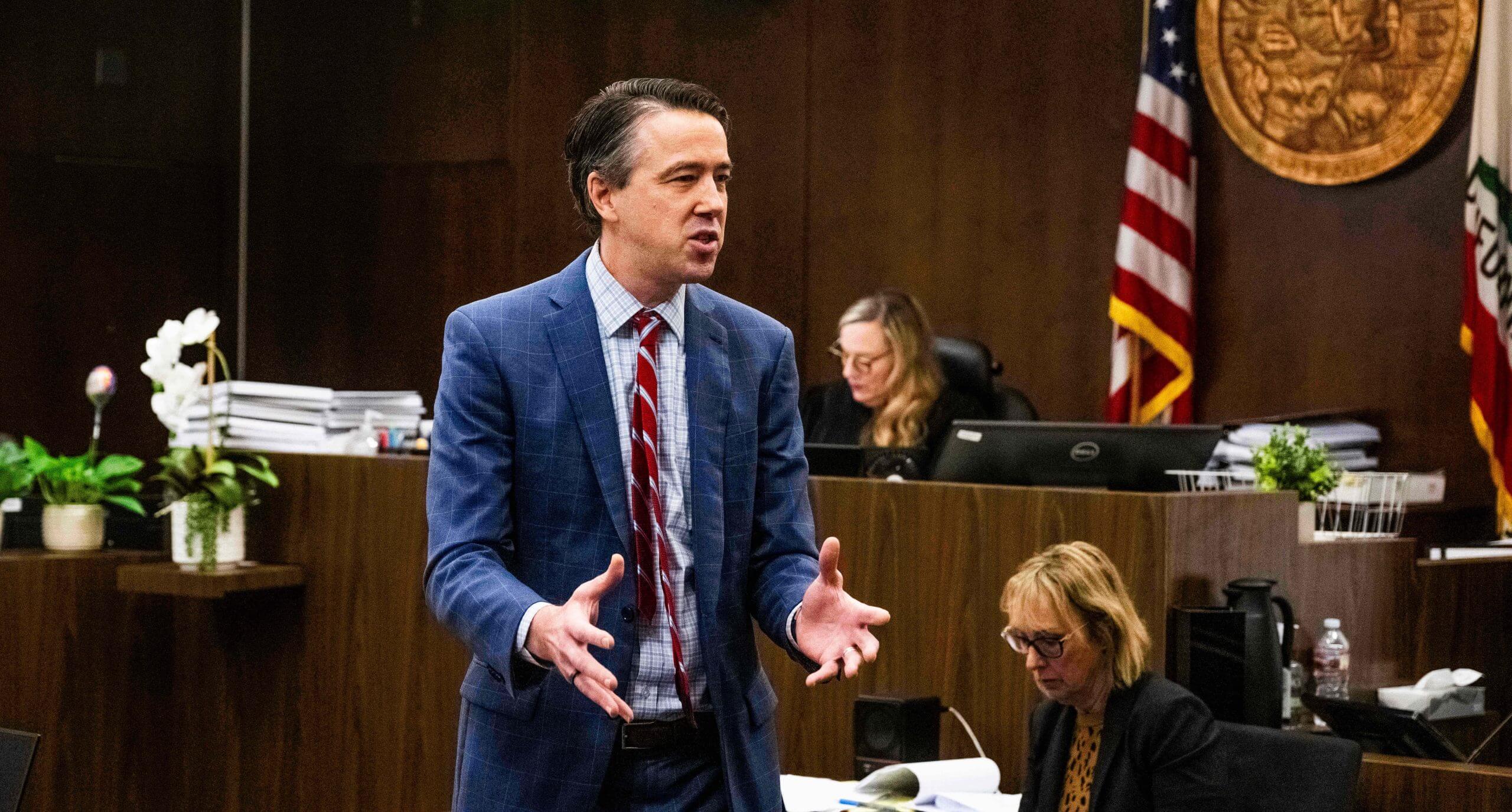
Skaggs attorney Daniel Dutko gives his closing arguments Monday. (Paul Bersebach / The Orange County Register via AP, Pool)
Dutko went through the entire verdict form, answering questions one by one, and highlighting testimony and evidence from the trial to explain how they should answer.
Was Kay negligent? Yes, Dutko argued, citing Kay’s own concerns about fentanyl, which he expressed in online messages to drug dealers. Those messages came into evidence through his work email address, which he used to purchase drugs through the online marketplace OfferUp.
Was Kay working within the course and scope of his employment when providing pills? The Angels have argued he was not, because it’s not his job to be a drug dealer. Dutko said Kay’s actions were “reasonably related to the kind of tasks that the employee was employed to perform,” quoting the verdict form for this question.
Making that argument, Dutko said the Angels had no issue with Kay’s clubhouse antics, such as eating a pimple off of Mike Trout’s back, or deliberately taking a 90-mile per hour fastball to the knee. Dutko said the Angels accepted that as part of the course and scope of his employment, as was getting tickets for players, or doing them other favors, such as procuring a viagra prescription from an unnamed player.
Dutko continued down the line of questions. He cited evidence that ex-VP for communications Tim Mead and traveling secretary Tom Taylor knew about Kay’s drug use, citing testimony from Kay’s ex-wife, Camela Kay, about a time when Mead and Taylor found baggies of pills in Kay’s home, following an October 2017 intervention. Mead said he didn’t remember that incident, and Taylor has denied that it happened.
Dutko ended his closing arguments by pre-empting the Angels’ argument. He asked the jury to listen closely to what Theodora said. “Have the Angels ever come in here and taken responsibility?” he asked, noting that no one from the team has lost their job or been reprimanded.
“Nothing has changed at Angels baseball. Nothing has changed. And nothing will change,” Dutko said. “… The only people that can fix this problem are you.”
He highlighted the testimony of Angels senior executive Molly Jolly, who has sat with the defense throughout the trial. She testified, when asked if she’d do anything differently, that she’d review the company’s policy manual.
“She sat there and listened to failure after failure,” Dutko said.
So, he asked the jurors to listen to Theodora’s argument.
“See if they say they’re sorry,” Dutko said. “Or just blame Tyler Skaggs.”
The Angels’ closing arguments
While the plaintiffs’ closing arguments largely centered on the Angels and Kay, Angels attorney Todd Theodora focused almost solely on Skaggs’ conduct.
Theodora’s PowerPoint included a pyramid-shaped graphic with Skaggs at the top, with the faces of all the other players who testified below Skaggs. Their purpose was to show Skaggs as the driver of the drug dynamic within the Angels clubhouse, and not Kay.
The graphic highlighted quotes from their testimony, where the different players said they hadn’t been aware of Kay’s access to pills before Skaggs let them know.
“He’s taking 150 pills a month,” Theodora said of Skaggs.
Theodora utilized a slide suggesting “Without alcohol, Tyler would not have died.” The judge had previously ruled the slide inadmissible during the trial. In closing arguments, it was used to show that alcohol was a significant factor in Skaggs’ death, and to argue that the fentanyl provided by Kay wasn’t enough to kill Skaggs on its own.
The fentanyl, Theodora contended, was within the “therapeutic range” and wouldn’t have been enough to kill Skaggs, if not for the alcohol in his system. “Fentanyl is not in and of itself lethal,” he said.
Theodora attempted to show Skaggs’ drug use as continuous from 2011 through his death in 2019. He utilized a quote from the testimony of addiction specialist, Dr. Elie Aoun, who suggested that it’s likely Skaggs’ drug use had continued throughout the last eight years of Skaggs’ life. The defense has presented minimal evidence that Skaggs was using drugs illegally from 2014 until 2017.
“The evidence you’re seeing here is the tip of the iceberg,” Theodora said, suggesting there was more drug use than the available evidence proved.
Theodora argued Skaggs and his family attempted to cover up his drug use, so that the Angels wouldn’t find out. He cited the testimony of Dr. Neal ElAttrache in making this argument. ElAttrache’s medical records suggest that Skaggs did not list his past 2013 Percocet addiction on his forms ahead of his 2014 Tommy John surgery.
Skaggs’ mother, Debbie Hetman, testified that ElAttrache was told of her son’s past drug use, and that he hadn’t been prescribed an opiate post-surgery as a result. Evidence showed he had been prescribed Percocet.
“Angels Baseball signed Tyler Skaggs under false pretenses,” Theodora said.
Theodora also attempted to show that Skaggs’ drug use was not just to help him deal with pain from pitching, but was done recreationally — utilizing text messages with friends and teammates to drive home that point. The Angels lawyer said it’s “absolutely shameful” for the plaintiffs to suggest that pain is a justification for drug use.
Theodora tried to justify the team’s handling of Kay, suggesting he received adequate treatment, and that doctors cleared him to return to work in June of 2019. He argued that it wouldn’t have mattered whether or not the Angels flew Kay to Texas, because he would have provided Skaggs with the pill regardless.
“The evidence is overwhelming that Eric Kay never became unfit or incompetent to perform the work for which he was hired,” Theodora said. “It did not happen.”
Theodora finished his closing argument by equating the conduct of Kay to that of Skaggs.
Theodora asked the jury why Skaggs should have continued pitching and using drugs, while Kay — who Theodora acknowledged was “complicit” — should have been punished or terminated for his conduct.
“What you see here is a classic double standard,” Theodora said.