
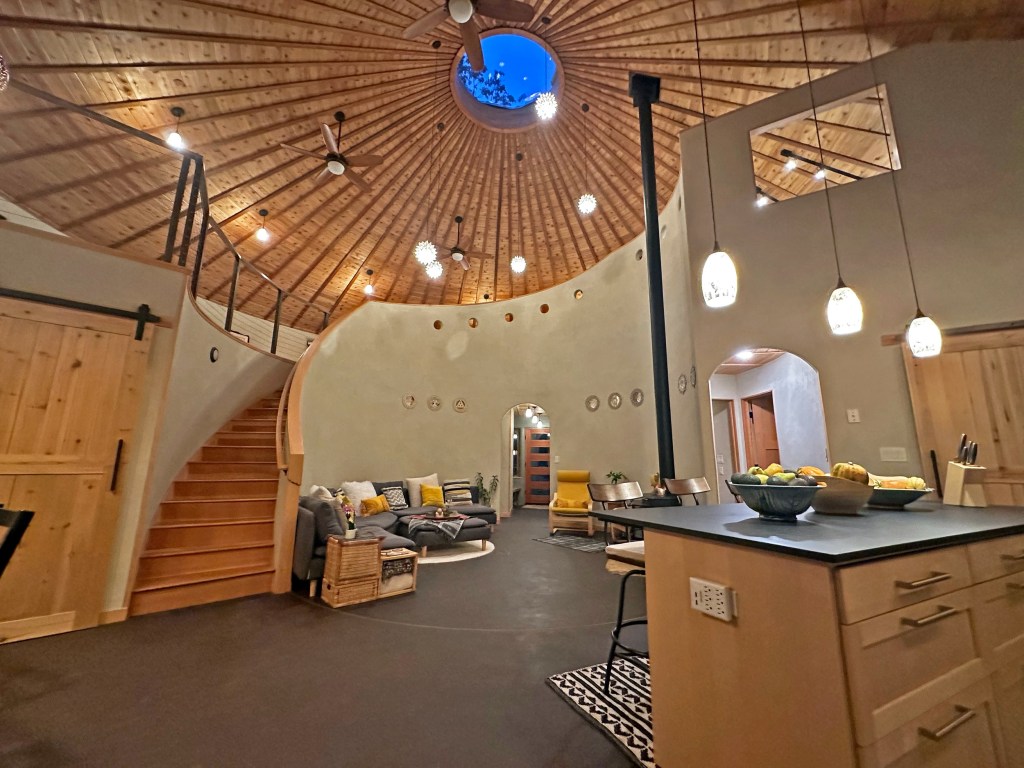
One person’s castle is another person’s … cave?
Or if not a cave dwelling in France or an underground troglodyte dwelling in Washington State’s Cascade Mountains, a “castle” could be a cork-wrapped compostable home in an abandoned urban lot in Washington D.C.; a roundhouse with hempcrete walls in California’s Gold Country; a 10-by-8-foot shanty boat made of reclaimed materials from a Santa Cruz backyard; or an abandoned housebarn restored in Italy’s Orco Valley. These are among dozens of unusual homes profiled in “Life-Changing Homes: Eco-Friendly Designs That Promote Well-Being” (bit.ly/48W2TdL), a book co-authored by Kirsten Dirksen and Nicolás Boullosa.
Together, the couple now based in Berkeley launched Faircompanies Productions Inc., a 100% self-funded company devoted to investigating and sharing stories about minimalist living, unconventional homes and their owners/builders, backyard gardens and livestock, alternative transport and related life philosophies. After a well-established career as a TV videographer and filmmaker, Dirksen, along with Boullosa — an equally acclaimed journalist and writer — began making videos for their “Faircompanies” website. Their YouTube channel in 2025 has 2.08 million subscribers and 1,200 videos.
While working on the videos and their first book, they and their three children, now ages 18, 16 and 13, lived a largely nomadic life from homes based in the United States and Europe. Roughly two years ago, they bought a two-bedroom, 1908 South Berkeley cottage, a fixer-upper requiring its own innovative, ongoing renovations including combining the kitchen and laundry room, converting an unheated, unfinished attic into the master bedroom and more.
“It’s interesting finding the rhythms of a place,” Dirksen says in an interview shared with Boullosa. “I grew up in Cloverdale (in Sonoma County), and even though the kids have never lived in the U.S. before, they spent summers visiting, so California’s not foreign to them.”
Boullosa says, “Our oldest daughter says our new house is both urban enough and still light-filled and spacious, with nature embedded. Culturally, they all like Berkeley and feel they fit in.”
During his childhood living in Spain, Boullosa recalls the instant feeling of being at home when visiting his grandparents in their small village.
“I would get out of the car, and old ladies would say, “Whose kid is this one?” Just by my looks they would guess I was family. Kids would climb, go in the creek and just go back to the house when it was dark or you were starving. Other than that, it was a place of being free.”
As is true of Dirksen and Boullosa, most of the stories and homes of people featured in their book trace back to childhood passions and experiences.
“It’s true,” says Dirksen. “A lot of kids build forts or sheds. For these people, they’re sort of re-living their early teen years when they had freedom to go into the backyards or woods and build something. These are people who never shut that energy off.”
If the book answers a question, it’s “What is the meaning of home?” There are universal traditions applicable to sustainable, eco-aware homes. Boullosa says that while some stories may not resonate with everyone, everyone recognizes that the meaning of a home transcends a bare-bones building.
Many owners of life-changing homes begin the process by first living on the future homesite to discover the land’s cadence. University of Texas computer engineer Gary Zuker, while building his do-it-yoursefl cob home, formed the practical “design as you build” philosophies and guidelines found in his book, “A Pattern of Language.”
“He was interested in the patterns and also the magic of things,” Boullosa says. “He understood the enchantment of a home cannot be put into math but also how a window in a certain place will give so much pleasure.”
This blend of intense planning, slower pacing and the ability to adjust to shifting circumstances or realizations are unifying threads connecting the diverse solutions profiled in their books and videos. As a videographer, Dirksen says slowing down and considering all the stories in the book as a whole allowed her to see the connections.
“Even if it’s between a person living in a wagon in Oregon and someone renovating a ruined 16th century church in Spain, there are mirrored patterns,” she said.
Home understories frequently reflect a unique family culture, ancestral history and ideas about each member’s role. Similarly, there are universal themes such as the joy found in building or creating not the perfect home but one that feels true to oneself — or courage gained by living proactively in response to loss such as the death of a loved one or losing a treasured home, childhood deprivation, discomfort with materiality or dismay over proliferative homelessness or the environmental destruction caused by humans.
“There’s pain in housing,” says Dirksen. “Broad spectrum homelessness, lack of affordability. Some people start from a place of difficulty but show tremendous creativity. Having less space and clutter can feel like sacrifice at first. With time, it grows to a positive.”
During the last 15 years operating faircompanies, their three children were integral participants and charismatic roadies in their videos, photos and stories. Dirksen admits that being stuck in a vehicle for 15 hours wasn’t always fun for them, even in places that look great on film. Anxiously driving up a steep mountainside road with 40 switchbacks in Italy, they reached a place occupied by just two people. Their oldest daughter misheard the name of the priest they were visiting and thought he was a prince.
“He made it magical, helped them find chestnuts, taught them to roast them,” she said. “They thrived on the excitement.”
The relationships their family forms with people in their stories extend and honor each person’s history and legacy.
“I like to think their memories and connections to a place are never going away,” says Boullosa. “Their work, their souls, things dying, decaying and re-emerging as new growth will live on.”
Dirksen says the enormous online following attracted to their 30- to 40-minute films is not an indication of over-reliance on the digital realm.
“It’s not social media: There’s instant feedback in the comments that help us shape what we do and provide ideas of stories we might do. It’s an amazing two-way conversation we love.”
For more information, visit faircompanies.com online.
Lou Fancher is a freelance writer. Reach her at lou@johnsonandfancher.com.